Odin
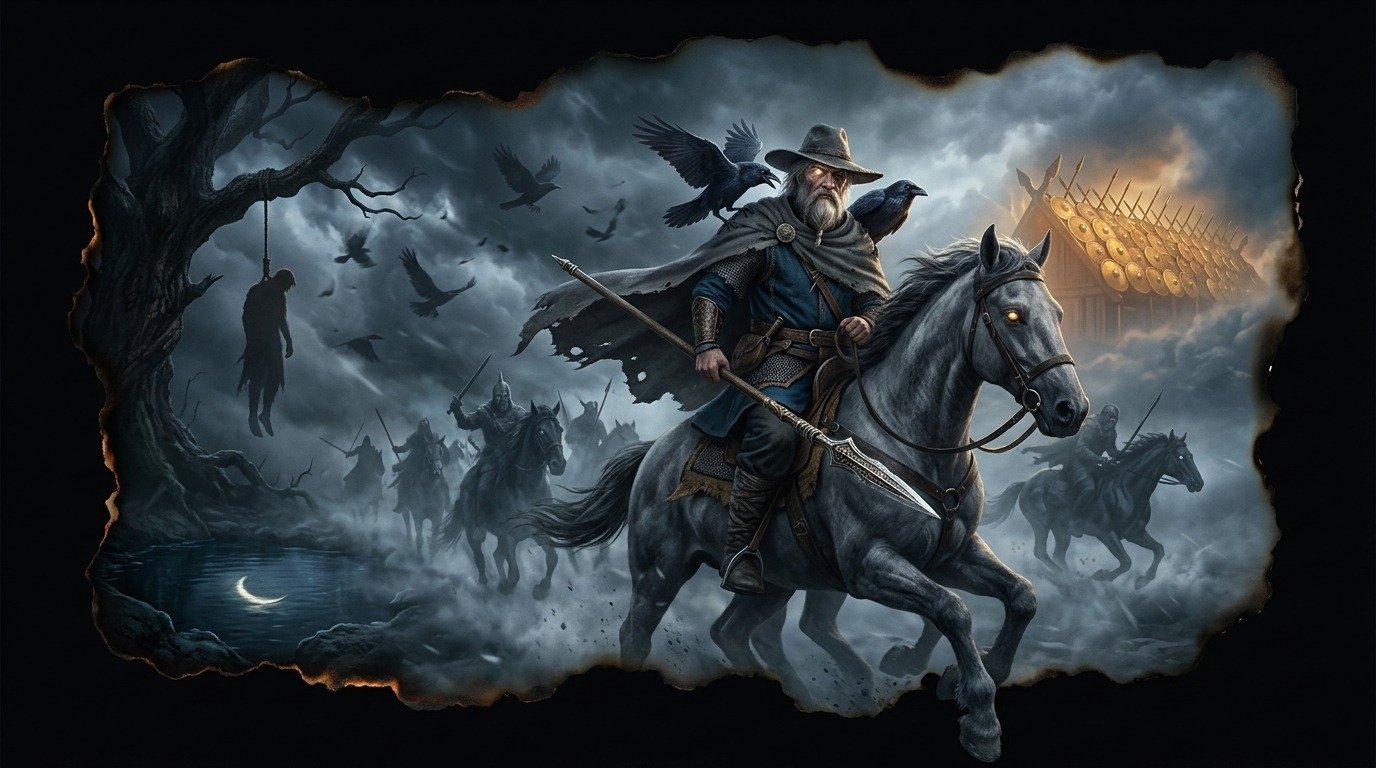
Odin: The Price of Wisdom and the Whisper of the Gallows
The Pact with the Abyss
Before the first temple was raised in the north, Odin already carried an insatiable thirst that did not belong to this world. He was not born the supreme sage; instead, he sculpted his own mind through sacrifices that would make men and the gods themselves tremble. His quest for absolute understanding led him to the roots of Yggdrasil, the world tree, where the black water of Mimir's well guards the secrets of existence. There, the price of a single sip of knowledge was his own right eye. Odin did not hesitate: he tore his eye from its socket with his own hands and cast it into the depths of the well, where it still shines like a reflection of the moon beneath the water.
But knowledge of the cosmos required an even deeper pain. Eager to decipher the runes, the sacred characters that weave the fate of all things, Odin hung himself from a wind-swept branch of the world tree. He pierced his side with his own spear, Gungnir, consecrating himself to himself, a god given to a god. For nine terrible nights, suspended between heaven and the abyss, with no bread to eat nor water to drink, he stared into the blackness until the secrets of runic magic were revealed before his bloodied eyes. Upon falling from the tree, he was no longer the same: he was the lord of ecstasy, of death, and of the poetry born of madness.
The Lord of the Fallen and the Storm
When the winter wind roars through the pine tops and clouds cover the stars, the men of the northern lands lock themselves in their cabins, knowing that the Allfather sweeps across the skies. It is the Wild Hunt, a ghostly procession of dead warriors riding upon the tempest. At the head goes Odin, mounted on Sleipnir, his eight-legged gray steed that gallops over sea and wind as easily as over land. By his side fly Huginn and Muninn, Thought and Memory, two black ravens that set out every morning for the ends of the earth and, as evening falls, perch on the god's shoulders to whisper in his ear everything that mortals try to hide.
His dwelling is Valhalla, a palace roofed with golden shields and polished spears where the smell of blood and mead never fades. However, Odin's interest in warriors is neither benevolent nor fatherly. He does not seek to save men; he seeks to recruit the best for his own army. He is a collector of select souls. Through the Valkyries, his battle maidens, Odin sows discord on the battlefields of Midgard, deciding who lives and who dies, often betraying his favorites at the last moment to ensure their souls reach his great hall before the end of the world begins.
The Cunning of the Wanderer
Beneath the roofs of royal halls or on muddy roads, Odin rarely shows himself in his golden armor and dark blue cloak. He prefers the guise of the wanderer: a hunched old man, covered in a threadbare gray cloak and a wide-brimmed hat that conceals the empty socket of his lost eye. In this disguise, he walks among mortals and giants, testing the hospitality of kings and challenging the wise to riddle duels where the wager is always the loser's head.
His cunning knows no moral bounds. When he coveted the mead of poetry, guarded by giants deep inside a mountain, he did not hesitate to seduce the guardian of the treasure, promise her eternal love, and, after drinking the three vats of the precious liquor in a single draft, transform into an eagle to escape to Asgard, leaving a trail of betrayal behind. For Odin, the end—gathering the necessary power to delay the inevitable Ragnarok—justifies any lie, any broken pact, and any sacrifice.
The Twilight on the Horizon
The figure of Odin is marked by a melancholy that no other god shares. Despite all his knowledge, his runes, and the whispers of the dead, he knows exactly how and when he will die. He knows that all the defenses he has built, that all the fallen warriors who train day after day in the courtyards of Valhalla, will not be enough to save him.
When Ragnarok arrives, the colossal wolf Fenrir will break his chains and open his jaws, thirsty for divine blood. Odin will ride toward him with his spear Gungnir held high, but fate is already written on the bark of the tree that once held him. The Allfather will be devoured by the beast, leaving an immense void in the cosmos he ruled with an implacable hand and an ever-watchful eye.
Comments
Share information, an experience, or a source to help enrich this entry. They are automatically reviewed before being published.
Loading comments...