Runes
Runes: The Oracle of the Norse Glyphs
What It Is
Runes are a system of alphabetic symbols used by Germanic and Norse peoples not only for writing, but as a method of divination, talismanic magic, and communion with the cosmos. In their esoteric dimension, each glyph represents a cosmic force and an existential state of the universe and of the human being.
How It Works
The most widespread runic divinatory system is based on the Elder Futhark, an alphabet of 24 characters. These 24 runes are divided into three groups of eight, called *aetts* or families, each under the tutelage of Norse deities: * **Freyr's Aett:** Governs the material plane, survival, fertility, and primal strength. It contains runes such as *Fehu* (wealth) and *Uruz* (strength). * **Heimdall's Aett:** Rules the forces of nature, existential trials, destiny, and transformation. It includes runes such as *Hagalaz* (hail/crisis) and *Naudhiz* (need). * **Tyr's Aett:** Is associated with the spiritual plane, cosmic law, justice, and the development of the self. It contains runes such as *Tiwaz* (justice) and *Sowilo* (sun/success).
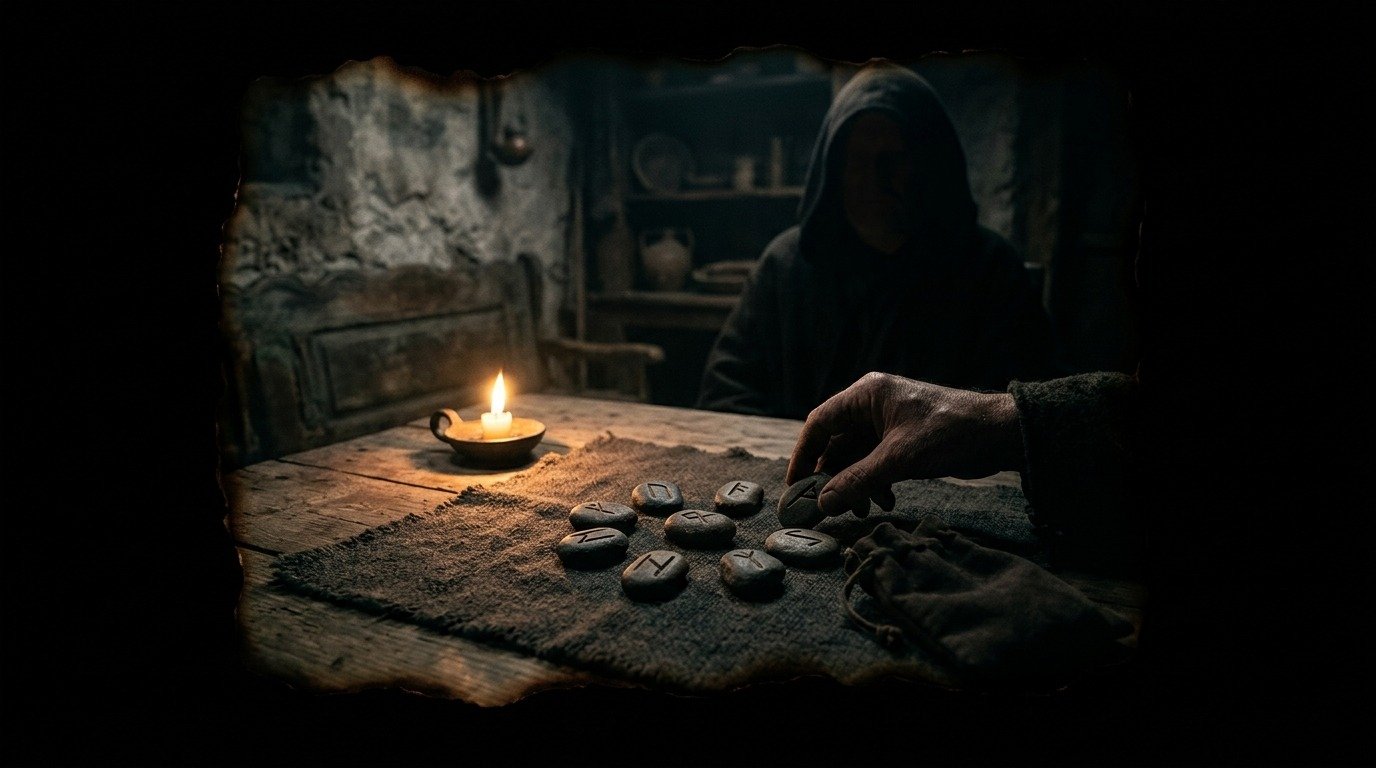
A rune reading works by drawing these symbols, commonly engraved on stone, wood, or bone, from a cloth bag. The runes are cast onto a reading cloth. Interpretation is not based on predicting a fixed destiny, but rather on revealing the current energy flows (*Ørlög*) and the potential consequences of present actions (*Wyrd*). The meaning of the glyph and its position are analyzed: an inverted rune indicates a blockage or the manifestation of the opposite polarity of that force.
Origin and History
Runes emerged in the 1st century AD in the regions of contact between Germanic peoples and the Roman Empire. The Elder Futhark is the oldest and most mystical variant. In the year 98 AD, the Roman historian Tacitus described in his work *Germania* the method of divination used by these tribes, which consisted of cutting branches of fruit-bearing trees into strips, marking each with a symbol, and casting them onto a white cloth for a priest to interpret. With the Christianization of Northern Europe, runes were displaced by the Latin alphabet. Their magical use became suspect, and in 17th-century Iceland, it led to accusations in witch trials. The knowledge survived in fragments in Iceland and rural areas of Scandinavia through medieval grimoires and rune poems, which preserved the names and meaning of each glyph.
Key Figures
* **Odin:** In Norse mythology, he is the discoverer of the runes. According to the poem *Hávamál*, he hung from the world tree, Yggdrasil, wounded by his own spear for nine days and nine nights, without food or drink, to obtain the secret of the glyphs after an initiatory sacrifice. * **Guido von List:** 19th-century Austrian occultist who revived runic esotericism. He created the Armanen Futhark, a system of 18 runes conceived in 1902, which laid the foundation for the modern revival of rune magic; his nationalist esotericism also influenced German völkisch occultism. * **Ralph Blum:** American author who popularized runes in the West in 1982 with his book *The Book of Runes*. He introduced the controversial "blank rune" or Odin's rune, absent from historical records but widely adopted in contemporary practice.
How It Is Understood Today
In modern esotericism, runes are a central tool of Germanic neopaganism, the Ásatrú tradition, and the path of modern rune magic (*runesophy*). Archetypal psychology uses them as projections of the subconscious mind. From a historical and philological standpoint, runes are studied strictly as an ancient epigraphic script, distinguishing academic runology from its contemporary esoteric application.
Connections
Runes are directly related to the Norse tree of life (Yggdrasil), the nine worlds of Germanic cosmology, the deities of the Norse pantheon (Odin, Freyja, Thor, Tyr), and the Hermetic Qabalah, through modern systems of correspondences that link the glyphs to the paths of consciousness.
Comments
Share information, an experience, or a source to help enrich this entry. They are automatically reviewed before being published.
Loading comments...