Palmistry
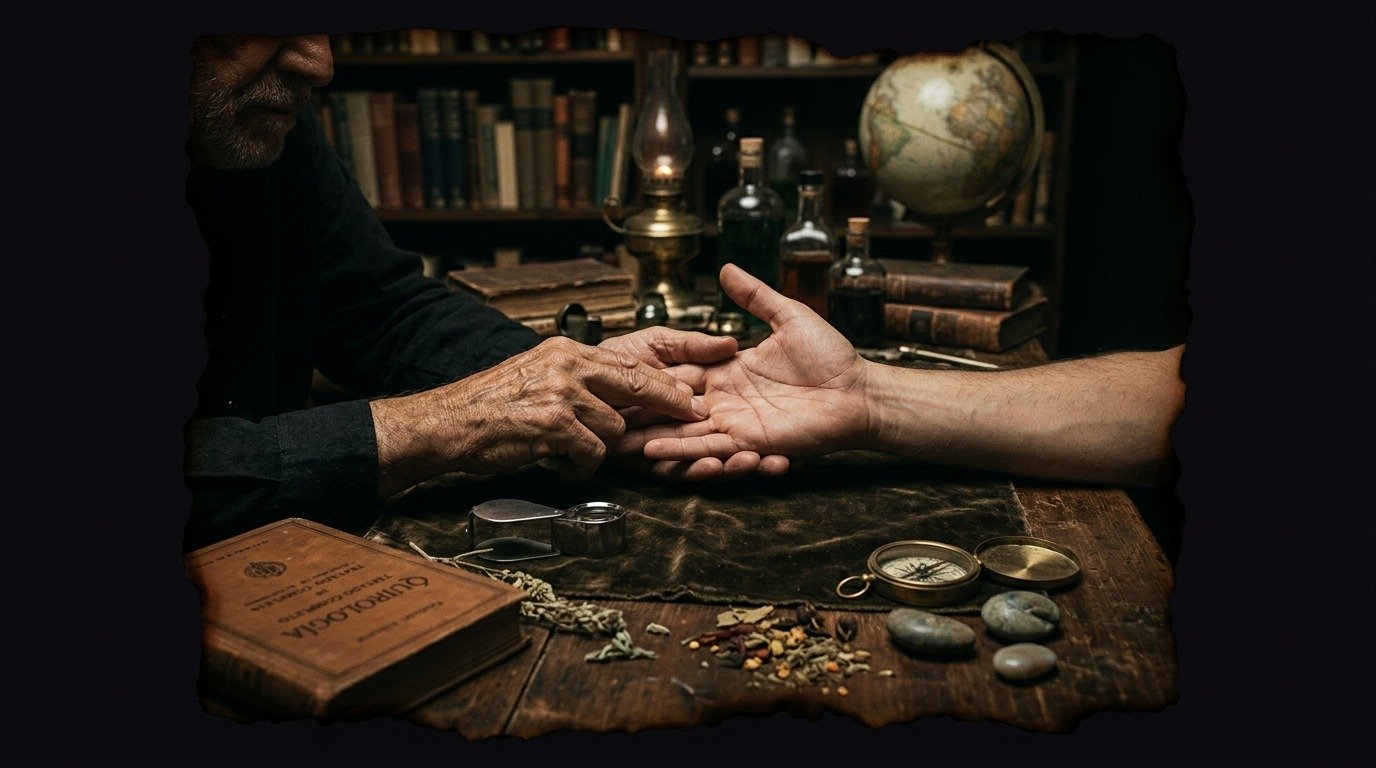
Palmistry: The Reading of the Hands
What It Is
Palmistry is the art of character reading and divination of fate through the interpretation of the lines, mounts of flesh, size, texture, and shape of an individual's hand. It holds that the hands are a direct reflection of the querent's nervous system and spiritual plane.
How It Works
To perform a complete palmistry analysis, both hands are evaluated. As a general rule, the non-dominant hand (the left in right-handed people) shows innate potential, hereditary tendencies, karma, and the subconscious, while the dominant hand (the right in right-handed people) shows the actual use of that potential, the decisions made, and the individual's present state. El sistema se estructura en dos áreas principales: 1. **The Major Lines:** * **Life Line:** It encircles the base of the thumb. It indicates vitality, general health, physical energy, and major changes in the life path. It does not define the exact duration of life, but rather its quality and vigor. * **Head Line:** It crosses the palm horizontally above the life line. It represents intellectual capacity, cognitive style, logic, and the way information is processed. * **Heart Line:** It is located beneath the base of the fingers. It reflects emotions, affective capacity, and romantic relationships. * **Fate Line:** It crosses the palm vertically toward the base of the middle finger. It represents professional direction, social success, and external factors that affect personal life. 2. **The Mounts:** They are the fleshy elevations located beneath the base of the fingers, associated with the planets of classical astrology and their attributes: * **Mount of Venus** (base of the thumb): Love, passion, sensuality, and vitality. * **Mount of Jupiter** (base of the index finger): Ambition, leadership, power, and pride. * **Mount of Saturn** (base of the middle finger): Wisdom, prudence, seriousness, and fate. * **Mount of Apollo or of the Sun** (base of the ring finger): Creativity, talent artistic, fame, and optimism. * **Mount of Mercury** (base of the pinky finger): Communication, commerce, intellect, and cunning. * **Mounts of Mars** (edge of the palm and space beneath the index finger): Courage, resistance, and temperament. * **Mount of the Moon** (lower edge opposite the thumb): Imagination, intuition, and the subconscious.
Origin and History
Palmistry has its origins in ancient India, where it was part of a broader system of body reading called *Hasta Samudrika Shastra* (the science of hand markings). From India, it spread to Persia, Egypt, and China. In classical Greece, philosophers like Aristotle became interested in the lines of the hand. A medieval legend tells that Aristotle found a treatise on palmistry on an altar consecrated to Hermes and presented it to Alexander the Great. During the European Middle Ages, palmistry was persecuted by the Church due to its association with witchcraft. However, in the 19th century, the study of hands resurfaced under a pseudo-scientific approach thanks to the work of French researchers who organized it into a rational methodology known as *chirology*.
Key Figures
* **Adrien-Adolphe Desbarrolles:** 19th-century French palmist, considered the father of modern palmistry after the publication of his fundamental work *Les Mystères de la Main* (1859). * **Jean-Baptiste d'Arpentigny:** French army officer who classified hand types by their physical shape (spatulate, conic, square, knotty), creating the branch of *chirognomy*. * **Cheiro (William John Warner):** Celebrated Irish palmist of the late 19th and early 20th centuries. He read the hands of figures such as Oscar Wilde, Mark Twain, and Thomas Edison, and his popular books attribute predictions about their lives to him.
How It Is Understood Today
Today, palmistry is practiced mainly as a form of entertainment and psychological exploration. Western medicine and science reject its divinatory value, although they recognize that the structure of the palm and fingerprints contain genetic information useful for detecting specific physical anomalies (dermatoglyphics), but they categorically deny any connection between the lines of the hand and a person's destiny.
Connections
Palmistry is intrinsically connected to Astrology, as it uses the nomenclature, symbology, and psychological characteristics of the planets and zodiac signs to classify the regions of the hand.
Comments
Share information, an experience, or a source to help enrich this entry. They are automatically reviewed before being published.
Loading comments...