I Ching
I Ching: The Book of Changes
What it is
The I Ching or *Book of Changes* is an ancient text of wisdom and a system of divination of Chinese origin. It functions as a map of the cosmos and the psyche that describes the constant changes in life and the universe, allowing the querent to understand the dynamics of their present situation in order to act in harmony with the natural order or *Tao*.
How it works
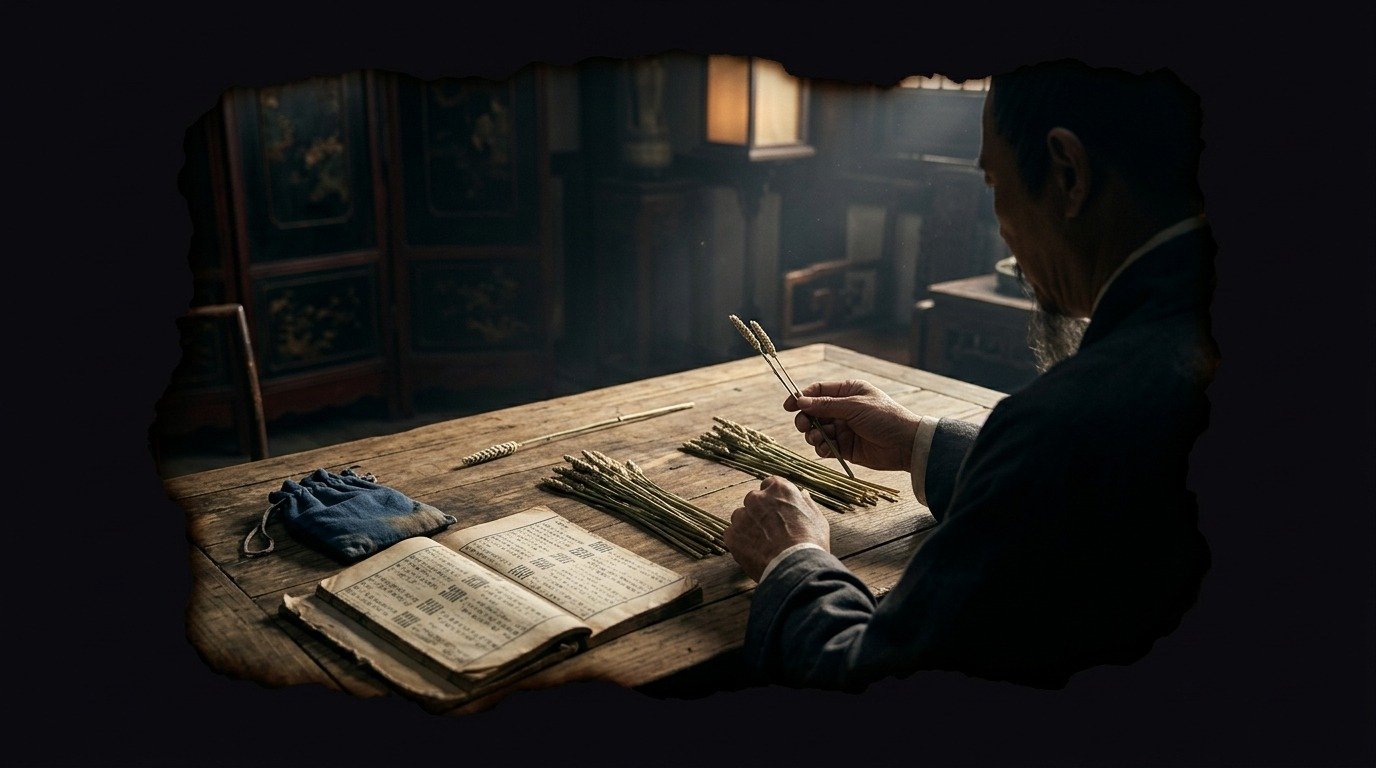
The system of the I Ching is based on the fundamental polarity of the universe: **Yin** (passive, dark, receptive principle, represented by a broken line: `-- --`) and **Yang** (active, luminous, creative principle, represented by a solid line: `————`). These lines combine in groups of three to form the **8 Trigrams** (*Bagua*), which represent the forces of nature (Heaven, Earth, Water, Fire, Thunder, Wind, Mountain, Lake). In turn, the trigrams overlap in pairs to give rise to the **64 Hexagrams** of the I Ching. Each hexagram describes a specific situation of human and cosmic becoming. The traditional method of consultation uses 50 yarrow stalks, a complex ritual procedure of mathematical division that determines the lines of the hexagram one by one, from bottom to top. An alternative and simpler method uses three identical coins. By casting the stalks or the coins, four types of lines are obtained: * Young Yin (fixed). * Young Yang (fixed). * Old or changing Yin. * Old or changing Yang.
The changing lines indicate that the energy of that situation is at the point of turning into its opposite. When interpreting the consultation, the primary hexagram, the meaning of the specific changing lines, and the new hexagram resulting from the transformation of those lines are analyzed, thus revealing the evolution of the issue raised.
Origin and history
The origin of the I Ching dates back to the end of the second millennium BCE in China. Tradition attributes the creation of the eight trigrams to the mythological figure of Fu Xi. Around 1000 BCE, during the Zhou dynasty, King Wen and his son, the Duke of Zhou, wrote the texts of the hexagrams and their individual lines. Originally used as a divination manual for the Zhou court, the book became a central work of Chinese philosophy during the Warring States period. Confucius and his disciples added a series of philosophical and ethical commentaries known as *The Ten Wings*, transforming the oracle into an ethical and metaphysical treatise of the highest order.
Key figures
* **King Wen of Zhou:** Writer of the judgments of the 64 fundamental hexagrams while imprisoned by the emperor of the Shang dynasty. * **Confucius:** Philosopher whose school endowed the I Ching with its deep moral and cosmic dimension through analytical commentaries. * **Richard Wilhelm:** German missionary and sinologist who translated the text directly from Chinese into German in 1924, a translation that was later rendered into other Western languages and rescued the conceptual precision of the book. * **Carl Gustav Jung:** Swiss psychiatrist who wrote the foreword to the English edition of Wilhelm's translation, where he used the I Ching to support his famous theory of *synchronicity* (a meaningful coincidence of events with no apparent physical cause).
How it is understood today
In contemporary esotericism and philosophy, the I Ching is valued as a tool for self-inquiry and psychological analysis. It is not used to foretell the future in a fatalistic way, but rather to reflect on the forces at play in a situation. In the field of science, it is studied from historical, sociological, and mathematical perspectives: the philosopher Gottfried Leibniz saw in the hexagrams an anticipation of his binary system, and it is often pointed out that the 64 hexagrams coincide in number with the 64 codons of the genetic code, a coincidence of combinatoric structure.
Connections
The I Ching is intimately connected with Taoism (the concepts of Tao, Yin, and Yang), Feng Shui (which uses the map of the eight trigrams or Bagua), traditional Chinese medicine, and the contemporary system of Human Design, which uses the 64 hexagrams to map bodily energy.
Comments
Share information, an experience, or a source to help enrich this entry. They are automatically reviewed before being published.
Loading comments...