Synchronicity
Synchronicity: The Non-Causal Connection of the Universe
What It Is
Synchronicity is the simultaneous occurrence of two or more events that are not linked by a relationship of cause and effect, but present a deep connection of meaning for the person experiencing them. It is the manifestation of an acausal organizing principle in the universe, which precisely links an internal mental state with an event in the external physical world.
How It Manifests
The phenomenon occurs when a person experiences a very specific thought, dream, word, or internal image, and almost immediately encounters that same element on the physical plane. It manifests in unexpected encounters with key people during moments of crisis, the constant repetition of specific numbers or visual patterns, or the appearance of a book, phrase, or exact information needed to resolve a deep personal conflict.
History and Origin
The term was coined by Swiss psychiatrist Carl Gustav Jung in collaboration with Nobel Prize-winning physicist Wolfgang Pauli. Jung formally presented the concept in 1952 in his essay *Synchronicity: An Acausal Connecting Principle*. The concept gathers the wisdom of ancient traditions, such as the alchemical notion of the *Unus Mundus* (the unified world) and the Taoist principle of the interconnectedness of all things, where that which is above is like that which is below, and the internal is reflected in the external.
Representative Cases
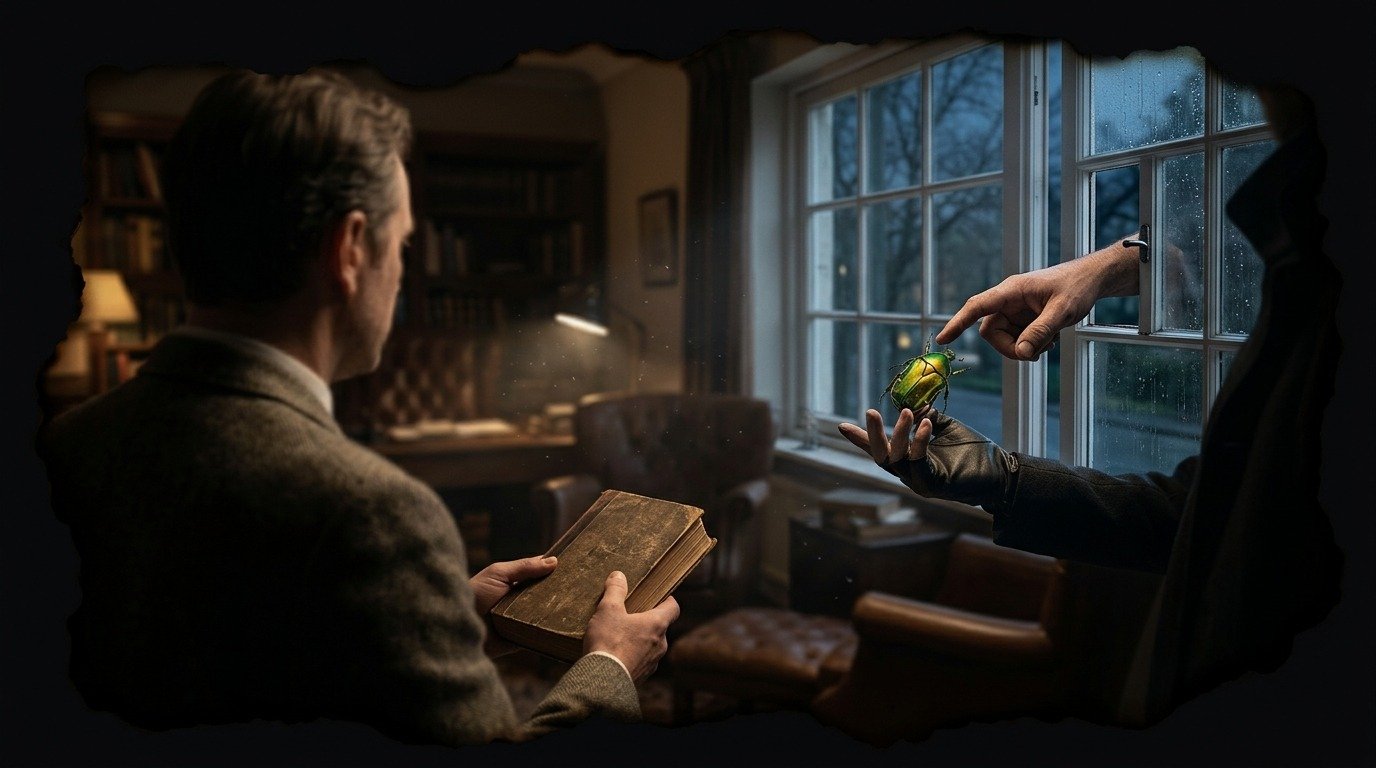
* **Jung's Golden Scarab (Zurich, mid-20th century):** During a clinical session, a patient was describing a dream in which she received a golden scarab. At that very moment, Jung heard a tapping on the window. Upon opening it, he caught a real scarab beetle (*Cetonia aurata*), an insect whose golden-green coloration matched the patient's dream. Jung handed it to her, and the event broke through the extreme rationalism that was blocking her treatment. * **Émile Deschamps's Plum Pudding (France, 19th century):** The writer Émile Deschamps was once given a piece of plum pudding by a man named Fortgibu. Ten years later, Deschamps saw this dessert in a Paris restaurant and wanted to order it, but the last serving was already reserved for Fortgibu. Years later, at a dinner where this pudding was served to him, Deschamps joked that only Fortgibu was missing; at that exact moment, an elderly and disoriented Fortgibu entered the dining room, having taken the wrong address.
Explanation of the Phenomenon
From the perspective of Jungian analytical psychology and spiritual traditions, synchronicity demonstrates that psyche and matter are not separate realities, but rather two aspects of the same underlying unity. The archetypes of the collective unconscious act as organizers of physical and mental reality. When an individual experiences a deep evolutionary need, the archetype is activated and projects an event that manifests in parallel in the mind as an idea and in the environment as a physical occurrence.
Academic science and classical statistics explain synchronicity through apophenia, which is the tendency of the human brain to find patterns and meaning in random data. It is also associated with the law of large numbers, which demonstrates that, given an enormous quantity of daily events, highly improbable coincidences are statistically inevitable and will eventually occur by pure chance.
Linked Phenomena
Synchronicity is directly linked to traditional divination practices such as the I Ching and the Tarot, which operate under the principle of capturing the present moment through meaningful coincidence. It is also related to precognition, telepathy, and clairvoyance. ---
Comments
Share information, an experience, or a source to help enrich this entry. They are automatically reviewed before being published.
Loading comments...