Tarot
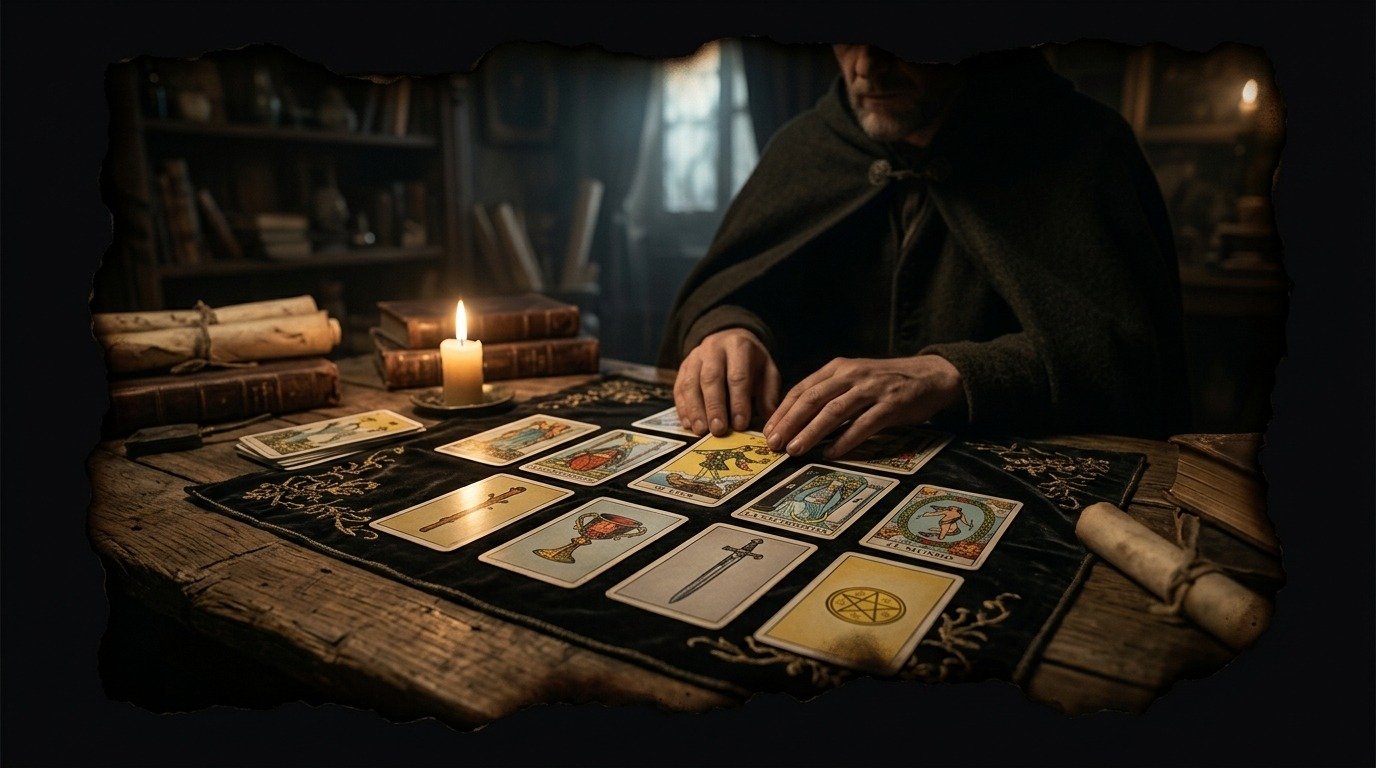
Tarot: The Symbolic Language of the Arcana
The Essence of Tarot
Tarot is a system of cartomancy composed of seventy-eight cards. It functions as an oracle of divination, a tool for analytical introspection, and a visual map of Western esoteric teachings. Each card represents a universal archetype, a state of consciousness, or a situation of the human experience, allowing life circumstances to be interpreted through the analogical reading of its images.
Structure and Functioning of the System
The Tarot deck is divided into two major groups: twenty-two Major Arcana and fifty-six Minor Arcana. The word "arcane" comes from the Latin *arcanum*, which means mystery or secret.
The Major Arcana represent spiritual principles, universal forces, and stages of psychological development. They go from number zero (The Fool) to twenty-one (The World). This sequence traces an allegory of the learning path of the human soul, known in esotericism as "the Fool's Journey." Each of these arcana embodies a life lesson or an existential trial.
The Minor Arcana represent the daily, mundane, and practical aspects of existence. They are divided into four suits that correspond to the four elements of nature: * **Wands (Fire):** They govern action, vital energy, work, growth, and passion. * **Cups (Water):** They govern emotions, relationships, love, feelings, and intuition. * **Swords (Air):** They govern the mind, intellect, thoughts, decisions, and conflicts. * **Coins or Pentacles (Earth):** They govern matter, money, the body, the work domain, and physical security.
Each suit contains ten cards numbered from ace to ten, and four court cards: Page, Knight, Queen, and King.
In practice, Tarot works through symbolic projection and correspondence. The querent poses a question and, after shuffling the deck, cards are drawn and arranged in a specific reading pattern known as a spread. The meaning of the message is determined from the individual symbolism of each card, its position in the spread, and the fluid relationship established between the images that appear together.
Origin and Historical Evolution
Tarot was born in northern Italy, primarily in the courts of Milan, Ferrara, and Bologna, in the mid-15th century, between the years 1440 and 1450. Its origin was not esoteric, but playful: it was created as a card game for the aristocracy known as *Tarocchi* or *Trionfi* (triumphs). The oldest deck preserved almost in its entirety is the Visconti-Sforza Tarot, hand-painted around 1450.
The strictly esoteric and divinatory use of Tarot was structured in France during the last third of the 18th century. In 1781, the French scholar Antoine Court de Gébelin published in his work *Monde primitif* the theory that Tarot was the Book of Thoth, a compendium of sacred wisdom from ancient Egypt that had survived the destruction of the temples disguised as a game of chance.
In 1783, Jean-Baptiste Alliette, under the pseudonym Etteilla, published the first systematic manual for Tarot reading and designed the first deck created exclusively for cartomancy, assigning astrological meanings to the cards.
During the 17th and 18th centuries, the standard model of mass production was the Tarot of Marseilles, characterized by its medieval-style illustrations and its geometric Minor Arcana without narrative scenes.
In 1909, the occultist Arthur Edward Waite directed the creation of a new deck drawn by the artist Pamela Colman Smith and published by the British house Rider. This deck, known as the Rider-Waite Tarot, revolutionized the discipline by illustrating the fifty-six Minor Arcana with figurative scenes that facilitate intuitive interpretation.
Key Figures of Esoteric Tarot
* **Antoine Court de Gébelin (1725–1784):** Initiator of the esoteric interpretation and the Egyptian origin of Tarot. * **Etteilla (1738–1791):** The first professional cartomancer and systematizer of modern Tarot spreads. * **Éliphas Lévi (1810–1875):** French occultist who definitively unified the twenty-two Major Arcana with the twenty-two letters of the Hebrew alphabet and the paths of the Kabbalah's Tree of Life. * **Arthur Edward Waite (1857–1942):** Creator of the Rider-Waite Tarot and reformer of the deck's hermetic symbology. * **Aleister Crowley (1875–1947):** Designer of the Thoth Tarot alongside the painter Lady Frieda Harris, a deck that complexly integrates alchemy, astrology, and the philosophy of Thelema.
Tarot Today
Today, Tarot coexists in two major currents of practice. The traditional predictive branch seeks to anticipate future events and interpret trends of material reality. The therapeutic or evolutionary branch, influenced by the analytical psychology of Carl Jung, uses the cards as mirrors of unconscious internal processes for self-knowledge and conscious decision-making. Current historical research studies it as a valuable cultural and artistic artifact of the Italian Renaissance.
Connections with Other Systems
Tarot is intimately intertwined with: * **The Kabbalah:** The paths connecting the spheres of the Tree of Life correspond to the Major Arcana. * **Astrology:** The planets, zodiac signs, and elements govern the different cards of the deck. * **Alchemy:** The phases of the Great Work and the transmutation of metals are allegorically reflected in the progression of the arcana. * **The Hermetic Order of the Golden Dawn:** A secret society that unified all these systems and established definitive correspondences used in most contemporary decks.
Comments
Share information, an experience, or a source to help enrich this entry. They are automatically reviewed before being published.
Loading comments...