Thoth
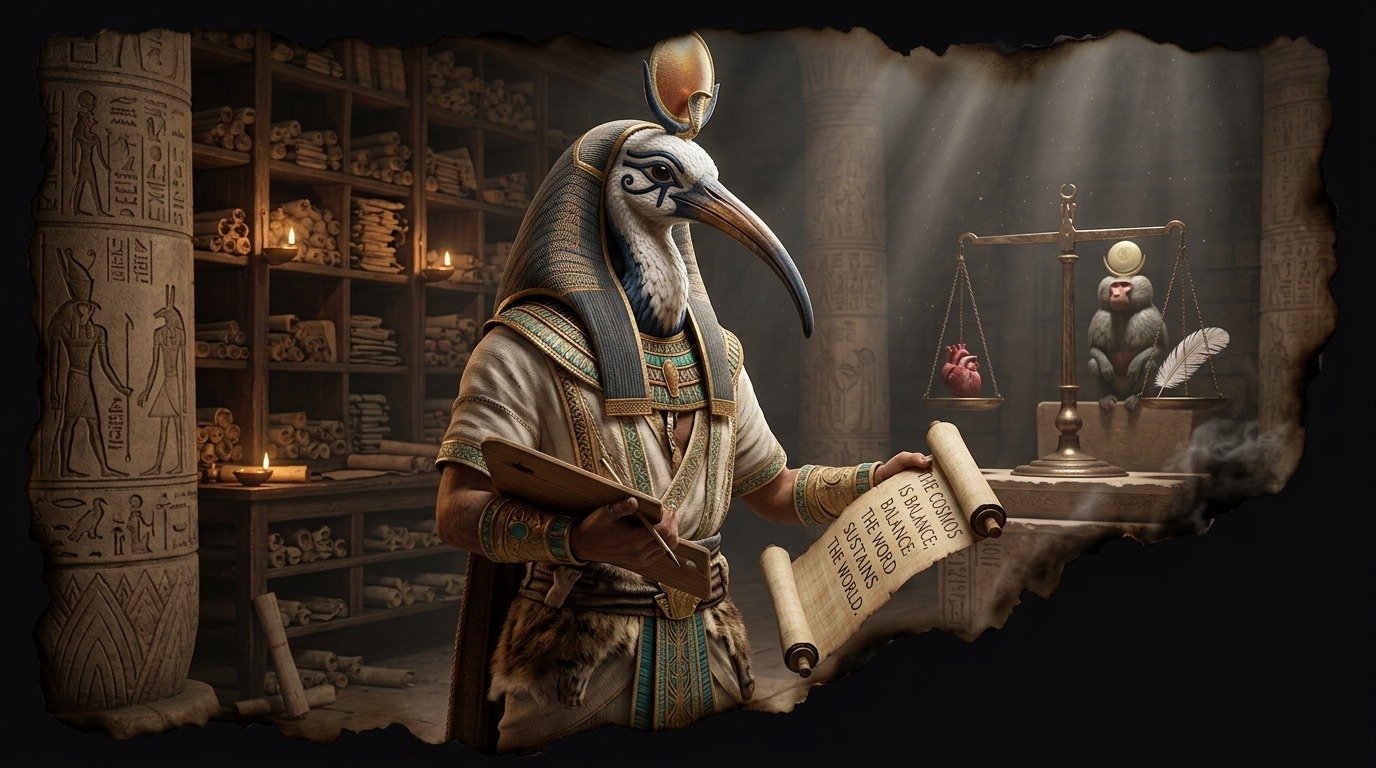
Thoth: The Primordial Word and the Balance of the Cosmos
The Scribe Who Invented Himself
Before time had a name and before the first word was spoken, there existed the abyss of Nun, a primordial, dark, and silent ocean. From that absolute nothingness arose neither a battle cry nor a flash of fire, but a thought. That thought took the form of an ibis with plumage as white as salt and a beak curved like the crescent moon. Thoth had no parents; he self-engendered through the power of his own mind, pronouncing his own name to bring himself into existence. Upon opening his beak, the silence of the cosmos was shattered, and sound became geometry, order, and law. From that instant, Thoth became the brain of the universe. While other gods wielded brute force or solar fire, he ruled through ink, word, and number. He is often represented as a man with the head of an ibis, carrying a scribe's palette and stylus, or as a baboon with a wise gaze and silvery fur who observes the transit of the stars. He is the one who measures time, who separates the months, and who invented hieroglyphic writing, which the ancients called the words of the gods, a sacred bridge between immortal thought and the clay of men.
The Language That Sustains the World
The power of Thoth does not reside in destruction, but in precision. He is the lord of magic words, *heka*, a cosmic force that is not mere sorcery, but the ability to alter reality by pronouncing the true name of things. If the sun rises every morning, it is because Thoth has calculated its mathematical route with exactness; if the river floods fertilize the land, it is because he has written the laws that govern the waters. As scribe of the gods, Thoth does not take sides in the passions of mortals or the intrigues of the celestial palace, yet he is indispensable to all. He is the guardian of *Ma'at*, the universal concept of justice, balance, and truth. Without his pen, the cosmos would slide back into the chaos from which it emerged. His mind is an infinite library where the births, deaths, and deeds of every being that breathes under the light of the sun are recorded.
The Arbiter of Divine Battles
The myth that best defines Thoth's cunning and temperance is his role as the great peacemaker in the dynastic conflict between Horus and Seth. For decades, the young falcon god and the lord of storms tore each other apart for the throne of Egypt. In one of their most ferocious encounters, Seth tore out Horus's left eye and scattered it in pieces across the desert. The entire cosmos faltered at the loss of the lunar light that this eye represented. Thoth did not use the sword to resolve the crisis. He traversed the burning sands, searched for each of the fragments of the mutilated eye, gathered them, and, through his spells and divine saliva, welded them back together to create the *Wedjat*, the eye of wholeness and protection. By returning it to Horus, he healed not only the god, but the order of the world. His ingenuity also saved humanity before it even existed. When the goddess Nut was cursed by the creator so that she could not give birth on any day of the calendar year, Thoth challenged Khonsu, the moon god, to a game of *senet*. Betting fractions of the lunar light, Thoth won the game and accumulated enough light to create five additional days, the epagomenal days, which fell outside the official calendar. It was during these five days of grace that the great gods of the earth were born, thus circumventing the creator's decree thanks to the cunning of the scribe.
The Master of Destiny and Time
At the twilight of human existence, when the soul of the deceased descends to the Hall of Two Truths to undergo final judgment, Thoth waits beside the scales. While the heart of the dead is weighed against the feather of truth, it is Thoth who stands, clay tablet ready and stylus raised. With absolute impartiality, he records the verdict that will determine whether the soul will be devoured by the monster Ammit or if it will ascend to the reed fields to live eternally. His cult in the city of Hermopolis became the beacon of knowledge in the ancient world. For sages, physicians, and priests, Thoth was not a distant myth, but a living presence in every library, in every papyrus, and in every mathematical formula. His legacy survived the collapse of empires, later merging with other deities of wisdom in distant lands, but always retaining its primordial essence: the certainty that, in the end, the universe is not ruled by the force of the sword, but by the power of the written word.
Comments
Share information, an experience, or a source to help enrich this entry. They are automatically reviewed before being published.
Loading comments...