Amun
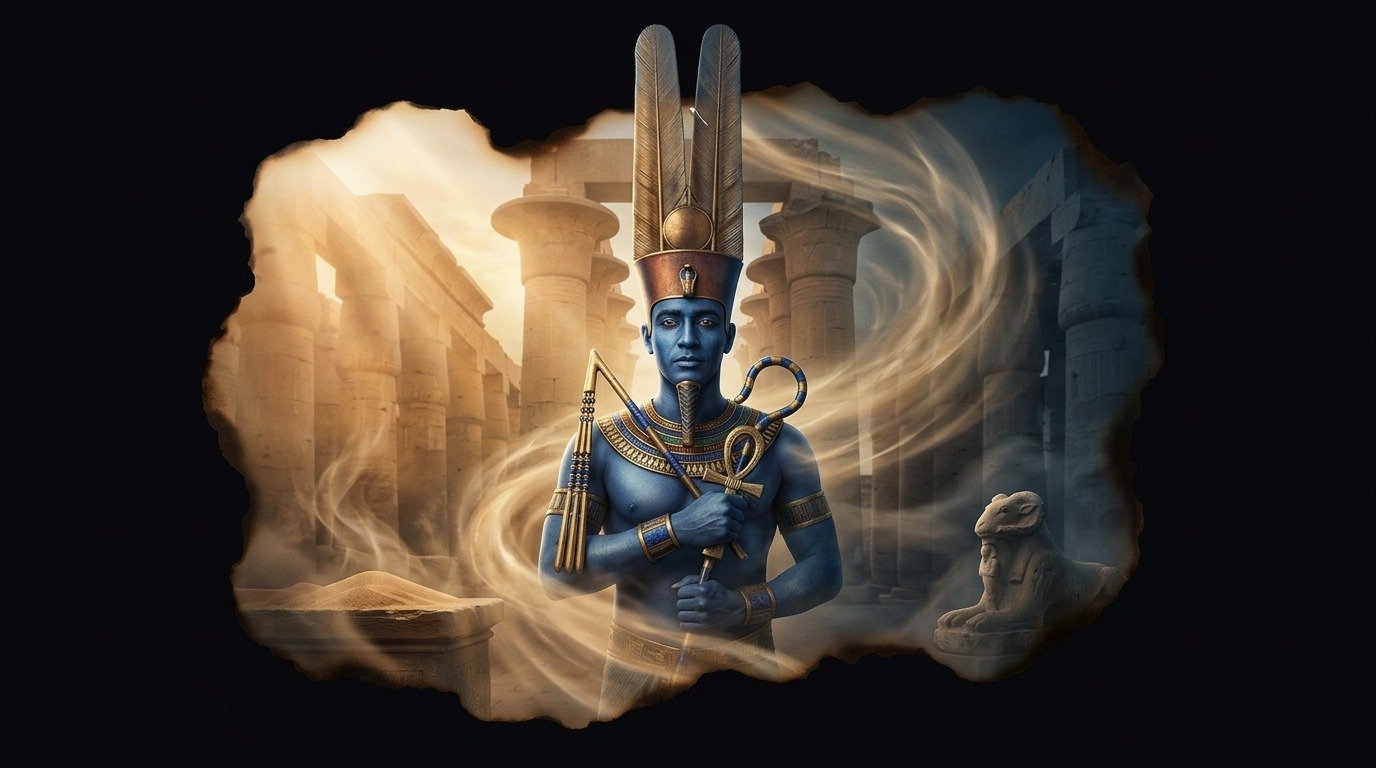
Amun: The Hidden Wind That Sustains the Empire
The Invisible Breath of the Cosmos
Amun began his existence in the shadows of creation myths, as one of the deities of the Ogdoad of Hermopolis, representing the force of air, wind, and "the hidden." Unlike Ra, who shines visibly in the sky, or Osiris, who dwells in the underworld visible to spirits, Amun is the god who is present everywhere but whom no one can see. He is the breath that swells the sails of the boats on the Nile, the air that fills the lungs of living beings at birth, and the invisible space that separates the earth from the sky. His classical representation is that of a blue-skinned man—the color of the infinite sky and the atmosphere—crowned by a tiara from which two long, straight falcon feathers emerge, waving with the slightest breath of wind. He often holds the scepter of power and the ankh of life. His nature is so vast and mysterious that his very name means "The Hidden One," suggesting that his true form is inaccessible even to the other gods.
The Ascent to the Throne of the Sun
When the princes of the city of Thebes unified Egypt and founded the New Kingdom, they carried their local god, Amun, to the pinnacle of the state pantheon. But Amun did not destroy the previous divinities; in an act of sublime syncretism, he merged with the ancient sun god, becoming Amun-Ra, the King of the Gods. In this way, the invisible wind joined the visible light of day, creating an absolute cosmic force that ruled both the material and spiritual planes. From his great temple of Karnak, a sacred city within Thebes with colossal columns that touch the sky, the priests of Amun administered wealth that rivaled that of the pharaoh himself. The "Hidden" god became the patron of military conquests. Under his banner, the pharaohs extended the borders of Egypt to the Euphrates and Nubia, attributing every victory to the favor of the god who blew behind their arrows and guided their war chariots.
The Whisper of the Desert and the Oracle of Siwa
Despite his immense political and military power, Amun retained his mystical character and accessibility to the common people. The marginalized, the poor, and the sick called him "the vizier of the poor," a god who hears the prayers of the humble and who does not need grand temples to manifest his compassion. His voice, soft as a whisper in the sand, was sought in the most remote places of the known world. The most famous example of his spiritual influence beyond the borders of Egypt was the Oracle of Amun at the Siwa Oasis, a green haven surrounded by dunes in the Libyan desert. There, in a modest temple built upon a rock, the deity spoke through the movement of his sacred bark carried on the shoulders of the priests. It was to this inhospitable corner of the world that the young conqueror Alexander the Great traveled through sandstorms to consult the oracle. Upon entering the sanctuary, the priest greeted him not as a mortal, but as the "Son of Amun," a recognition that granted the Macedonian general the divine legitimacy to rule the ancient world. Amun, the wind that cannot be caught, keeps blowing through the ruins of his fallen temples, invisible yet eternal.
Comments
Share information, an experience, or a source to help enrich this entry. They are automatically reviewed before being published.
Loading comments...