Osiris
Osiris: The Verdant King of Eternity
The First Sovereign of the Black Land
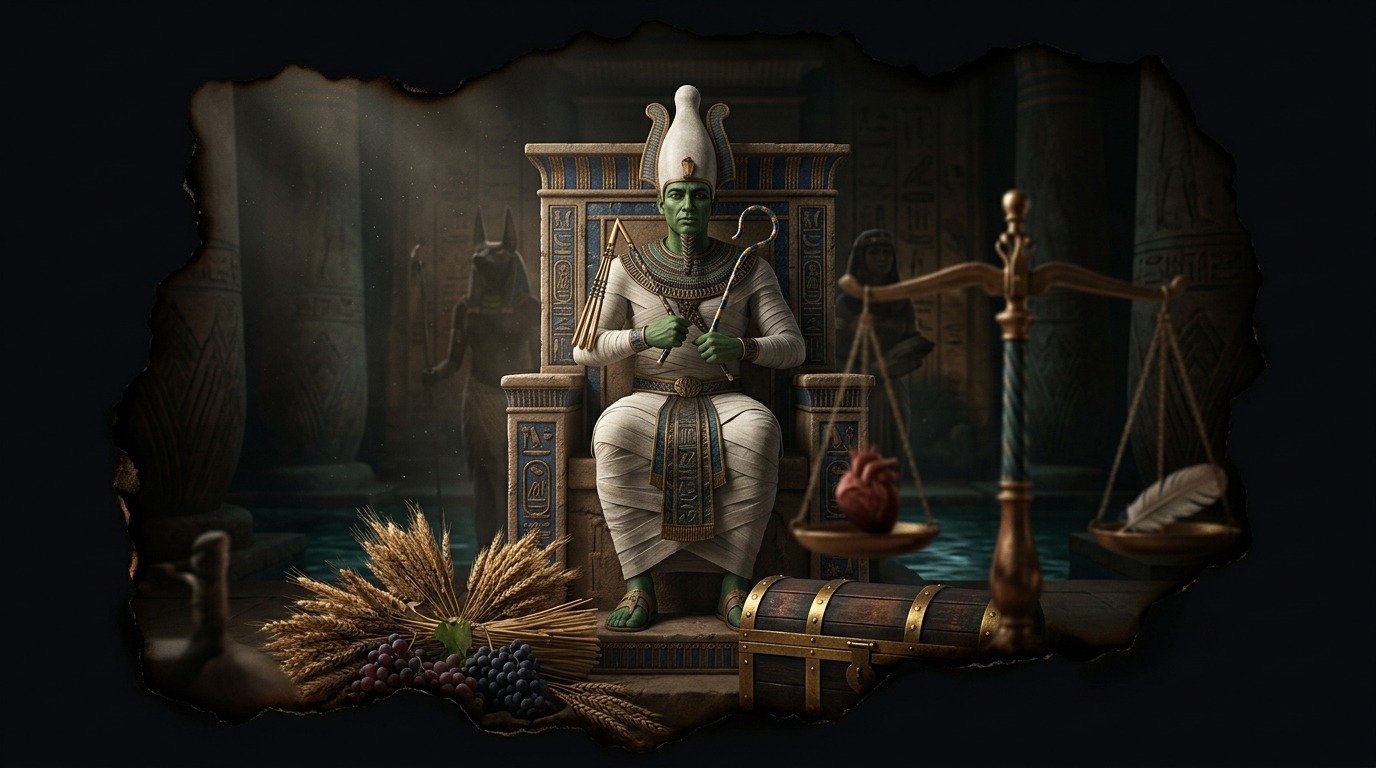
There was a time when the land knew neither laws, order, nor cultivation. Men wandered like beasts across the desert plains until Osiris descended to claim his rightful inheritance as the firstborn of earth and sky. With skin as green as the sprouts that emerge after the flood, and a serene and majestic bearing, Osiris taught mortals the art of agriculture. He showed them how to open furrows in the black mud of the Nile, how to sow wheat and barley, and how to press grapes to obtain the wine that gladdens the heart. Under his scepter and flail, laws replaced brute force and temples rose to honor the creators. Osiris did not rule through fear, but through abundance and justice, becoming the mirror of civilization itself and earning the unconditional love of the entire Nile Valley.
The Treachery of the Chest and the Fragmented Body
The light of his reign awakened a poisonous envy in the shadows of the desert. His brother Set, the lord of sandstorms and barren land, devised a perfect trap motivated by jealousy. During a sumptuous royal banquet, Set presented a chest of precious wood, inlaid with gold and ivory, announcing that he would gift it to whoever fit perfectly inside it. One by one, the guests lay down inside, but none managed to fill it. When Osiris, trusting and smiling, lay down in the chest, the dimensions proved exact, for Set had secretly built it by measuring his brother's footprints. In the blink of an eye, Set and his conspirators slammed the heavy lid shut, nailed it with bronze nails, and sealed it with molten lead, casting the chest into the currents of the Nile. Not content with this regicide, and after learning that the body had been recovered, Set sought out Osiris's corpse and tore it into fourteen fragments, scattering them to every corner of the kingdom to ensure his brother could never return or find rest.
The Throne of the Duat and the Judgment of the Soul
Osiris's body was scattered, but his essence was indestructible. Reconstructed through the magic of his wife Isis and the embalming rites of Anubis, Osiris became the first mummy in history. Although his feet could no longer walk upon the land of the living, his journey took him to the depths of the Duat, where he claimed an even greater empire. There, in the Great Hall of Double Truth, Osiris sits on a throne surrounded by sacred waters, wearing the white crown and wrapped in shrouds of fine linen that reveal his greenish skin, a symbol of the resurrection that awaits beneath the earth. He is the supreme judge of the dead. Before his unshakeable gaze, the hearts of men are weighed on the scales of justice. For the righteous, Osiris is not a spectator of the abyss, but the promise of eternal life: the god who, just like the grain of wheat that must die beneath the soil to rise again with strength, guarantees that death is not the end, but the threshold of an eternal rebirth.
Comments
Share information, an experience, or a source to help enrich this entry. They are automatically reviewed before being published.
Loading comments...