Maat
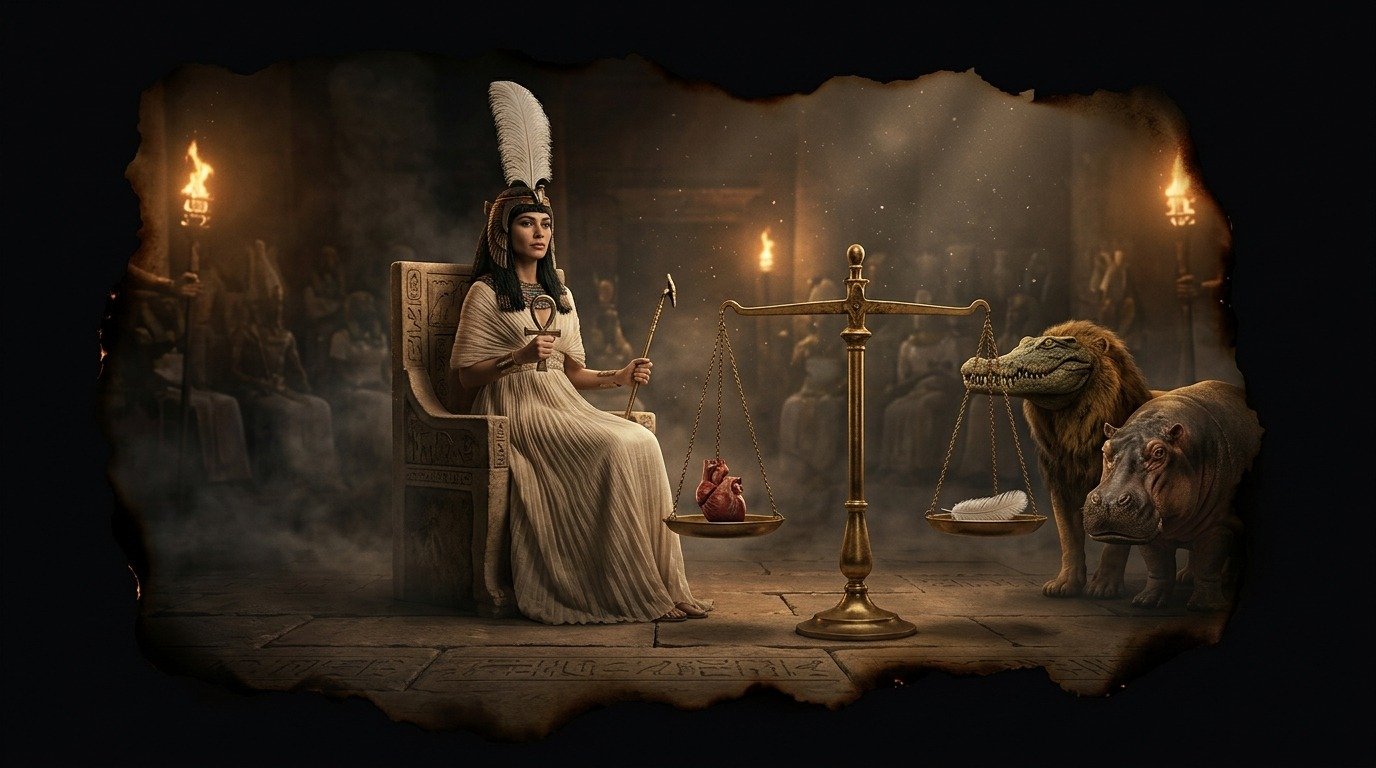
Maat: The Feather of Justice and the Heartbeat of the Cosmos
The Primal Sigh of Creation
Before the sun tore through the blackness of Nun for the first time, the chaotic and infinite waters that flooded everything, there was no direction, nor time, nor measure. The universe was a boundless abyss, a roar of disordered possibilities known as Isfet. But when the demiurge, the solar god, emerged from a hill of primordial earth to utter his own name, he did not do so into a vacuum. Alongside him, like a golden breath that tempered the world's first morning, Maat was born.
She was not created as an object or a servant; Maat is the very structure of reality, the vector of light that ordered the stars, regulated the course of the seasons, and taught the Nile River the exact path it had to travel each year to fertilize the land. Represented as a woman of serene bearing, crowned by an impeccable ostrich feather, Maat is the dynamic balance that prevents the cosmos from collapsing back into the abyss of chaos. Her presence is the guarantee that day will follow night and that justice will prevail over tyranny.
The Scales of the Two Truths
The power of Maat is not exerted through brute force, but through a silent and absolute judgment that awaits every soul at the end of its earthly journey. In the twilight of the Great Hall of the Two Truths, deep within the underworld, the dead must face her tribunal. There, before Osiris and forty-two divine judges, the heart of the deceased, the container of all their actions, thoughts, and guilt, is deposited on one of the pans of a golden scale.
On the opposite pan, Maat herself is placed, often embodied in her white ostrich feather. The verdict is mathematical and sacred: if the heart is heavy with lies, greed, or cruelty, it will weigh more than the feather, tipping the scales and condemning the soul to be devoured by the beast Ammit. But if the deceased lived in harmony with the laws of the cosmos, if their words were just and their hands clean, the heart and the feather will find a perfect balance, a weightless silence. In that instant, the soul becomes an eternal light, merging with the imperishable order that Maat has sustained since the beginning of time.
The Food of the Gods and the Order of the Nile
For the people of the sands and for the gods themselves, Maat is daily sustenance. The pharaoh is not a simple ruler by right of blood; he is the supreme priest whose sole duty is to maintain the flow of Maat upon the earth, returning order to the world of men through just laws, consecrated temples, and a scrupulous respect for the cycles of nature. In the most sacred ceremonies, the king does not offer gold or oxen to the temples; he holds a small statuette of Maat in his palms and raises it toward the heavens. With this gesture, he assures the creators that the world continues to function as they planned.
Even the great sun god, on his daily journey aboard the celestial bark, feeds on the presence of Maat to defeat Apophis, the devouring serpent that lurks in the shadows of the underworld. Without Maat, the stars would fall from their orbits, water would turn to poison, and the spoken word would lose its meaning. She is the invisible constant that allows everything that breathes to continue doing so, the promise that light will always find a way back.
Comments
Share information, an experience, or a source to help enrich this entry. They are automatically reviewed before being published.
Loading comments...