Nut
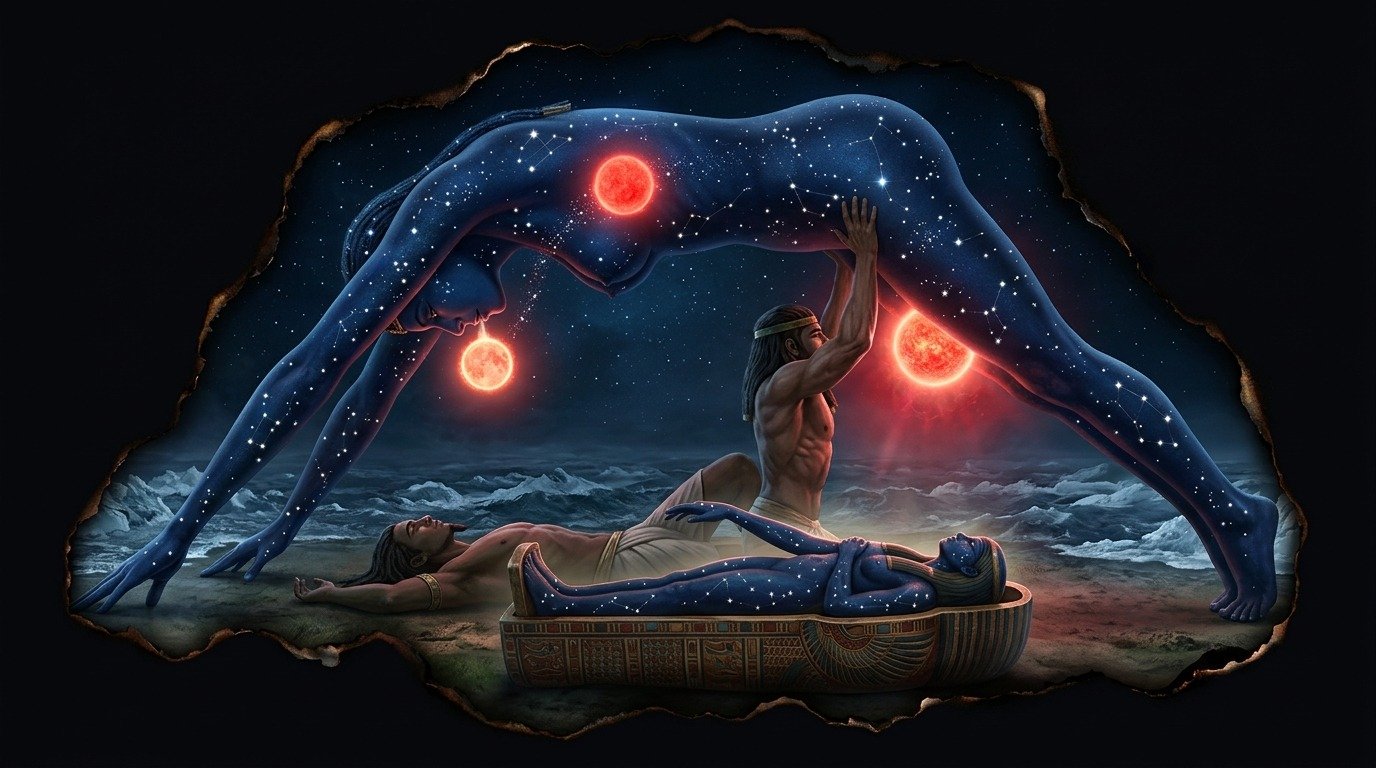
Nut: The Starry Womb That Shelters the Infinite
The Blue and Jeweled Vault
In the beginning, the sky and the earth were united in an embrace so tight that there was no space for light to penetrate or for life to flourish. Nut, the goddess of the firmament, lay stretched over her brother Geb, the earth, in perpetual communion. It was their father, Shu, the god of the air, who by order of the creator interposed himself between them, pushing Nut into the heights with his powerful arms and forcing Geb to remain below.
From that moment on, Nut was transformed into the immense celestial vault. She is represented as a woman with infinitely long limbs, whose skin is the deep blue of the night, dotted with thousands of bright stars that float over her body like floating jewels. Her hands rest in the far west and her feet in the east, barely touching the limits of the earth, while her arched back forms the roof of the visible world, protecting it from the cold and chaotic waters that press from the outer void.
The Cycle of the Sun and the Stars
The daily life of the cosmos depends on the body of Nut. She is the great devourer and the great mother of the sun. Every evening, when the solar disk of Ra touches the western horizon, Nut bows her head and swallows the sun. The sun king then travels through the interior of her body during the hours of the night, illuminating her dark blue entrails and granting momentary life to the souls that inhabit her firmament.
During the nightly journey, the sun regenerates in the mystical waters of her maternal womb. At dawn, after twelve hours of silent transit, Nut gives birth once again to the solar disk in the east, bathed in the red color of childbirth blood. This eternal cycle of death and rebirth, repeated day after day, is the heartbeat of time itself, guaranteeing humanity that darkness is never the final end, but rather the prelude to a new birth.
The Pact of the Hidden Days
Nut's love for her children defied the mandates of the oldest gods. When she became pregnant by her brother Geb, the sun god Ra sensed that the offspring of this union would threaten his sovereignty. Filled with wrath, he decreed an implacable curse: Nut would not be able to give birth to her children on any day of any of the twelve months of the year.
Desperate from the weight of her starry womb and the pain of being unable to give birth, Nut turned to the cunning Thoth for help. Thanks to his victory over the moon god in a game of chance, five special days were added to the solar year that did not belong to any month. On those intercalary days, suspended outside the time decreed by the curse, Nut was finally able to give birth. From her womb were born in succession Osiris, Isis, Seth, Nephthys, and, in some traditions, Horus the Elder himself. With this act of resistance and maternal love, Nut seeded the earth with the deities that would define the destiny of humanity.
The Eternal Refuge of the Deceased
For the ancient inhabitants of the Nile Valley, Nut was not a distant and inaccessible deity, but the protective mother who awaited them at the end of their earthly journey. Artisans painted her figure on the inside of the lids of wooden and stone sarcophagi, so that the deceased, upon being laid in their tomb, gazed eternally upward and found themselves face to face with the starry face of the goddess.
Upon entering the sarcophagus, the deceased symbolically entered the body of Nut. The goddess stretched her constellation-jeweled arms over the lifeless body, uttering words of comfort: "I am your mother Nut; I stretch myself over you to protect you from all evil." Thus, the deceased did not sink into the cold earth to disappear, but instead became imperishable stars navigating through the body of the sky goddess, awaiting the moment to be reborn alongside the sun on the horizon of eternity.
Comments
Share information, an experience, or a source to help enrich this entry. They are automatically reviewed before being published.
Loading comments...