Geb
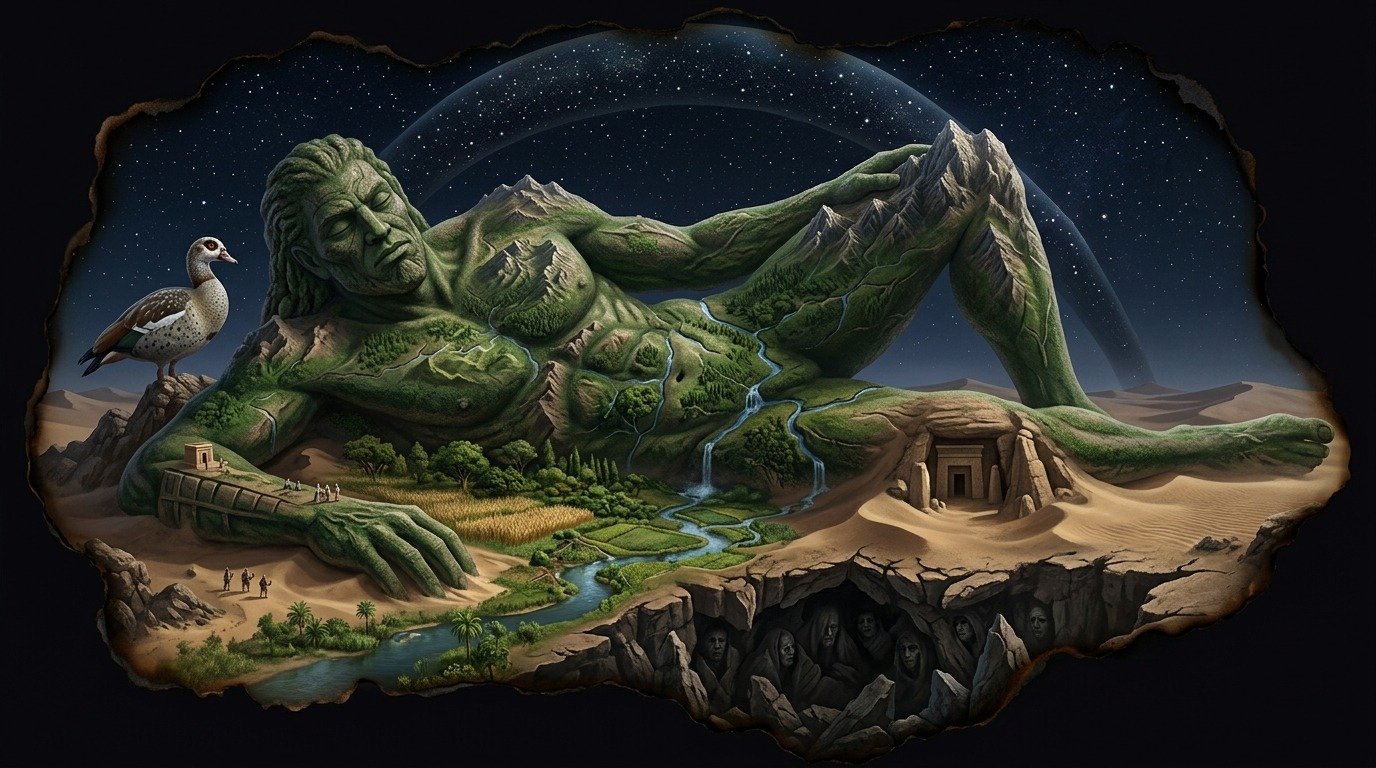
Geb: the heartbeat of rock and the laughter that shakes the earth
The foundation of the living world
Beneath the immense starry vault of the sky stretches the colossal body of Geb, the god of the earth and the foundation upon which all creation rests. While his wife Nut arches high above, Geb lies stretched out face down or propped up on an elbow, with one knee bent to mimic the contours of mountain ranges and valleys. He is the primordial rock, the fertile soil, and the dark abyss that waits beneath the desert sands.
Son of Shu and Tefnut, Geb represents stability and physical matter. He is usually depicted with deep green skin, the color of the vegetation that sprouts from his depths after the flooding of the river, or the brown color of plowed earth. At times, a mystical goose, the *Nile goose*, rests upon his head or flies near him, recalling the myth that it was Geb who laid the cosmic egg from which the sun was born at the dawn of time.
The green weeping and the roar of the rock
Geb is not a passive deity who simply bears the weight of the world; his body is alive, breathes, and reacts to the events of the cosmos. It is said that the hills and mountains are Geb's bones protruding from the skin of the earth, and that the valleys and depressions are the curves of his divine musculature. When the god shudders in pain or anger, the earth trembles in earthquakes that crack temples and displace mountains.
The plants, trees, and grain crops that feed mankind are nothing but the hair of his body, sprouting when fertilized by the tears he sheds at being separated from his beloved Nut. The fresh water that runs through the rivers and wells up from underground oases is the sweat of Geb flowing from the depths of mountain caverns. Thus, every step a mortal takes upon the soil of Egypt is direct contact with the vibrant and sacred body of this god.
The primordial throne and the judgment of the earth
In the divine hierarchy, Geb holds the office of the great lawmaker and the first legitimate king of the earth. After the departure of the celestial gods to the heights, it was Geb who assumed the government of the world of men, establishing borders, dividing provinces, and organizing the first temples and irrigation canals. His reign was an era of abundance and justice that served as a model for all future pharaohs, who assumed the throne under the title of "heirs of Geb."
As judge of the divine tribunal, Geb had the final word in the territorial dispute between his son Seth and his grandson Horus. Listening to the arguments of both sides with the patience of the mountains, Geb handed down the definitive sentence: he granted Seth dominion over the deserts and foreign lands, and Horus absolute rule over the black, fertile lands of the Nile Valley. With this decision, Geb restored harmony to the land and consecrated the royal crown as a sacred institution legitimized by the earth itself.
The guardian of tombs and crops
Geb's relationship with human beings is one of breathtaking duality. On one hand, he is the nurturing father who provides the wheat, barley, and precious stones with which monuments are built. On the other hand, he is the guardian of the dead, the jailer of unworthy souls, and the custodian of tombs.
Those who do not pass the judgment in the underworld remain trapped in the depths of the earth, devoured by the jaws of Geb, which close upon them like a stone prison from which they can never escape. However, for the righteous, Geb opens his hills and allows their bodies to rest in peace, protecting their mummies from looters and the decay of the sand. The god who makes the ear of wheat sprout from the dry soil is the very same who ensures that the seed of the human soul can germinate in the darkness of the tomb to flourish in the afterlife.
Comments
Share information, an experience, or a source to help enrich this entry. They are automatically reviewed before being published.
Loading comments...