Bastet
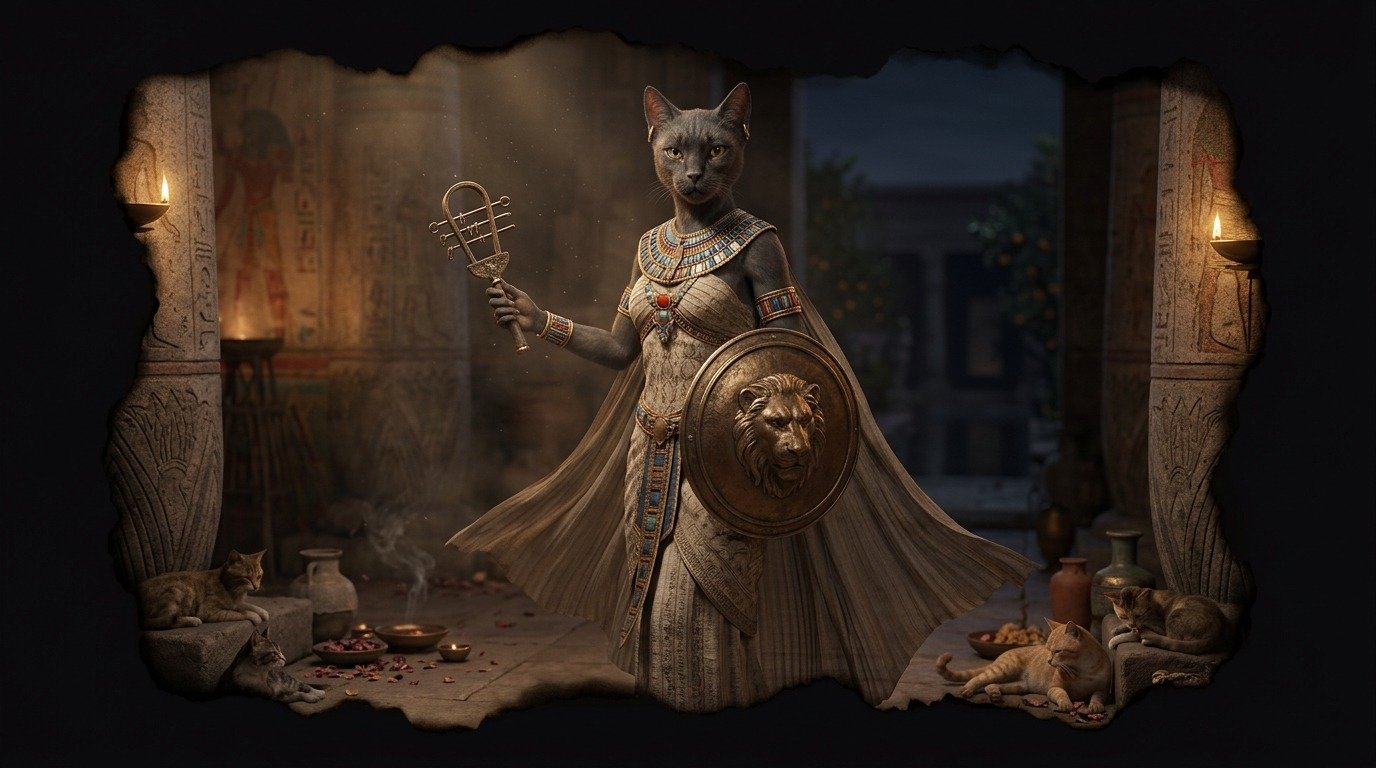
Bastet: The Guardian of the Home and Perfume
From the Savage Claw to the Purr of the Home
In the beginning, when the lands of the Nile Delta were untamed swamps filled with predators, Bastet shared the fury of her sister Sekhmet. She was a deity of sharp claws, a lioness who protected the borders of Lower Egypt with indomitable ferocity. But as men domesticated the land, planted fields, and built their mud-brick homes, Bastet underwent a metamorphosis. Her lioness coat softened, her figure became slender, and she adopted the form of a domestic cat, becoming the intimate protector of civilization against the chaos of nature.
Unlike the distant gods who dwell in the heavens or in the depths of the underworld, Bastet prefers the closeness of mortals. She is depicted as a woman with the head of a cat, holding in her hand a sistrum—a sacred bronze rattle that drives away dark spirits—and a shield with the head of a lioness, a subtle reminder that beneath her docile and elegant appearance beats the heart of an implacable hunter.
The Sistrum That Drives Away the Shadows
The cat is not just a companion animal in the land of the pharaohs; it is a sacred guardian, the eye that watches in the night. Bastet, through her feline counterparts, protects granaries from rodent pests and defends families from venomous cobras that slither under beds. The simple act of a cat grooming itself in the sun is a manifestation of her protective presence, a blessing of health and fertility for the home that shelters it.
But her most crucial role occurs on the invisible plane. Every night, when the solar bark of the god Ra descends through the underworld of the Duat, it is stalked by Apophis, the gigantic serpent of chaos that seeks to devour the light and plunge the cosmos into eternal darkness. In the darkest moments of the journey, Bastet transforms into a giant cat and, with the agility and instinct characteristic of her species, confronts the serpent, tearing its scales with her golden claws to allow the sun to rise once more over Egypt.
The Sacred Drunkenness of Bubastis
The cult of Bastet reaches its peak splendor in the city of Bubastis, in the eastern delta. There, her great red granite temple, surrounded by water canals and fruit trees, houses thousands of sacred cats that are fed and mummified with royal honors upon their death. The annual festivals in honor of the goddess are the most heavily attended in the entire country. Boats laden with pilgrims travel down the Nile to the sound of flutes and sistrums, surrendering themselves to dance, music, and the consumption of wine in colossal quantities.
For Bastet, joy, physical pleasure, perfume, and dance are not frivolities, but the antidote to the rigidity of death and the pain of existence. She is the protective mother who ensures the fertility of women and ease in childbirth, the divinity who embraces the beauty of daily life without ever forgetting that, if the home is threatened, her hidden claws will shine once more under the sunlight.
Comments
Share information, an experience, or a source to help enrich this entry. They are automatically reviewed before being published.
Loading comments...