Eye of Horus
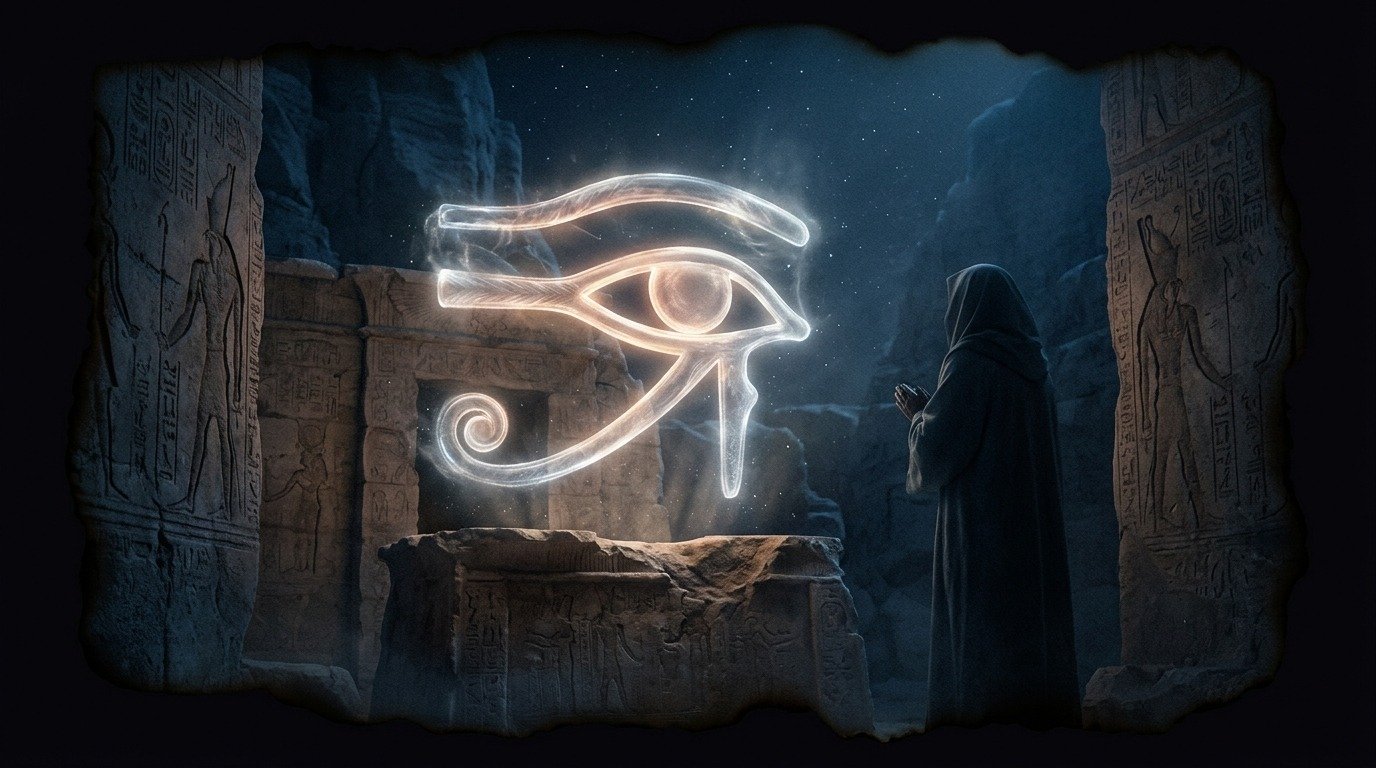
Eye of Horus: The Wedjat and the Power of Restoration
What It Is and What It Looks Like
The Eye of Horus, also known as *Wedjat* (meaning "the one that is complete" or "healthy"), is an ancient Egyptian symbol representing a stylized human eye that combines features of a falcon's eye and the facial markings of this bird of prey. The design consists of the eye itself, an arched eyebrow above, a vertical line descending from the outer corner (mimicking the falcon's tear), and a diagonal line curving backward in the shape of a tail or spiral, associated with the plumage of the sacred animal.
Origin and History of the Symbol
The symbol has its origin in the mythology of Ancient Egypt, specifically in the dynastic conflict between the falcon god Horus and his uncle Seth for the throne of Egypt. During the battle to avenge the death of his father Osiris, Seth tears out Horus's left eye and breaks it into six parts. The god of wisdom and magic, Thoth, finds the fragments, gathers them, and restores them using his magical powers, restoring Horus's sight and health.
Once reconstructed, the eye acquired the name *Wedjat*. Horus offered this healed eye to his deceased father, Osiris, to restore him to life and allow him to rule the underworld. Since the Old Kingdom, the Eye of Horus was carved onto amulets, temple reliefs, sarcophagi, and stelae to provide protection to the living and ensure the rebirth of the dead.
Meanings in Each Tradition
In Ancient Egypt, the Eye of Horus symbolizes health, physical integrity, protection against evil, healing, and the restored cosmic order (*Maat*). The right eye of Horus represents the Sun, while the left eye (the *Wedjat*) represents the Moon. The mutilation and subsequent restoration of the eye mythically explained the lunar phases.
In modern esoteric tradition, the parts of the Eye of Horus are associated with base-two fractions used to measure grain or liquids: the inner corner of the eye with 1/2, the pupil with 1/4, the eyebrow with 1/8, the outer corner with 1/16, the vertical line with 1/32, and the spiral with 1/64. The sum equals 63/64, and the missing fraction (1/64) would be Thoth's magic that completes the total. This reading became popular in the 20th century; current Egyptologists dispute that the Egyptians used it this way.
In Hermetic esotericism and Theosophy, the Eye of Horus is interpreted as the awakening of spiritual vision, clairvoyance, and the pineal gland (the Third Eye). In the mystical current of Thelema, founded by Aleister Crowley, the Eye of Horus is a central symbol representing the beginning of the "Aeon of Horus," an era of self-liberation and the awakening of individual will.
Magical and Ritual Use
In ancient Egyptian ritual practice and contemporary Neopaganism, the *Wedjat* is consecrated as an apotropaic amulet of active defense. It is placed at the entrance of homes or worn on the body to deflect negative energies, envy, and the evil eye.
During funerary rites and healing rituals, an Eye of Horus amulet is drawn or placed over the affected area of the sick person's body to promote healing and the restoration of the body. In modern ceremonial magic, it is traced in the air with a dagger or magic wand to consecrate the ritual space and open mental perception before performing high magic operations.
Presence in Popular Culture and Connections
The Eye of Horus is one of the most recognizable Egyptian symbols in the world. It is widely used in jewelry, tattoos, music album covers, and archaeological or fantasy-themed movies.
It is frequently associated and confused with the Eye of Ra (which represents the destructive and protective solar force, and is generally shown in the opposite way, reflecting the right eye), with the Eye of Providence (the eye within the triangle of Christian and Masonic origin), and with protective Egyptian deities such as the cobra goddess Wadjet and the god Thoth.
Comments
Share information, an experience, or a source to help enrich this entry. They are automatically reviewed before being published.
Loading comments...