Sigils
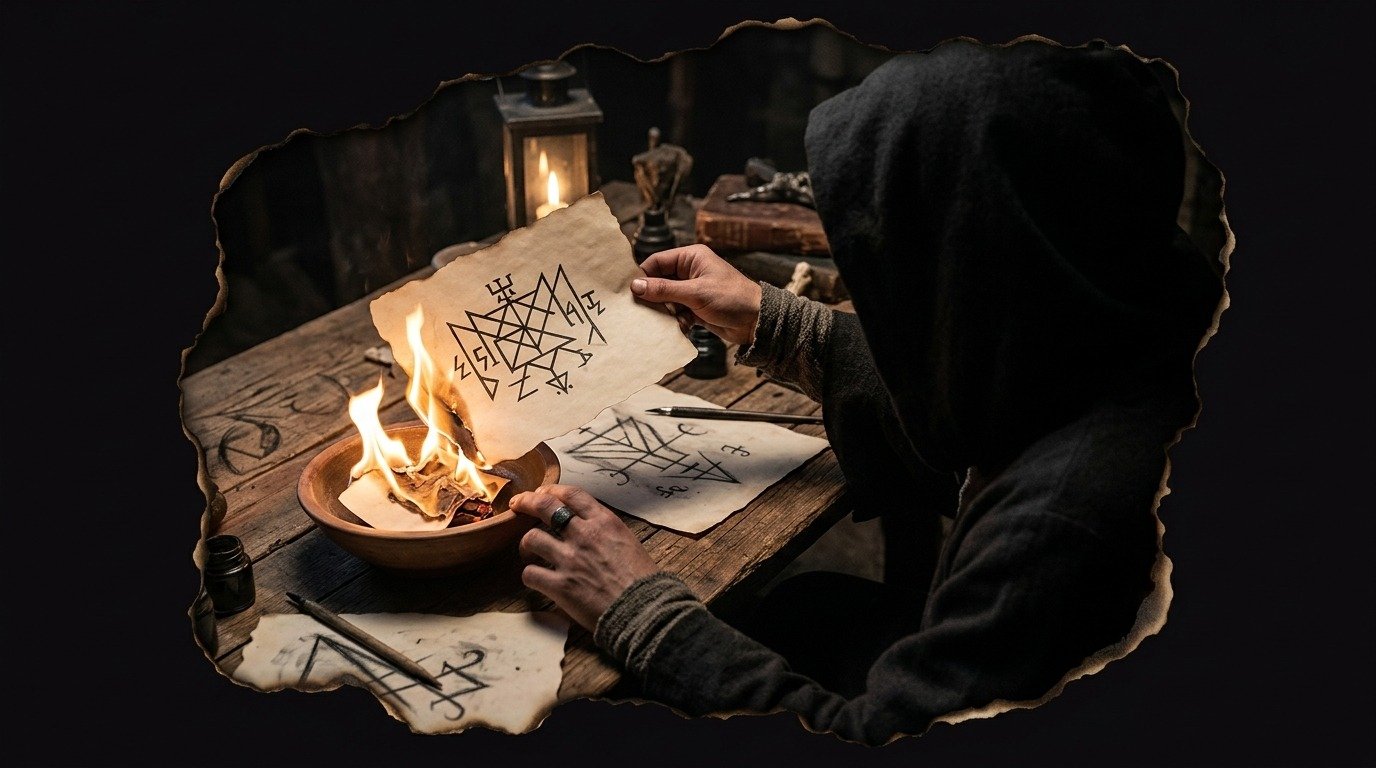
Sigils: the art of codifying the will into symbols of power
What it is and what it is like
A sigil (from the Latin *sigillum*, "seal") is a unique abstract symbol created expressly by a magician to represent a desire, an intention, or the name of a spiritual entity. Its physical form is a complex and irregular geometric line that lacks an obvious meaning at first glance, deliberately designed so that the operator's conscious mind does not recognize the original phrase or concept from which it was drawn.
Origin and history
In medieval and Renaissance magic, sigils were considered the signatures of angels, demons, and planetary spirits. Grimoires such as the *Heptameron* of Pietro d'Abano or the *Three Books of Occult Philosophy* by Cornelius Agrippa show numerical tables (magic squares) through which lines were drawn connecting letters or numbers corresponding to the names of the entities, resulting in their characteristic seals. At the beginning of the 20th century, the British artist and occultist Austin Osman Spare revolutionized the creation of sigils in his work *The Book of Pleasure* (1913). Spare eliminated the need for spiritual intermediaries and designed a purely psychological method to create symbols based on the magician's own desires. In the 1970s, the Chaos Magic movement adopted, simplified, and popularized Spare's method as its fundamental operational tool.
Meanings in each tradition
In traditional ceremonial magic, the sigil represents the pure essence, the phone number, or the vibrational frequency of a specific spiritual entity. Possessing the sigil of a spirit is equivalent to having authority over it. In Chaos Magic, the sigil is a psychological bypass tool. Its purpose is to bypass the censorship of the conscious mind and plant an intention of change directly into the deep unconscious mind (the "subconscious"), which is where the magician's true operational power resides.
Magical or ritual use
The contemporary process of sigilization developed by Spare and used today consists of three defined phases: 1. **Linguistic reduction:** A clear phrase with the magician's intention is written in the present tense (example: "MY DESIRE IS TO HAVE HEALTH"). All repeated letters and vowels are removed, leaving a unique consonantal residue. 2. **Design:** With the remaining letters, the magician draws an intertwined abstract design until the original letters are no longer recognizable. 3. **Charging and activation:** The magician enters an altered state of consciousness known as "gnosis" (through extreme exhaustion, deep meditation, hyperventilation, or sexual arousal). At the peak of this state, the sigil is visualized or contemplated with intensity to imprint it onto the unconscious. Subsequently, the symbol is destroyed (burned, torn, or buried) and the magician deliberately forgets the original desire to allow the unconscious to work without interference from conscious obsession.
Presence in popular culture and connections
The concept of sigils is the operational basis of modern corporate branding and logo design, which seek to influence consumer behavior subconsciously. In popular culture, they appear in comic books by authors such as Alan Moore and Grant Morrison (who coined the term "hypersigil" to describe entire works of art used as sigils), in television series, and in video games. They connect directly with Chaos Magic, the magic squares of Cornelius Agrippa, and the psychology of the unconscious.
Comments
Share information, an experience, or a source to help enrich this entry. They are automatically reviewed before being published.
Loading comments...