Pentagram
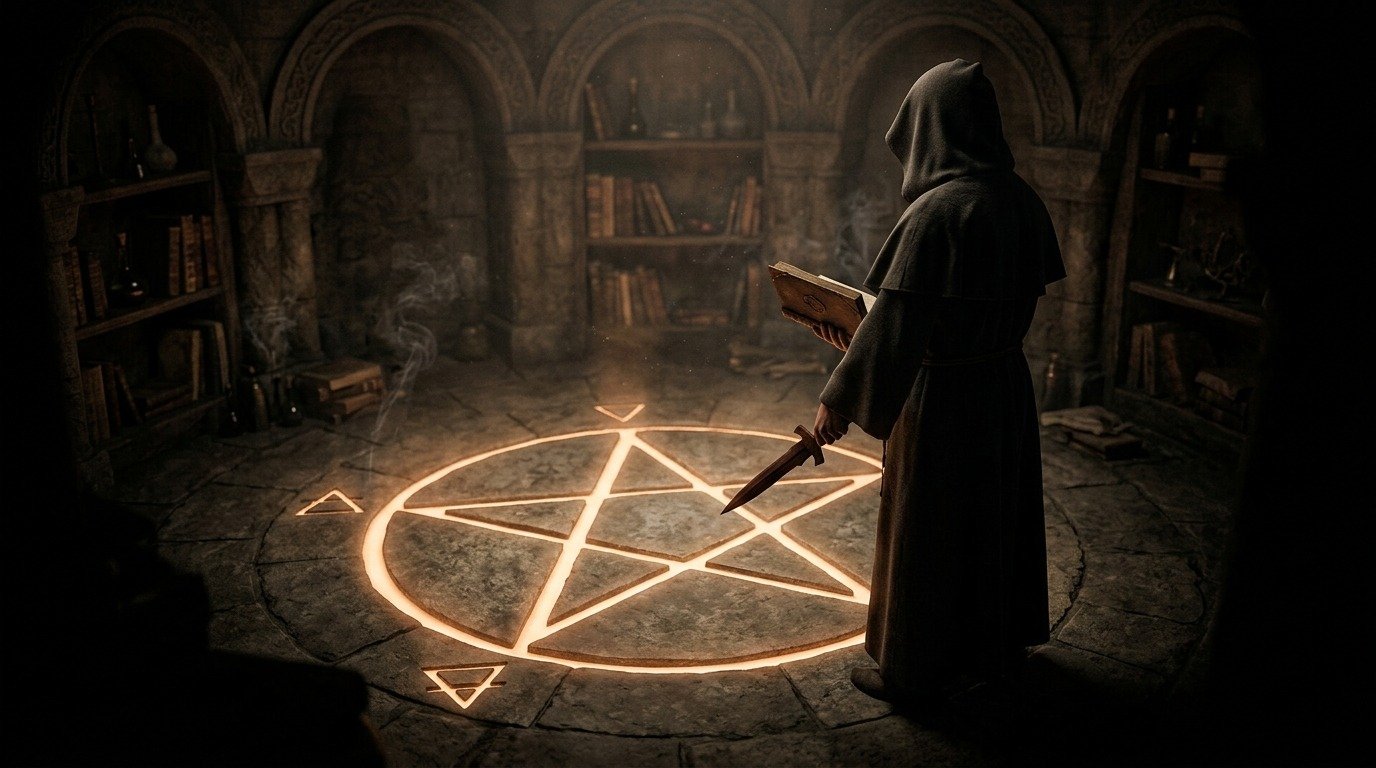
Pentagram: the Geometry of the Microcosm and the Balance of the Elements
What it is and what it looks like
The pentagram is a five-pointed star drawn with a single continuous line that intersects at five inner points. Its two-dimensional design features perfect golden symmetry, where each intersection divides the segments into proportions based on the golden ratio. Its orientation defines its operational polarity: the upright pentagram features a single point pointing upward and two downward; the inverted pentagram features two points pointing upward and one downward.
Origin and history
The earliest graphic records of the pentagram appear in the Mesopotamian region around 3000 BCE, as a Sumerian pictogram meaning "direction" or "region". In classical Greece, the Pythagorean school adopted the symbol in the 6th century BCE, calling it "pentalpha" because its drawing emulates the overlapping of five alpha letters. The Pythagoreans considered it the emblem of health, cosmic order, and human harmony.
During the Middle Ages and the Renaissance, the symbol was integrated into Christian mysticism as a representation of the five wounds of Christ and as a protective talisman against demonic entities. In 1854, the French occultist Éliphas Lévi published *Dogma and Ritual of High Magic*, a fundamental work where the moral distinction of the symbol based on its orientation was established for the first time. In 1966, Anton LaVey founded the Church of Satan, which adopted as its emblem the inverted pentagram with the head of the Goat of Mendes inscribed inside it: the Sigil of Baphomet.
Meanings in each tradition
In Hermeticism and ceremonial magic, the upright pentagram represents the microcosm: the human being in harmony with the universe. The four lower points correspond to the elements of nature (earth, water, air, and fire), while the upper point represents the spirit or quintessence that rules over matter.
In Wicca and Neopaganism, the pentagram is a sacred symbol representing the connection of the elements with the consciousness of the Earth and the Goddess.
In the Left-Hand Path and Satanism, the inverted pentagram represents the supremacy of matter over spirit, rebellion against the established cosmic order, self-sovereignty, and the satisfaction of earthly desires.
Magical or ritual use
In contemporary ceremonial magic, the pentagram is the primary tool for consecrating, banishing, or invoking specific energies. The Hermetic Order of the Golden Dawn developed the Lesser Ritual of the Pentagram, a daily practice where the operator traces the symbol in the air with a dagger or index finger at the four cardinal points.
The direction in which the symbol is drawn determines its function: starting the trace from the top point toward the bottom-left point invokes the forces of earth, while starting from the bottom-left point toward the top point banishes them from the sacred space.
Presence in popular culture and connections
The pentagram is the most widespread esoteric symbol in contemporary mass culture. Its association with the occult and horror is recurrent in heavy metal music, genre cinema, and fantasy literature. It is directly linked to figures such as the demon Baphomet, the practice of traditional witchcraft, the use of the athame as a drawing instrument, and fundamental magical texts such as the *Grand Grimoire*.
Comments
Share information, an experience, or a source to help enrich this entry. They are automatically reviewed before being published.
Loading comments...