Ceremonial Magic
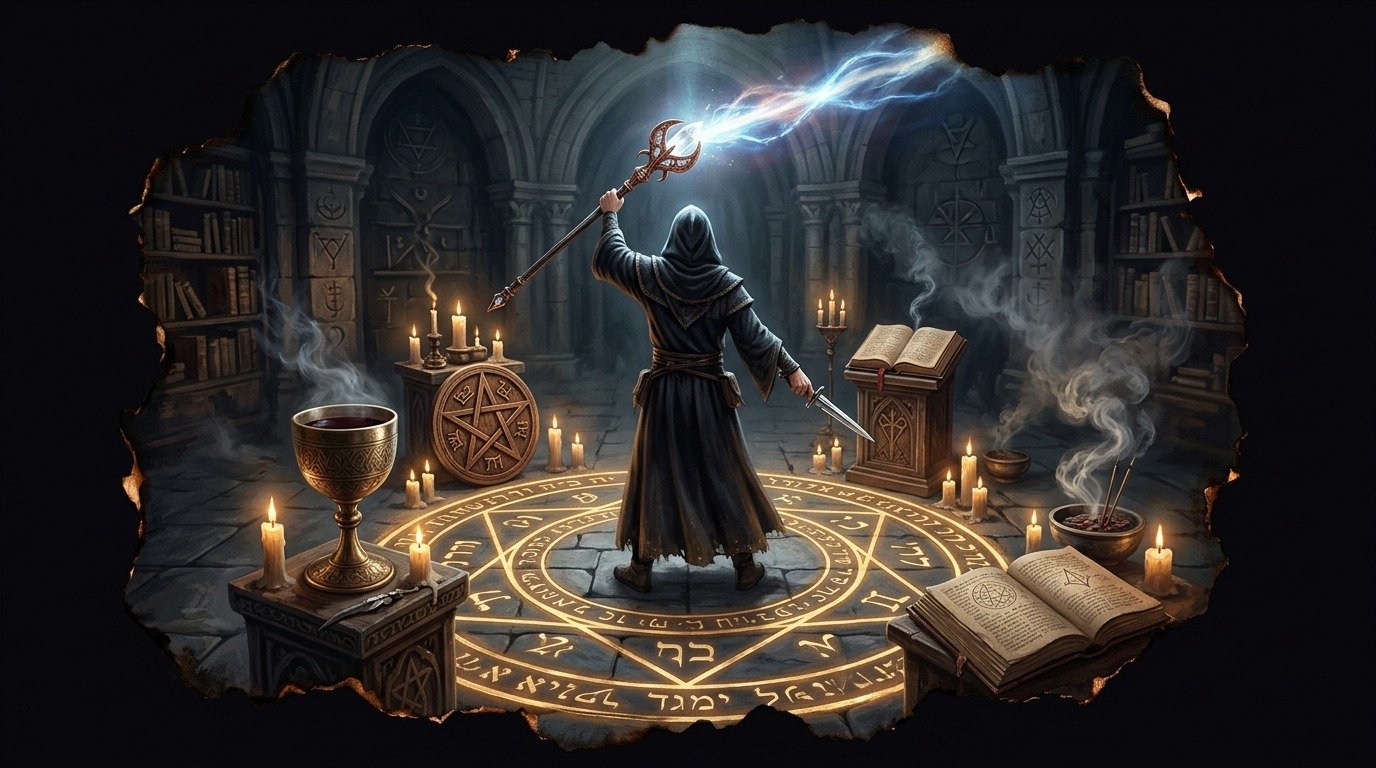
Ceremonial Magic: The Precision of the Rite and the Invocation of Cosmic Forces
The Essence of the Rationalized Rite
Ceremonial magic, also known as high magic, is an esoteric discipline that uses complex rituals, precise formulas, and consecrated tools to interact with spiritual, divine, or universal forces. Unlike folk or popular magic, which is intuitive and domestic in nature, ceremonial magic is governed by an intellectual, rigorous, and almost scientific method. Its primary purpose is the spiritual elevation of the practitioner—a process called the Great Work—and the conscious mastery of the energies that govern the cosmos.
The System of Correspondences and Tools
The practice is based on the principle of correspondence: every element of physical reality is linked to a higher planetary, elemental, or spiritual force. The ceremonial magician does not act by chance, but through a code of exact equivalences that includes astronomical hours, colors, metals, incense, and sacred names.
The tools represent the authority of the magician and the four elements of Creation: * **The sword or dagger:** Linked to the element of Air and the intellect. It is used to banish unwanted influences and direct the will. * **The wand:** Linked to the element of Fire and the creative will of the magician. It is the direct channel of his power. * **The cup:** Linked to the element of Water and intuition. It contains the ritual waters of transmutation. * **The pentacle:** A disc of metal or wood engraved with a pentagram, linked to the element of Earth and the physical manifestation of the ritual.
The basic ritual space requires the drawing of a magic circle, which acts as an impassable fortress and a representation of the infinite universe. Outside of it, the triangle of manifestation is often placed, the delimited space where the invoked forces must materialize without coming into contact with the operator. A fundamental rite of this discipline is the Lesser Ritual of the Pentagram, designed to purify the space and the mind of the magician before any major operation.
Origin and History
Ceremonial magic originated in the Neoplatonic theurgy of the third century and the practices of Greco-Egyptian magic. During the Middle Ages and the Renaissance, it drew from Jewish Kabbalah and Hermetic astrology, giving rise to the first grimoires, practical manuals of magic attributed to figures of the past.
In the late 1880s, the founding of the Hermetic Order of the Golden Dawn in London transformed the discipline. This secret society unified the tarot, Kabbalah, astrology, and Egyptian esotericism into a single doctrinal body. In the twentieth century, this system diversified with the creation of the Thelema current and, later, chaos magic, which eliminated the rigidity of traditional dogmas while maintaining the use of structured ritual.
Key Figures
* **Heinrich Cornelius Agrippa (1486-1535):** His work *De occulta philosophia* systematized all the magical knowledge of the Renaissance. * **Éliphas Lévi (1810-1875):** French intellectual who unified ceremonial magic with Kabbalah and tarot, returning esotericism to Europe's intellectual discussion. * **Samuel Liddell MacGregor Mathers (1854-1918):** Leader of the Golden Dawn and translator of the classic grimoires indispensable for modern practice. * **Aleister Crowley (1875-1947):** Creator of the *Thelema* system, who reformulated ceremonial ritual under the concept of *Magick*.
The Place of High Magic Today
In contemporary esotericism, ceremonial magic is practiced in initiatory orders and by solitary practitioners seeking self-perfection. Carl Jung's analytical psychology interprets this discipline as a process of confrontation with the unconscious. From this psychological perspective, the symbols, ritual weapons, and invoked entities are seen as archetypes of the human mind that the practitioner projects and masters to integrate their own psyche.
Connections
This discipline connects directly with Hermeticism, Kabbalah, Goetia, Tarot, Alchemy, and the historical figure of John Dee.
Comments
Share information, an experience, or a source to help enrich this entry. They are automatically reviewed before being published.
Loading comments...