White magic and black magic
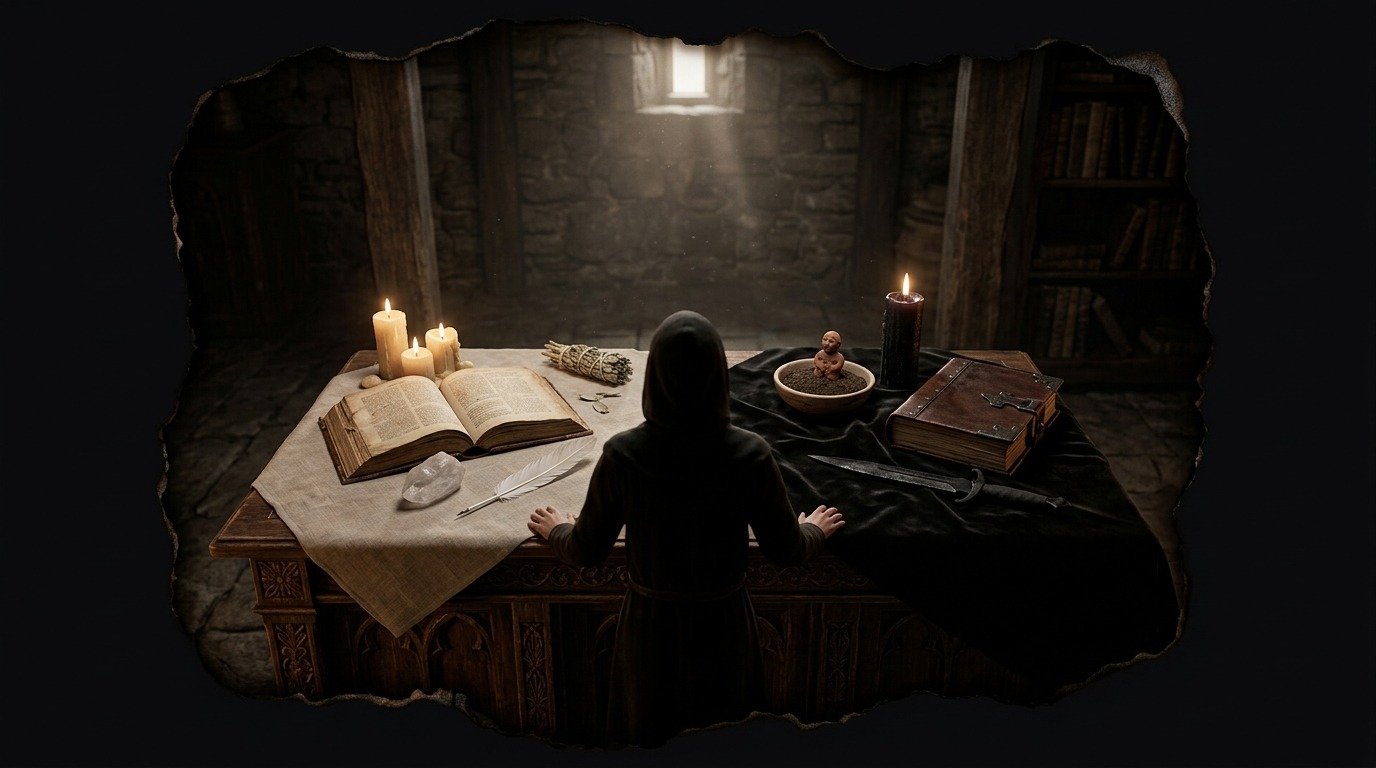
White Magic and Black Magic: The Division of Intention and Power
What it is
The division between white magic and black magic is the moral and utilitarian classification of esoteric practices. White magic groups together operations aimed at healing, protecting, purifying, and seeking spiritual elevation or harmony with natural laws. Black magic comprises practices oriented toward harming, dominating, obtaining selfish benefits at the expense of others, or altering free will through the manipulation of occult forces.
How it works
This classification operates under a binary structure of intentions and correspondences. White magic is based on theurgy, which seeks communication with celestial, angelic, or divine entities. Its main tools are prayer, meditation, smoke cleansing with purifying plants such as sage, the use of quartz crystals, and light-colored candles, especially white. The practitioner acts as a passive channel for the divine will or the forces of nature. Black magic is historically associated with goetia, which involves the evocation of demons and chthonic spirits. It uses principles of sympathetic magic to subdue the will of others. Its tools include bodily fluids, wax or clay figures to represent the victim, graveyard dirt, and black candles. In this system, the magician imposes their personal will over the cosmic order through pacts, oaths, or spiritual coercion.
Origin and history
In the ancient civilizations of Mesopotamia, Greece, and Rome, the distinction was not theological, but legal and social. The Law of the Twelve Tables in Rome (451 BC) already criminally punished *malum carmen* (the harmful incantation) intended to ruin others' crops, while rituals for agricultural fertility were permitted and promoted. Strict moral conceptualization arose with medieval Christianity. Saint Augustine of Hippo (354-430 AD) determined in his work *De doctrina christiana* that any magic, regardless of its beneficial purpose, was illicit and demonic because it implied an implicit pact with demons. In the 19th century, the French occultist Éliphas Lévi redefined the division in his work *Dogma and Ritual of High Magic* (1854). Lévi associated white magic with the use of the Astral Light to achieve spiritual balance, and black magic with the diversion of this same force to satisfy human passions and generate disorder.
Key figures
Éliphas Lévi established the theoretical foundations of the division in the modern era. Arthur Edward Waite, co-creator of the Rider-Waite Tarot, critically analyzed both paths in his book *The Book of Ceremonial Magic* (1911). In the 20th century, Dion Fortune detailed the defense mechanisms against black magic in her work *Psychic Self-Defense* (1930), establishing parameters to identify psychic attacks.
How it is understood today
In contemporary esotericism, currents such as chaos magic reject this binary division. They consider magic to be a neutral force, similar to electricity, and that the classification of "white" or "black" lies solely in the ethics of the person performing it. In contrast, the Wiccan religion maintains a clear division based on the Wiccan Rede and the Threefold Law, which states that any energy sent out (positive or negative) will return to the sender threefold. Modern anthropology analyzes this division as a reflection of the social norms and anxieties of control of each era.
Connections
This duality is directly related to the concepts of the Right-Hand Path and the Left-Hand Path. It links elements such as Theurgy, Goetia, the Grimoire of Saint Cyprian, and the symbolic figure of Baphomet.
Comments
Share information, an experience, or a source to help enrich this entry. They are automatically reviewed before being published.
Loading comments...