Chaos Magic
Chaos Magic: Pragmatism and the Deconstruction of Esotericism
What It Is
Chaos magic is a contemporary current of practical magic oriented toward concrete results. It is not defined by traditional rituals or devotion to specific gods, but rather by the deconstruction of traditional esotericism. Its fundamental postulate is that belief does not represent an absolute truth, but rather an active psychological tool that the magician adopts or discards at will according to the utility it provides at any given moment.
How It Works
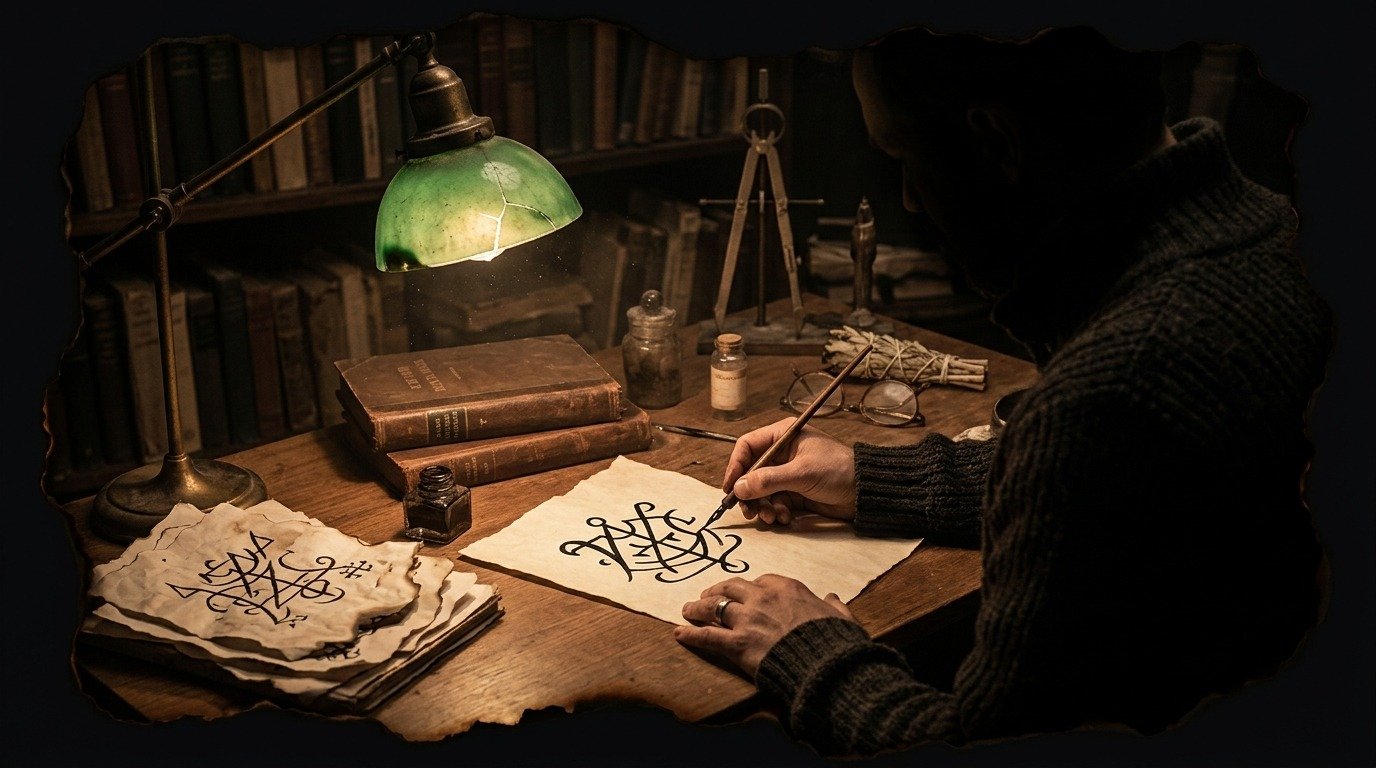
The practice is sustained by three conceptual pillars that dispense with established dogmas: 1. **Gnosis**: an altered state of consciousness in which the analytical mind and the conscious censor are temporarily shut down. It is reached through excitatory pathways (extreme physical activity, hyperventilation, pain, orgasm, rhythmic music) or inhibitory pathways (deep meditation, sensory deprivation, silent contemplation). All magical work is executed within this state. 2. **Sigils**: desires that are explicitly written down, simplified by removing repeated letters until they form an abstract glyph, and then charged in the subconscious mind during the state of gnosis. Once charged, the sigil must be forgotten immediately to allow the subconscious to work without the interference of conscious desire. 3. **Servitors**: artificial entities created from the magician's own psychic energy to perform a specific task on the subtle plane. In this system, the chaos magician is free to use representations of ancient deities, comic book characters, scientific concepts, or abstract symbols, since the power resides in the focus of the operator themselves and not in the object or the entity invoked.
Origin and History
Chaos magic emerged in the late 1970s in Yorkshire, England. It was developed by Peter J. Carroll and Ray Sherwin, who were dissatisfied with the elitism, material expenses, and rigidity of the rituals of ceremonial magic of the time. Both sought to isolate the basic psychological mechanisms that make magic work and to eliminate the Victorian trappings of the Golden Dawn. To achieve this, they drew directly upon the work of the English painter and esotericist Austin Osman Spare, who in the early 20th century created the method of rapid sigilization and the "death posture" as fast tracks to the subconscious. In 1978, Carroll and Sherwin founded the Illuminates of Thanateros (IOT), the first chaos magic order to formalize these practices.
Key Figures
- **Austin Osman Spare**: the artistic and intellectual precursor whose theories on the subconscious and sigils laid the technical foundations of the system. - **Peter J. Carroll**: author of *Liber Null & Psychonaut*, the foundational works that theoretically and formally structured chaos magic. - **Phil Hine**: writer who popularized the current through accessible texts and practical approaches focused on daily life. - **Grant Morrison**: comic book writer who incorporated the principles of chaos into popular works like *The Invisibles*, popularizing the use of sigils on a massive scale.
How It Is Understood Today
Chaos magic is the most widespread current in the esoteric community born in the digital age. Its flexibility and lack of hierarchies make it compatible with contemporary culture and skepticism. Modern psychology and cultural studies consider it a postmodern expression of magic, where the individual detaches themselves from traditional religious institutions to self-manage their own spirituality in a direct and instrumental way.
Connections
Chaos magic is linked to the work of Austin Osman Spare, Discordianism, scientific skepticism, and mass pop culture.
Comments
Share information, an experience, or a source to help enrich this entry. They are automatically reviewed before being published.
Loading comments...