Aleister Crowley
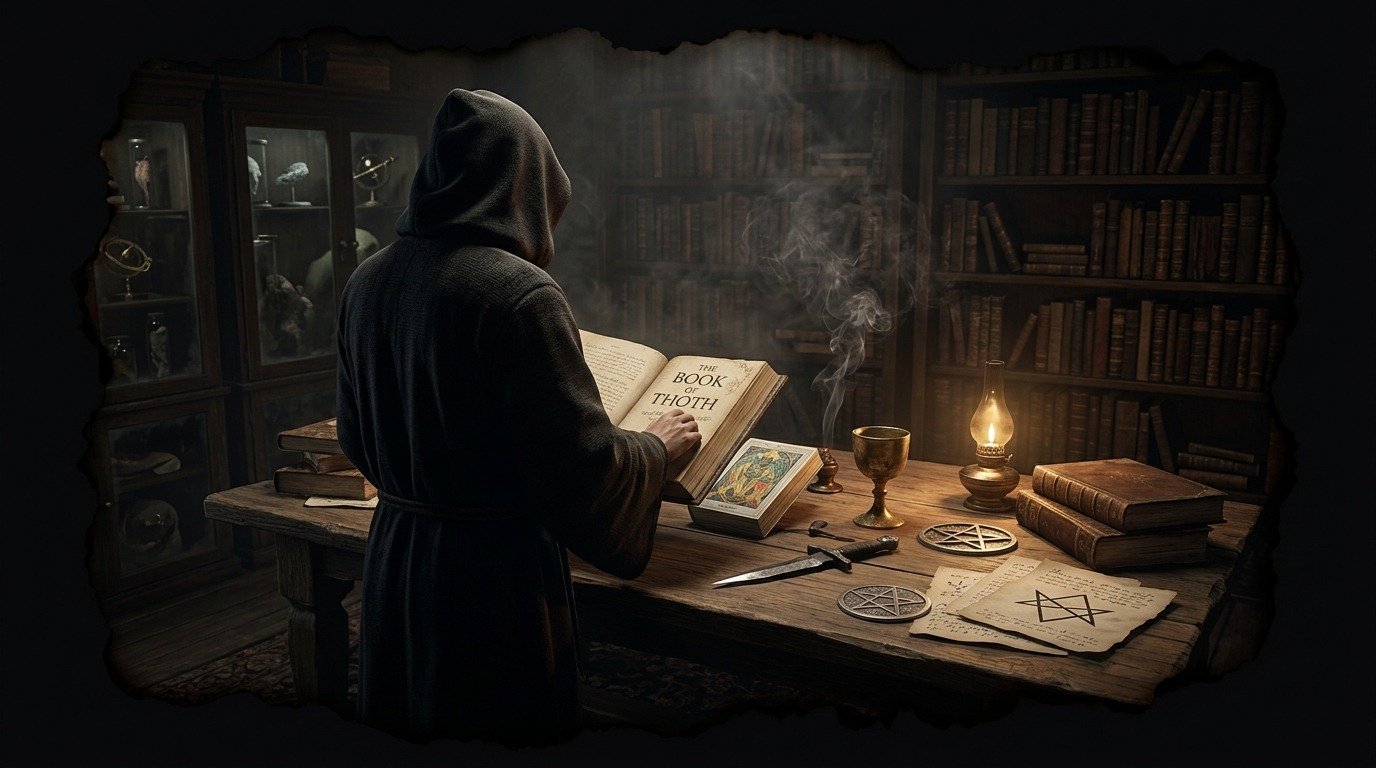
Aleister Crowley: The Magician Who Defied the 20th Century
Who Was the Occultist of the Will
Aleister Crowley is the most influential figure in 20th-century Western occultism. Founder of the philosophical and spiritual movement of Thelema, reformer of the Ordo Templi Orientis (O.T.O.), and member of the Hermetic Order of the Golden Dawn (Hermetic Order of the Golden Dawn), he redefined the practice of ceremonial magic. His approach integrated the European esoteric tradition with Eastern mysticism, yoga, and a rigorous methodological focus that he termed "scientific illuminism."
Career and Historical Facts
Edward Alexander Crowley was born on October 12, 1875, in Warwickshire, England, into a wealthy family belonging to the Plymouth Brethren, a strict Christian sect. He inherited a fortune that allowed him to finance his travels, publications, and mountaineering expeditions through the Himalayas and Mexico. He studied at Trinity College, Cambridge, where he began publishing poetry and became interested in esotericism. In 1898, he entered the Golden Dawn under the initiatory name of Frater Perdurabo. There, he trained under the tutelage of Samuel Liddell MacGregor Mathers, but internal disputes over control of the order led to his departure and the subsequent fragmentation of the group. In April 1904, during a trip to Cairo with his wife Rose Kelly, Crowley experienced the founding milestone of his doctrine. He claimed to have received the oral transmission of an incorporeal entity named Aiwass, a messenger of the Egyptian god Horus. The resulting text, written over three days, was *The Book of the Law* (*Liber AL vel Legis*). In 1907, he founded the esoteric order A∴A∴ (Astrum Argentum) to teach his own system of magical and mystical training. In 1912, he assumed the leadership of the British section of the Ordo Templi Orientis (O.T.O.), a Masonic order of German origin that he completely restructured to focus on sexual magic practices. In 1920, he founded the Abbey of Thelema in Cefalù, Sicily, a spiritual commune based on his teachings that operated until 1923, when the fascist government of Benito Mussolini expelled him from the country. Crowley spent his final decades writing, battling his heroin addiction, and managing his meager resources. He died in Hastings, England, on December 1, 1947.
Doctrine and Magical Work
The core of Crowley's doctrine is Thelema, a Greek term meaning "will." The central precept of this system is: "Do what thou wilt shall be the whole of the Law," complemented by "Love is the law, love under will." In Thelemic philosophy, this does not represent a call to capricious hedonism, but rather the obligation to discover and execute one's "True Will," described as the individual cosmic purpose and the real destiny of each human being in the universe. Crowley coined the term *Magick* (adding the letter "k" to differentiate esotericism from stage magic) and defined it as "the science and art of causing change to occur in conformity with Will." His system unified the Hermetic Qabalah, the tarot, astrology, the invocation of spiritual intelligences, and Buddhist meditation. His written production is vast and systematic. His major works are: * *Magick in Theory and Practice* (Magic in Theory and Practice): the treatise where he expounds the logical foundations and operative laws of esoteric ritual. * *The Book of Thoth*: a reinterpretation of the Tarot that he designed alongside artist Frieda Harris, embodying a complex geometric and alchemical symbology. * *Liber 777*: a dictionary of mystical correspondences linking pantheons, metals, plants, and colors to the Kabbalistic Tree of Life.
Legends and Historical Realities
Crowley adopted for himself the epithet of "The Great Beast 666," a name his evangelical mother gave him in childhood and which he used to scandalize conservative Victorian society. The British press labeled him "the wickedest man in the world." Popular legend attributes to him child sacrifices and making pacts with demons of popular culture. Historically, these claims lack any foundation. His writings on "sacrifices" were purely symbolic in nature and referred to the transmutation of vital energy or the sacrifice of the ego itself on the altar of spiritual practice. His expulsion from Italy in 1923 was not due to ritual crimes, but rather to a media campaign following the death of an abbey member, Raoul Loveday, who died from drinking contaminated water from a local well, against Crowley's express warning.
Legacy and Contemporary Influence
Crowley's impact transcends occultism. His deck, the Thoth Tarot, is one of the three most studied and used decks in contemporary cartomancy. His definition of magic directly influenced the emergence of chaos magic in the 1970s and the liturgical structure of Wicca, whose founder, Gerald Gardner, used Crowley's texts to draft his first rituals. In the realm of popular culture, his figure notably influenced rock music and 20th-century art. The Beatles included his face on the cover of *Sgt. Pepper's Lonely Hearts Club Band*, Jimmy Page (guitarist of Led Zeppelin) collected his manuscripts and purchased his former residence of Boleskine House in Scotland, and artists like David Bowie, Ozzy Osbourne, and Marilyn Manson have made direct reference to his work and aesthetics in their creations.
Comments
Share information, an experience, or a source to help enrich this entry. They are automatically reviewed before being published.
Loading comments...