Eliphas Lévi
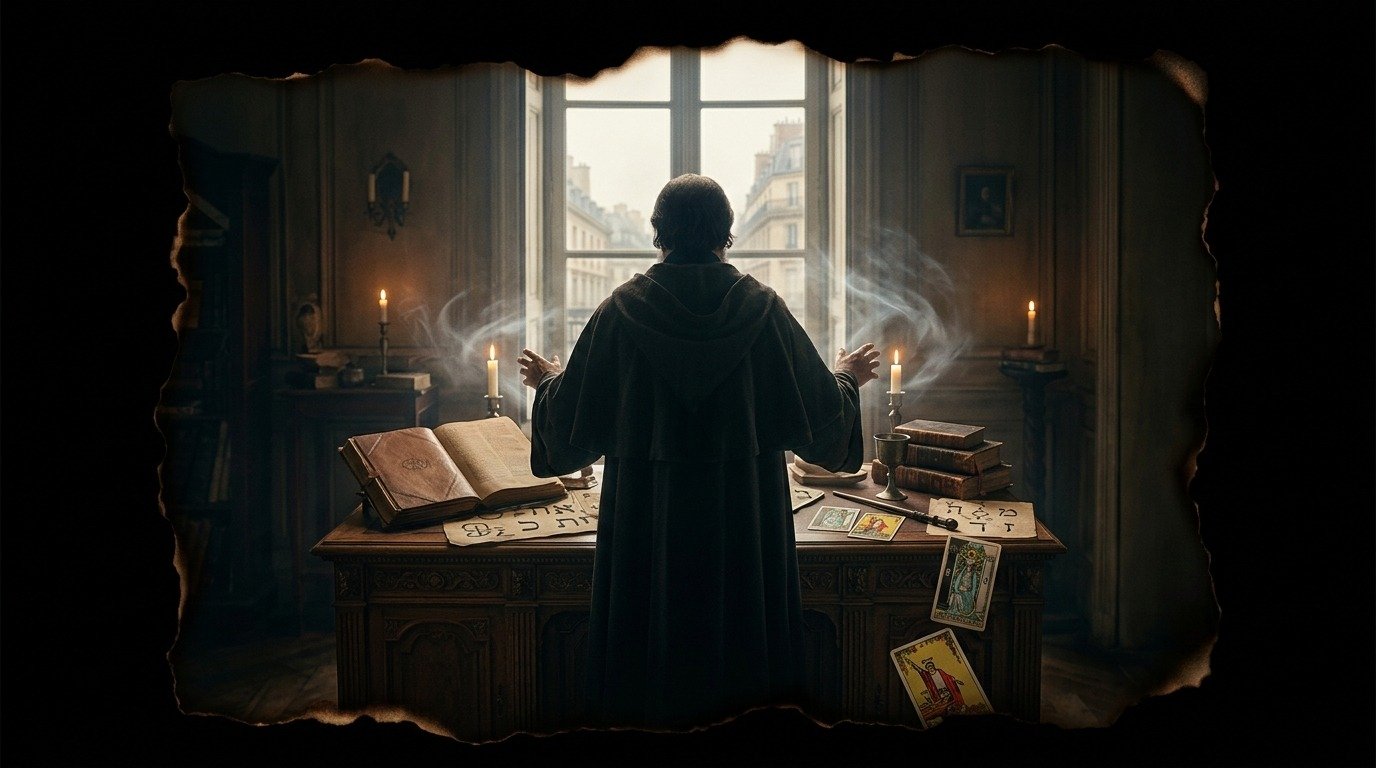
Eliphas Lévi: The Architect of the 19th-Century Occult Revival
Who He Was
Eliphas Lévi, the pseudonym of Alphonse Louis Constant, was the most influential French occultist, ceremonial magician, and author of the 19th century. His work unified for the first time disciplines that were previously studied separately: ceremonial magic, the Tarot, Kabbalah, alchemy, and magnetism. His work gave rise to the movement known as the "French Occult Revival."
Life
He was born on February 8, 1810, in Paris, into a humble family. Guided toward the priesthood due to his intelligence and devotion, he entered the seminary of Saint-Sulpice, where he was eventually ordained as a deacon. However, he left the seminary in 1836 before receiving priestly ordination due to theological doubts and a youthful infatuation. During the 1830s and 1840s, Constant dedicated himself to political journalism, literature, and utopian socialism, writing radical pamphlets under his real name that cost him several months in prison. In parallel, he immersed himself in the study of the works of Emanuel Swedenborg, the Kabbalah, and the doctrines of Louis-Claude de Saint-Martin. In 1854, he adopted the name Eliphas Lévi (an approximate translation of his real name into Hebrew) and published his masterpiece: *Dogme et Rituel de la Haute Magie* (*Dogma and Ritual of High Magic*), a book structured in twenty-two chapters corresponding to the twenty-two Major Arcana of the Tarot. This work was followed by fundamental texts such as *Histoire de la Magie* (1860) and *La Clef des Grands Mystères* (1861). He spent his final years teaching select disciples from all over Europe and passed away in Paris on May 31, 1875.
Doctrine and Magical Work
Lévi's great contribution was the systematization of occultism under a coherent philosophical framework. His main theories are summarized in three points: 1. **The astral light (Le grand agent magique):** Lévi defined the astral light as a universal, invisible, and plastic force that fills all space. It is the fluid that transmits the images of the mind and connects the magician's will with the material world. It corresponds to Franz Mesmer's concept of animal magnetism and the ether of the philosophers. 2. **The Tarot as a Kabbalistic key:** Lévi was the first to establish the direct correspondence between the twenty-two Major Arcana of the Tarot, the twenty-two letters of the Hebrew alphabet, and the paths of the Kabbalah's Tree of Life. He asserted that the Tarot was not a simple deck of cards for predicting the future, but a sacred book of universal keys containing all magical science. 3. **Human will:** The engine of the magical act is not the favor of demons or divine grace, but the trained will of the magician. Magic is "the direction of the force of the will through the astral light."
Legend and Controversies
Lévi is the creator of the graphic representation of Baphomet, the "Goat of Mendes," which appears in his book *Dogma and Ritual of High Magic*. Although Lévi designed this figure as a hermetic symbol of the union of opposites (male and female, human and animal, spiritual and material, with the words *Solve* and *Coagula* written on the arms), popular culture and conservative religious groups quickly misinterpreted it as a representation of the Devil or Satan, an association that persists to this day. In 1854, during a trip to London, Lévi claimed to have performed the evocation of the spirit of the Neoplatonic sage Apollonius of Tyana in the private temple of a British high-society lady. He described the experience in his books as physically exhausting, feeling extreme cold and observing an apparition wrapped in a shroud that vanished after answering his questions written on a piece of paper.
Legacy and Influence
The work of Eliphas Lévi is the foundation of modern magic. His texts directly influenced Albert Pike and his restructuring of the Ancient and Accepted Scottish Rite of Freemasonry in the United States. His theories on the Tarot and the Kabbalah were the basis for the founding of the Hermetic Order of the Golden Dawn in England. Aleister Crowley was born the same year as Lévi's death (1875) and publicly claimed to be the physical reincarnation of the French occultist, adopting many of his premises on the will and the astral light for the development of his esoteric system, Thelema.
Comments
Share information, an experience, or a source to help enrich this entry. They are automatically reviewed before being published.
Loading comments...