Count of Saint-Germain
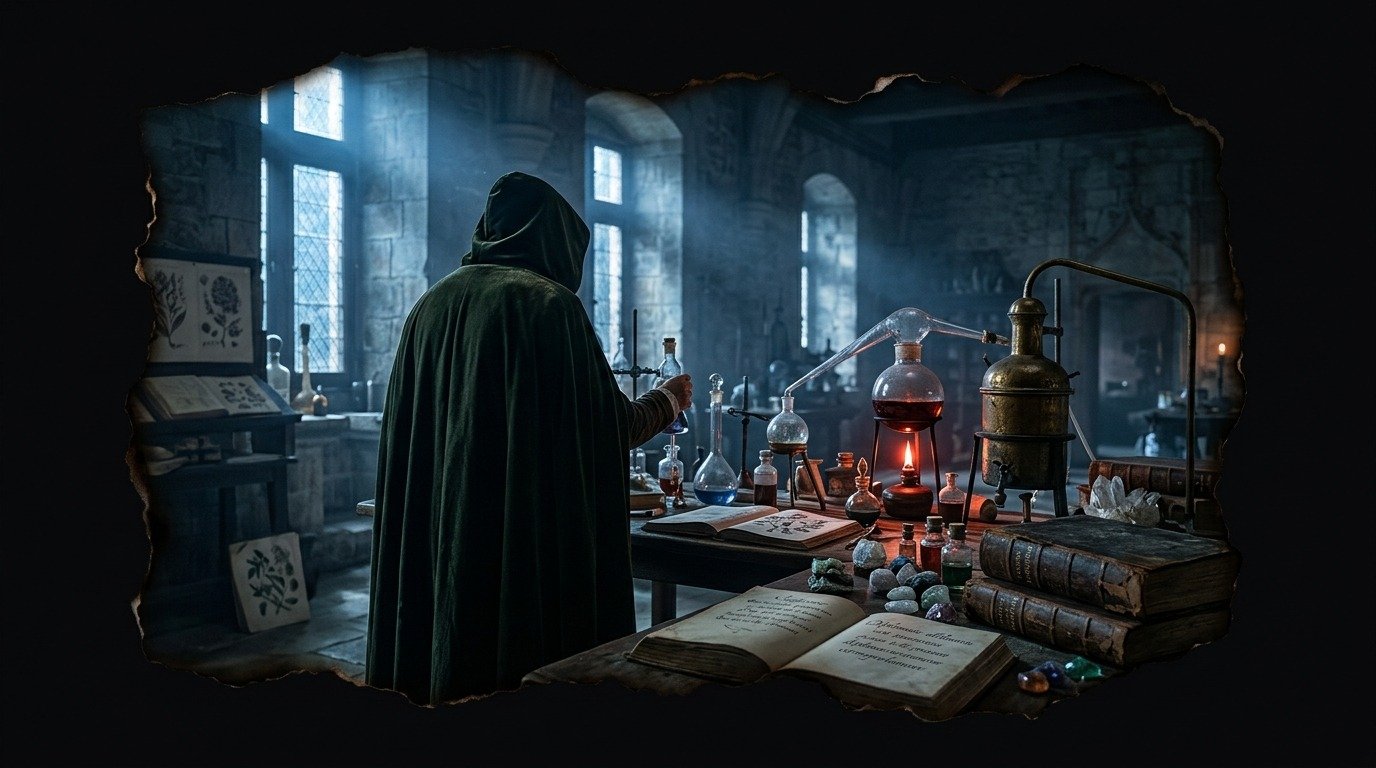
Count of Saint-Germain: the immortal alchemist and diplomat
Who he was
The Count of Saint-Germain was a courtly adventurer, diplomat, musician, and alchemist who frequented European royal courts during the 18th century. He was renowned for his vast erudition, his mastery of multiple languages, his skill in chemistry applied to jewelry and the creation of tinctures, and for the legend that he possessed the secret of longevity and the transmutation of metals.
Life and historical trajectory
The origins of Saint-Germain lack definitive official documentation, a void that he himself encouraged by adopting various identities. The most widespread hypothesis, supported by his protector Landgrave Charles of Hesse-Kassel, maintains that he was the son of Prince Francis II Rákóczi of Transylvania. He was first recorded in European high society in London in 1745, where he was arrested on suspicion of espionage in favor of the Jacobites and released shortly thereafter. There, he was already known as a talented violinist and composer. Between 1757 and 1760, he resided in Paris, winning the favor of King Louis XV and his favorite, Madame de Pompadour. The king assigned him an apartment and a laboratory at the Château de Chambord to conduct chemical and industrial research. In 1760, Louis XV sent him on a secret diplomatic mission to The Hague to negotiate peace between France and England, behind the back of the Minister of Foreign Affairs, the Duke of Choiseul. When the maneuver was discovered, Choiseul ordered his arrest, forcing Saint-Germain to flee to England. During the following two decades, his presence was recorded in Russia (some accounts link him to the circle that enthroned Catherine the Great in 1762), Italy, Saxony, and Prussia. In 1779, he settled in the Duchy of Schleswig under the protection of Charles of Hesse-Kassel, an enthusiast of alchemy and esotericism. Saint-Germain died in the quarters he occupied in the latter's castle, in Eckernförde, on February 27, 1784. His death certificate is recorded in the parish registers of Saint Nicolai Church in that town.
Esoteric doctrine and work
Saint-Germain did not found a formal mystical school nor did he publish treatises signed with his name during his lifetime. He is attributed with the authorship of *The Most Holy Trinosophia* (*La Très Sainte Trinosophie*), an 18th-century esoteric manuscript that combines alchemy, Kabbalah, and Masonic symbolism through a series of allegorical trials of spiritual initiation. His magical practice focused on operative and spiritual alchemy. In his laboratories, he conducted experiments for the purification of precious stones and the fixing of high-quality organic and inorganic dyes. On the spiritual side, he conceived matter as a vehicle for the manifestation of subtle energies and maintained that the physical body could be rejuvenated through the balance of internal fluids and the use of concentrated herbal elixirs.
Legends and controversies
Immortality is the core of the legend of Saint-Germain. At the court of Versailles, he himself fed this notion through ambiguous comments, suggesting he had conversed with historical figures such as Queen Cleopatra, the Queen of Sheba, or Pontius Pilate. His personal servant used to reply, when asked about the veracity of these encounters: "I cannot tell you, sir; I have only been serving the Count for three hundred years." The legend was reinforced by testimonies from contemporaries who claimed that the Count always appeared to be between forty and fifty years old, regardless of the passing of decades. Madame d'Adhémar, in her memoirs, claimed to have seen Saint-Germain in 1789, five years after his official death, and again in 1815 and 1821, always showing the same physical appearance of his maturity. Historians attribute these later appearances to impostors using his name, intelligence agents using his identity as a cover, or confusion with other nobles of similar features. His ability to transmute base metals into gold and to remove impurities from diamonds through chemical processes was dismissed by his detractors, such as the philosopher Voltaire or the adventurer Giacomo Casanova, as a well-executed trick of illusionism and charlatanry.
Legacy and influence
At the end of the 19th century, Theosophy incorporated Saint-Germain into its list of Masters of Wisdom. Later, theosophists Charles Leadbeater and Annie Besant positioned him as the Master of the Seventh Ray, and the "I AM" movement attributed the Violet Flame of transmutation to him. In the 1930s, Guy Ballard founded the "I AM" movement, centered on the channelings of Saint-Germain as an Ascended Master, a doctrine that continued to expand through groups such as Elizabeth Clare Prophet's Church Universal and Triumphant. His figure remains the archetype of the immortal sage in modern occultism.
Comments
Share information, an experience, or a source to help enrich this entry. They are automatically reviewed before being published.
Loading comments...