Helena Blavatsky
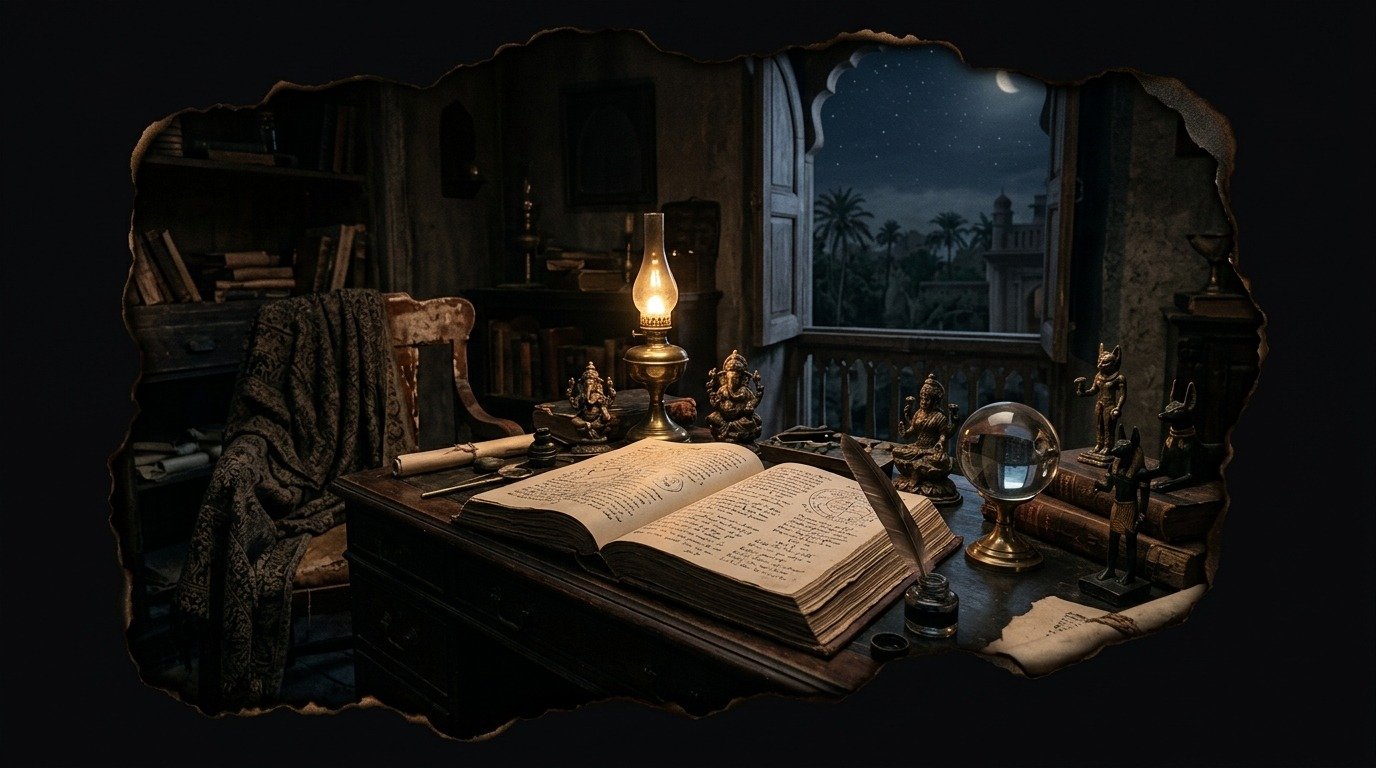
Helena Blavatsky: The Founder of Modern Theosophy
Who She Was
Helena Petrovna Blavatsky was a Russian writer, occultist, and traveler, co-founder of the Theosophical Society in 1875. She is the central figure of nineteenth-century esotericism. Her work unified Western Hermetic traditions with Eastern philosophies, primarily Hinduism and Buddhism, and laid the conceptual foundations of contemporary occultism and the New Age movement.
Life and Historical Trajectory
Helena von Hahn was born in Yekaterinoslav (now Dnipro, Ukraine) on August 12, 1831, into a Russian aristocratic family. At seventeen, she married the vice-governor of Yerevan province, Nikifor Blavatsky, whom she abandoned a few months later. Beginning in 1849, she embarked on a twenty-five-year period of travel through Egypt, Greece, Canada, Mexico, South America, India, and Tibet. In 1873, she arrived in New York. There, she met Colonel Henry Steel Olcott and attorney William Quan Judge. Together with them, she founded the Theosophical Society on November 17, 1875. Two years later, she published her first major work, *Isis Unveiled* (1877), a critical analysis of the science and religion of her era in the light of ancient wisdom. In 1879, Blavatsky and Olcott moved the Society's headquarters to India, finally settling in Adyar, near Madras, in 1882. During this period, Blavatsky began to manifest physical phenomena and to receive correspondence from incorporeal intelligences. In 1885, following accusations of fraud and political tensions in British India, she returned to Europe. She settled in London, where she wrote her magnum opus, *The Secret Doctrine* (1888), and founded the magazine *Lucifer*. She passed away in London on May 8, 1891, due to a severe flu combined with heart and kidney ailments.
Doctrine and Magical Work
The doctrine of Blavatsky, called Theosophy (from the Greek *theos*, god, and *sophia*, wisdom), postulates the existence of a single truth underlying all the world's religions and sciences. This doctrine is based on three fundamental propositions: 1. **An Omnipresent and Infinite Principle**: An absolute reality that transcends human comprehension and from which everything in existence emanates. 2. **The Eternity of the Universe**: The cosmos operates under the law of periodicity, alternating cycles of activity (manvantaras) and absolute rest (pralayas). 3. **The Identity of Souls with the Universal Soul**: Each human soul performs an obligatory pilgrimage through cycles of incarnation (reincarnation) governed by the law of cause and effect (karma). Blavatsky introduced to the West the idea of the Masters of Wisdom or Mahatmas: highly evolved human beings who guard humanity's esoteric knowledge and guide its spiritual evolution. Her writings maintain that humanity evolves through seven "root races," of which the current one is the fifth; among the previous ones, she places the Hyperboreans, Lemurians, and Atlanteans.
Legends and Controversies
Blavatsky's life is surrounded by debates regarding the truthfulness of her claims. The point of greatest conflict occurred in 1884 with the "Coulomb Case." Emma Coulomb, an employee at the Adyar headquarters, accused Blavatsky of forging letters attributed to the Masters and of simulating psychic phenomena through secret passages and double panels in her room. The Society for Psychical Research (SPR) of London sent Richard Hodgson to investigate the case. The *Hodgson Report* (1885) concluded that Blavatsky was an impostor and one of the most accomplished liars in history. In 1986, the same SPR published a re-analysis of the Hodgson report written by Vernon Harrison, who concluded that the original 1885 investigation lacked impartiality, scientific method, and technical rigor, declaring that the accusations of fraud were unproven. Regarding her travels, her seven-year stay in Tibet and her initiation in the monasteries of Shigatse are questioned by historians due to the lack of official customs records and the difficulty of access for foreigners at that time. However, defenders of her work highlight her profound knowledge of Tibetan geography and esoteric Buddhism, which was inaccessible to Western scholars of her time.
Legacy and Influence
Blavatsky's impact transformed the cultural and spiritual thought of the West. Her work facilitated the arrival of Eastern philosophies in Europe and America. The Theosophical Society gave rise to numerous offshoots, such as Rudolf Steiner's Anthroposophy and Alice Bailey's Arcane School. Her cosmology directly influenced avant-garde artists such as Wassily Kandinsky, Piet Mondrian, and the composer Alexander Scriabin, as well as scientists of the caliber of Thomas Edison, who was a member of the Theosophical Society. Today, the Theosophical Society maintains active headquarters in more than fifty countries, preserving the literature and teachings of its founder.
Comments
Share information, an experience, or a source to help enrich this entry. They are automatically reviewed before being published.
Loading comments...