Paracelsus
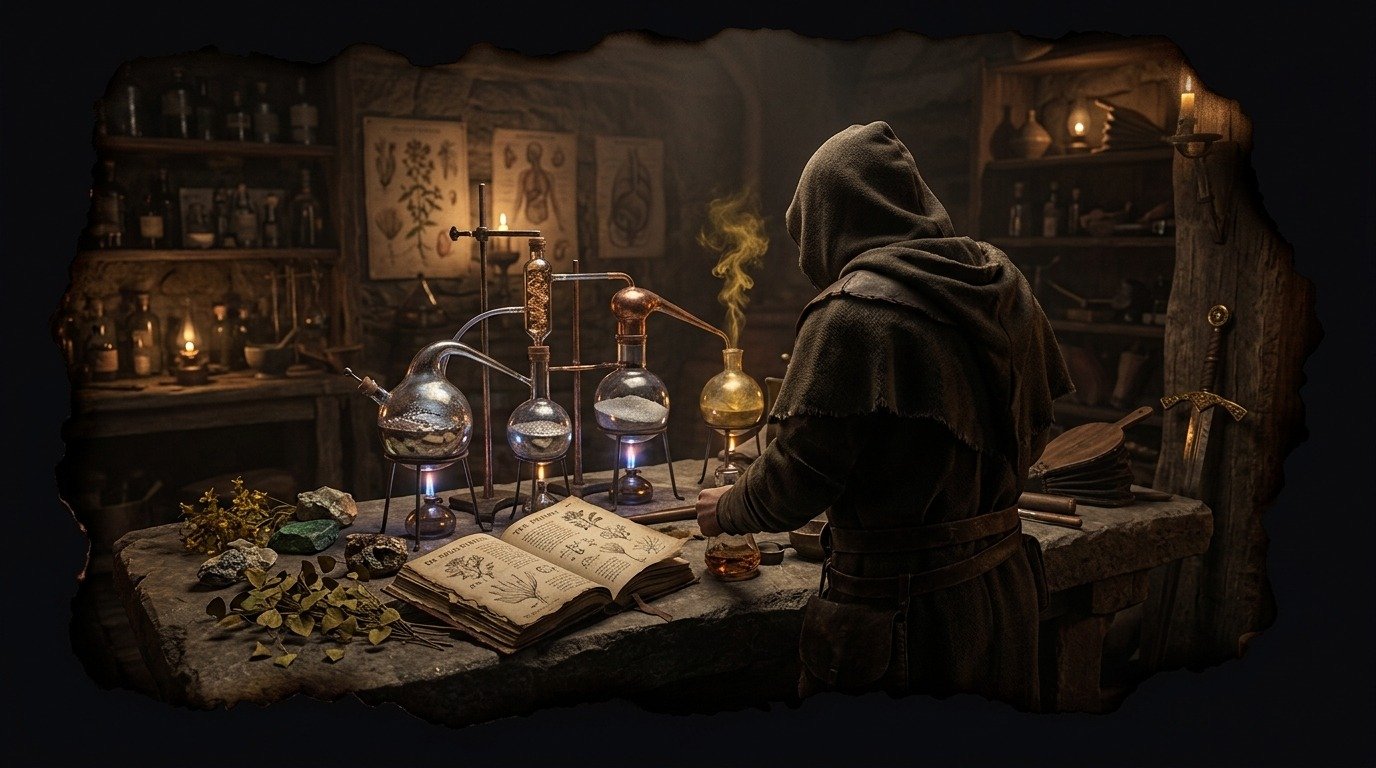
Paracelsus: The Reformer of Medicine and the Alchemy of Nature
Who He Was
Philippus Aureolus Theophrastus Bombastus von Hohenheim, known as Paracelsus, was a Swiss physician, alchemist, and astrologer. His pseudonym means "greater than Celsus," in reference to the celebrated Roman physician of the first century. Paracelsus revolutionized Western medicine by rejecting traditional academic orthodoxy and introducing the use of chemical substances and minerals in therapeutic treatments, integrating practical alchemy with medical healing.
Life
He was born on November 10, 1493, in Egg, near Einsiedeln, Switzerland. The son of a physician and chemist, he learned the basics of mineralogy and medicine from childhood. He studied at the University of Ferrara, where he received his doctorate in medicine. Dissatisfied with the purely theoretical teaching of the universities, he undertook a journey of nearly twelve years through Europe, Russia, and Egypt, learning from local physicians, healers, miners, and alchemists. In 1526 he returned to Strasbourg, and in 1527 he was appointed municipal physician of Basel and professor of medicine. His combative temperament and heterodox methods generated immediate rejection from the faculty. In an act of public protest, he threw a copy of Avicenna's *Canon* into the St. John's bonfire and began to teach his classes in German instead of Latin, which led to his expulsion from Basel. He spent the rest of his life as an itinerant wanderer, writing his medical and philosophical treatises. He passed away on September 24, 1541, in Salzburg, Austria.
Doctrine and Magical Work
The doctrine of Paracelsus is based on the intimate connection between the human being (microcosm) and the universe (macrocosm). For him, illness is not the result of an imbalance of the four bodily humors (the dominant Galenic theory), but rather the intrusion of external forces into the body that disrupt its natural harmony. His key concepts are: 1. **Spagyria (Spagyrics):** A term derived from the Greek *spao* (to separate) and *ageiro* (to bind). It is the application of alchemy to the preparation of medicines. It consists of extracting the healing virtues of plants and minerals through processes of fermentation, distillation, and incineration, eliminating physical impurities to release their spiritual essence. 2. **The Tria Prima (The Three Principles):** Paracelsus added a third principle to the traditional alchemical duality of sulfur and mercury. He postulated that all matter is composed of: * **Sulfur (Sulphur):** The principle of combustion, the soul, and growth. * **Mercury (Mercurius):** The principle of volatility, the spirit, and transformation. * **Salt (Sal):** The principle of solidity, fixity, the physical body, and cohesion. 3. **The Doctrine of Signatures:** He held that nature imprints visual signs on plants and minerals to indicate their therapeutic usefulness. For example, a plant with heart-shaped leaves possesses specific properties for treating heart ailments. 4. **The Archeus:** The vital force or "inner alchemist" that resides in the human stomach and is responsible for separating nutrients from toxins in food.
Legend and Controversies
Popular legend claims that Paracelsus carried in the pommel of his sword a fragment of the Philosopher's Stone or the "Azoth," a universal elixir that granted him youth and the power to cure any ailment. He was also credited with the ability to create a homunculus, a tiny human being artificially generated in a flask through alchemical processes using bodily fluids. Historically, his life was marked by constant lawsuits and disputes with pharmacists and academic physicians, who accused him of quackery due to his direct language, his contempt for traditional academic authority, and his defense of the folk wisdom of midwives and barber-surgeons.
Legacy and Influence
Paracelsus is considered the father of modern toxicology and of iatrochemistry (the precursor to chemical pharmacology). His insistence on observing nature directly instead of blindly trusting ancient texts laid the foundation for the scientific method in medicine. On the esoteric plane, his thought deeply influenced the Rosicrucian Manifestos of the 17th century and the homeopathy of Samuel Hahnemann. His figure remains the archetype of the physician-mage who seeks the integral healing of body and spirit through the occult laws of nature.
Comments
Share information, an experience, or a source to help enrich this entry. They are automatically reviewed before being published.
Loading comments...