Grand Grimoire
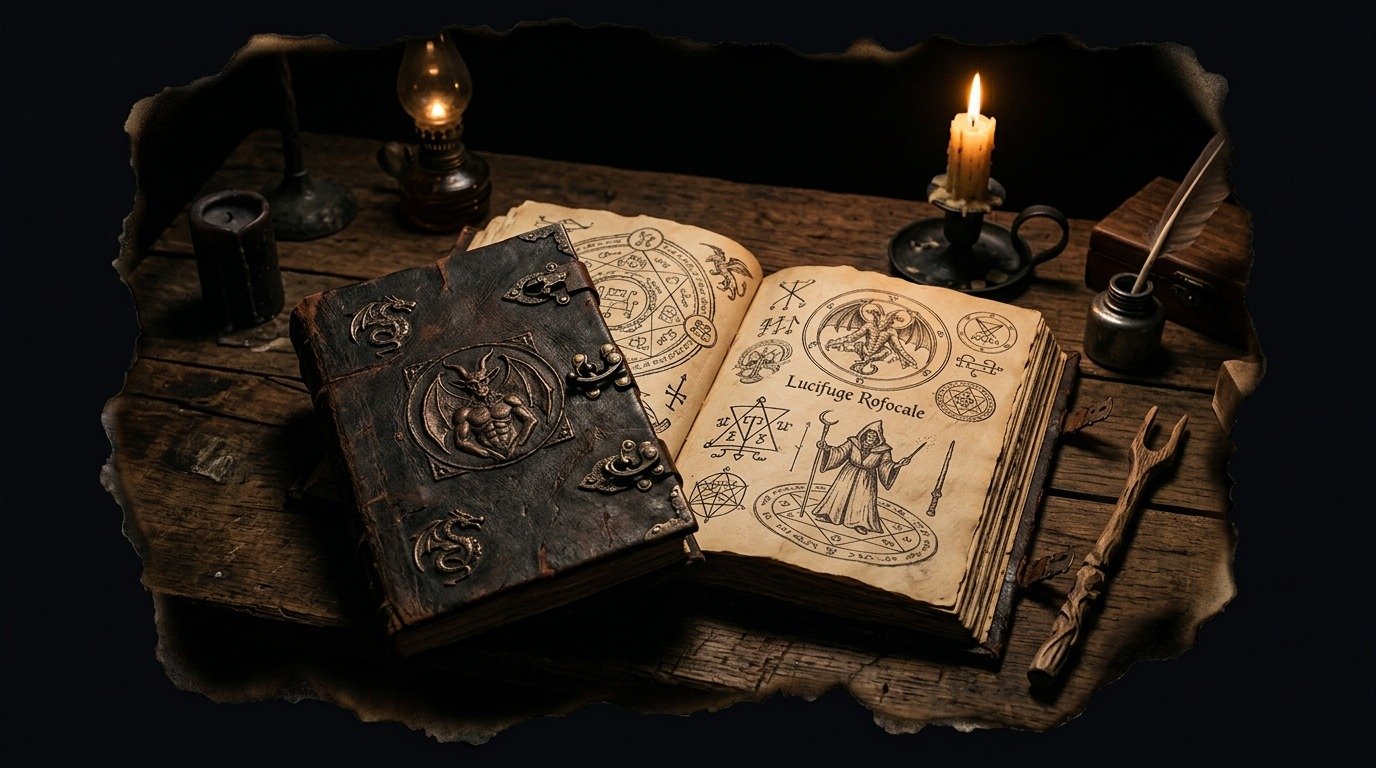
Grand Grimoire: The Absolute Pact with the Red Dragon
The Grand Grimoire, also known by its subtitle *The Red Dragon*, is classified by occultists as the most dangerous book of black magic ever printed. Its universal notoriety is due to a single and terrifying objective: to teach the reader how to summon Lucifuge Rofocale, the prime minister of Hell, to force a pact surrendering one's soul in exchange for limitless wealth and longevity. Its text is feared because it describes with surgical precision a ritual of direct subjugation where the magician risks their sanity and eternal salvation with every spoken word.
The Pact of the Blasting Rod
The heart of the Grand Grimoire is the ritual of the pact. Unlike other manuals that suggest a passive submission to the forces of evil, this book demands that the operator adopt a posture of violent domination. The magician must venture into a solitary place carrying the "Blasting Rod", a wild hazel fork cut at a specific astrological moment, which serves to threaten and punish the spirits if they refuse to obey.
The text details the exact dialogue that the summoner must maintain with Lucifuge Rofocale. When the demon emerges demanding the magician's body and soul after a twenty-year term, the grimoire instructs the operator on how to haggle over the conditions, offering in exchange annual services and the care of a black animal, delaying the final surrender of the soul. The Grand Grimoire also contains the summoning sigils, the design of the protective magic circle, and formulas for healing, the transmutation of metals, and searching for buried treasures using dowsing rods.
The Myth of the Year 1521 and the French Printing Presses
The Grand Grimoire claims to have been published in 1521 and written by a figure named Antonio Venitiana del Rabina, who allegedly compiled the writings of King Solomon himself. However, there are no records of any edition of this book prior to the 19th century.
The book actually originated in clandestine French printing presses of the early 1800s. It was cheap literature aimed at a rural public that yearned for magical solutions to their poverty. The anonymous compiler merged elements of medieval folklore, fragments of inverted Catholic exorcisms, and the mythology of Faustian pacts to create a highly attractive publishing product, wrapped in a language that mixed corrupt ecclesiastical Latin with direct instructions in French.
The Forbidden Grimoire of the Vatican and Its Trail of Mystery
The black legend of the Grand Grimoire claims that the original manuscript, written on animal skin and with blood ink, is kept under lock and key in the secret archives of the Vatican Apostolic Library, where it is kept out of humanity's reach to prevent it from unleashing spiritual catastrophes. Although the Vatican has never confirmed the existence of such a manuscript, popular belief has fueled the myth of its intrinsic danger for generations.
During the 19th and 20th centuries, the book traveled throughout the French-speaking world. In the Caribbean, especially in Haiti, translations of *The Red Dragon* were adopted by practitioners of local sorcery (*Makandal* and *Bizango*), who saw in the engravings of Lucifuge Rofocale and the methods of summoning a way to channel the most aggressive spirits of their pantheon (*the Petro*). For these practitioners, the book was not a literary fantasy, but a tool of real and lethal power.
The Red Dragon Today
Antique copies of the 19th-century printed editions of the Grand Grimoire are preserved today in the National Library of France and in private esoteric collections in Europe and the United States. These copies show the famous engraving of the demon with horns, goat hooves, and a body covered in scales, an image that has defined the popular representation of the devil in modern culture.
The Grand Grimoire continues to exert a magnetic fascination over those who seek the limits of human experience. Its pages continue to be read with fearful respect, as they represent the definitive document of man's greatest ambition: the promise of buying the entire world at the cost of losing, forever, one's own soul.
Comments
Share information, an experience, or a source to help enrich this entry. They are automatically reviewed before being published.
Loading comments...