Picatrix
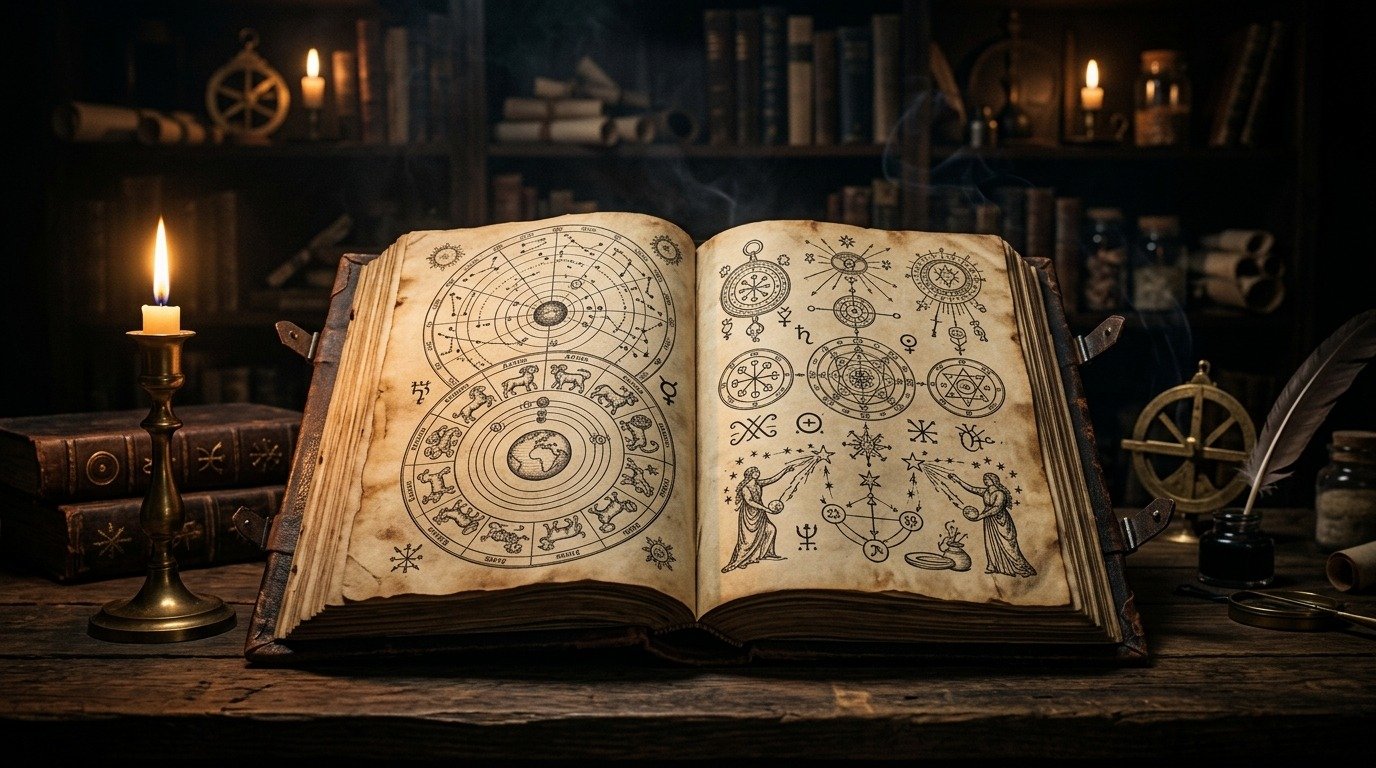
Picatrix: The Power of the Stars Manifested on Earth
The Picatrix is the most celebrated treatise on astral magic and talismans of the Middle Ages. This voluminous manuscript, translated into Castilian and Latin at the court of King Alfonso X the Wise in the 13th century, compiles the secrets of hermetic astrology from the Arab world. Its content is famous and feared for its detailed alchemical recipes, which require mixing grotesque ingredients such as blood, urine, and animal brains under precise celestial configurations, with the aim of channeling the energy of the cosmos to manipulate people's minds, gain political power, and predict the future.
The Union of the Mind and the Firmament
The Picatrix is presented as a monumental encyclopedia divided into four books that address the philosophy of the universe and magical practice. Its central theory holds that the entire cosmos is interconnected by invisible threads of energy that flow from the Creator, pass through the stars and planets, and end on the terrestrial plane. The magician is the one who knows how to intercept this energetic flow and trap it in a physical object: the talisman.
To successfully craft a talisman, the book details that it is not enough to engrave an image on stone or metal; the operation must be performed at the exact minute when the beneficial planets are in the proper astrological position. The text includes extensive lists of planetary correspondences, incenses, colors, and conjurations directed to the spirits of the celestial spheres. However, the most disturbing part of the Picatrix lies in its practical recipes for creating illusions and altering wills, which involve the burning of human hair, the distillation of plant poisons, and the use of bodily fluids intended to imbue the amulets with a primitive and obedient life force.
From Baghdad to the Court of Castile
The origin of the Picatrix lies in the 11th century, within the flourishing scientific and intellectual environment of al-Andalus (Islamic Spain). Its original Arabic title is *Ghayat al-Hakim* (The Goal of the Wise), and its authorship has traditionally been attributed to the astronomer and mathematician Maslama al-Mayriti, although subsequent research suggests it was written by an anonymous scholar from the Sufi mystical school or the Sages of Harran.
In the year 1256, King Alfonso X of Castile ordered the translation of the Arabic text into Castilian and, subsequently, into Latin. It was in this Latin translation that the title was corrupted to become *Picatrix*, a name that Renaissance scholars quickly associated with a mysterious Eastern philosopher. The court of Alfonso X, a beacon of knowledge that united Jewish, Christian, and Islamic scholars, saved this work from destruction and delivered it to medieval Europe.
The Engine of the Occult Renaissance
During the Renaissance, the Picatrix became clandestine yet essential reading for great European thinkers. Philosophers of the stature of Marsilio Ficino, Giovanni Pico della Mirandola, and Giordano Bruno studied the manuscript in secret. Through it, they attempted to purify astral magic, stripping it of its darkest and most ritualistic elements to integrate it into a humanist philosophy of the universe.
However, for the Catholic Church, the Picatrix was a book of necromancy and demonic worship disguised as stellar science. The fact that the text instructed the reader on how to pray to and invoke the planets as if they were independent divinities constituted a flagrant heresy. Those who owned the Picatrix risked ecclesiastical condemnation, forcing Latin copies to circulate exclusively in unsigned manuscripts and within the networks of Europe's most closed hermetic societies.
The Rebirth of Astrological Knowledge
Today, the medieval Latin manuscripts of the Picatrix are preserved in highly prestigious institutions, such as the British Library in London, the Yale University Library, and the Bibliothèque de l'Arsenal in Paris. The original Arabic text, *Ghayat al-Hakim*, is kept in the Berlin State Library.
The Picatrix has ceased to be considered a simple recipe book of bizarre superstitions and is now recognized as a fundamental link in the history of Western science. Its pages represent the moment when astronomy, medicine, chemistry, and philosophy united into a single body of knowledge, demonstrating the audacity of an era in which scholars believed that human destiny was not unalterably written in the sky, but could be shaped by the hands of a man who knew how to read the stars.
Comments
Share information, an experience, or a source to help enrich this entry. They are automatically reviewed before being published.
Loading comments...