Aim
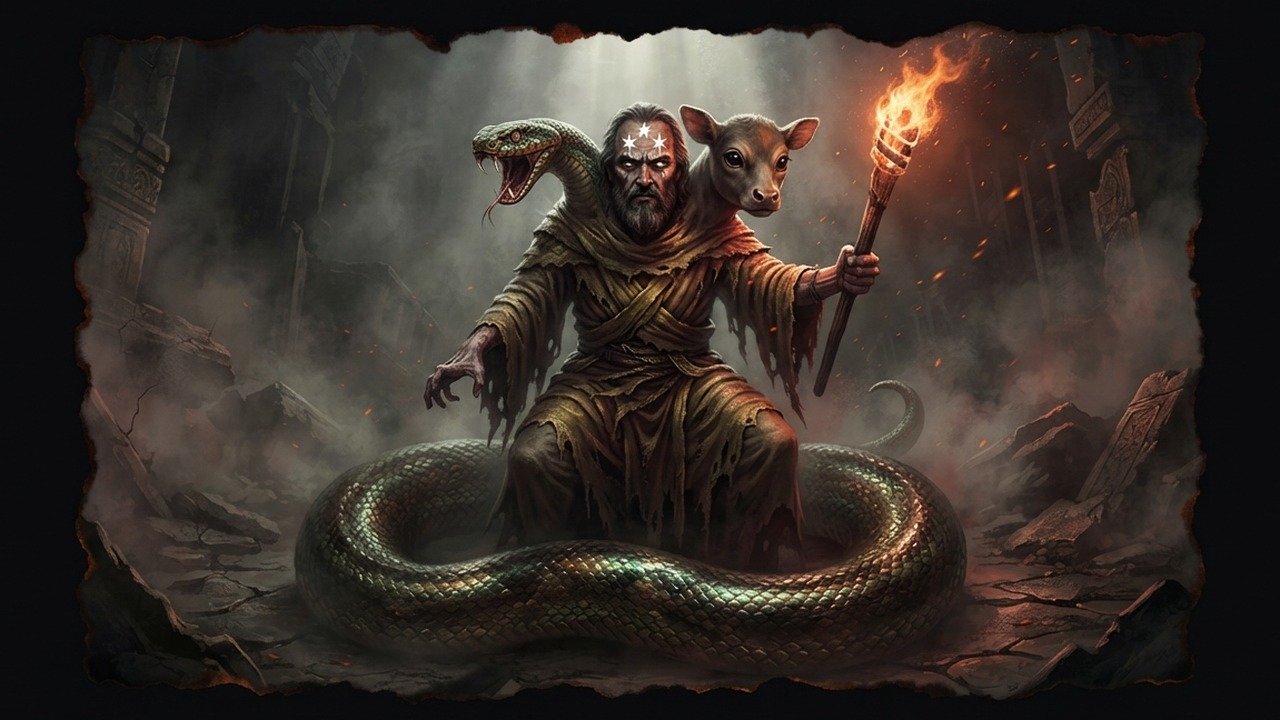
Aim
The Fire of Destructive Creativity and the Incendiary Intellect
1. Origin and Legend
Aim (also known as Aym or Haborym) has his origins in the ancient fire cults and the deification of the telluric-volcanic forces of the Canaan and Anatolia region. Originally, he embodied the primal fire that consumes to cleanse, the scorching aspect of the desert sun, and the divine spark that destroys obsolete structures. Historically visualized as a man of imposing body with three heads—one of a serpent, one of a man with two stars on his forehead, and one of a cat (or calf)—riding a viper and carrying a lit torch, Aim synthesizes occult cunning (serpent), the Illuminated intellect (man), and the agility of the shadow (cat).
2. Historical Evolution
Relegated in the Lemegeton to the rank of Great Duke of Hell in command of twenty-six legions, Aim was cataloged by the medieval Inquisition as a purely destructive spirit, an incendiary demon of cities and fortresses. However, deeper esotericists understood that the "cities" Aim burns are not always made of stone, but are mental fortresses, illusions, and dogmas. His lit torch came to be interpreted in nineteenth-century occultism as the fire of Promethean illumination, the torch of the rebellious intellect that burns away ignorance.
3. Esoteric Significance
Aim is the archetype of Incendiary Creativity, Cunning Intelligence, and the Spark of Genius. The two stars on his human forehead symbolize double illumination: knowledge of the macrocosm and the microcosm. The serpent and the cat represent cunning intuition and the survival instinct. In internal alchemy, Aim presides over the stage of Calcinatio: the burning of the dross of the ego through the fire of sovereign will and a sharp intellect. He is the force that allows the individual to think with strategic cunning in situations of extreme oppression.
4. Practice and Manifestation
Aim's manifestation is warm, intense, and mentally stimulating. It is perceived as an increase in body temperature, an inexhaustible torrent of brilliant ideas, or an urgent need to destroy old life patterns to build something new. He acts by igniting the spark of wit in moments of stagnation. Given his fiery nature, this force can lead to mental exhaustion, impulsiveness, or destructive anger if not approached with balance. The practitioner must act as the master of the fire, not as its fuel; sovereignty is maintained by channeling creative energy into concrete and coldly calculated works.
Comments
Share information, an experience, or a source to help enrich this entry. They are automatically reviewed before being published.
Loading comments...