Thor
Thor: The Roar of the Hammer and the Stone Frontier
The Beast of the Tempest
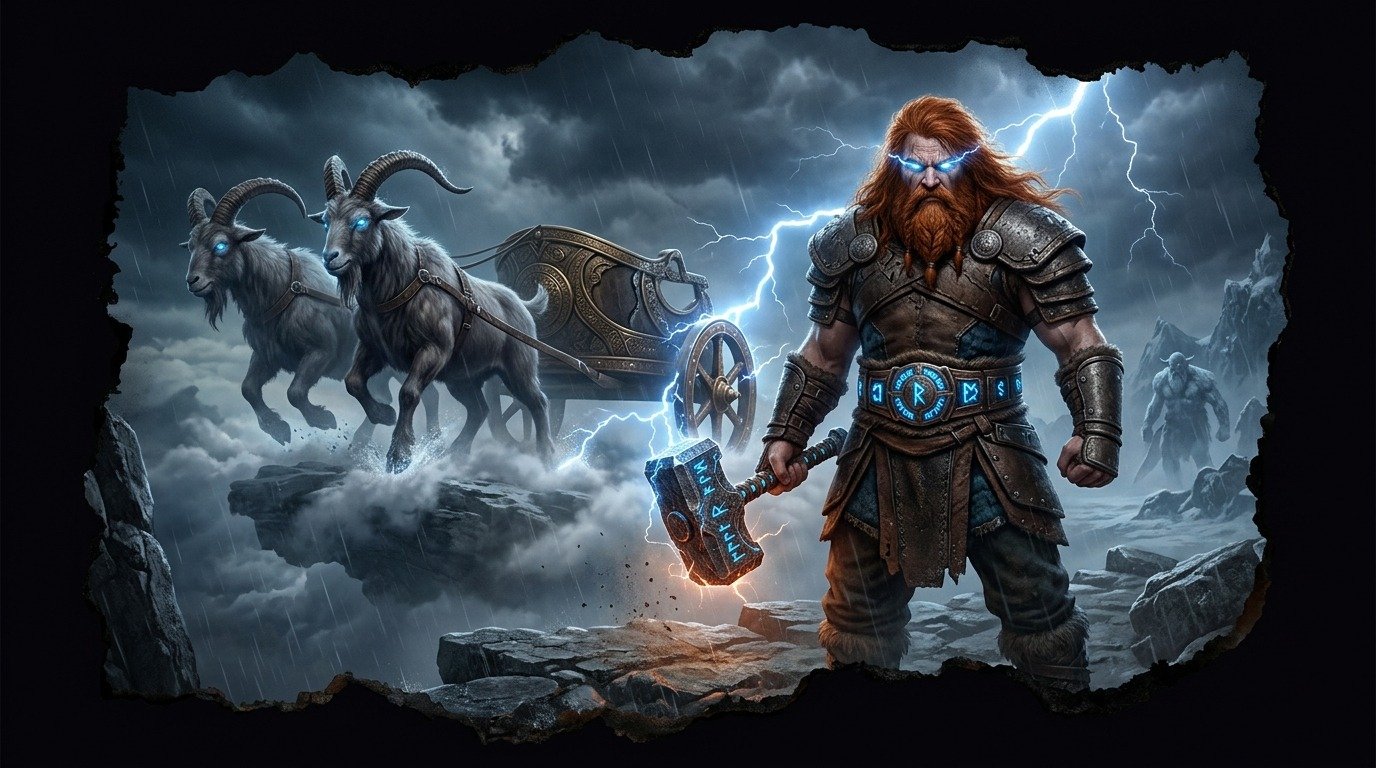
Son of Odin and the Earth herself, Thor is the brute force of nature incarnate, but devoid of his father's cold cruelty. He is a giant among the gods, with shoulders as broad as hills, hair and beard as red as the fire of the forge, and flashing eyes that, when his anger is kindled, shine with the purest blue of lightning. While Odin conspires in the shadows and seeks wisdom in death, Thor prefers the directness of combat, the warmth of a boisterous feast, and the unwavering defense of those who cannot protect themselves.
His arrival is announced long before he is seen. He crosses the sky in a bronze chariot pulled by two indomitable goats, Tanngrisnir and Tanngnjóstr. The creaking of the chariot's wheels on the clouds is the thunder that echoes in the valleys of Midgard, and the clashing of their hooves in the air unleashes the rain that fertilizes the fields of the peasants, who revere him not only as a warrior, but as the giver of life and good harvests. In times of scarcity during his long journeys, Thor can sacrifice and eat his own goats, taking care not to break a single bone; the next day, it is enough to bless the remains with his hammer for the beasts to return to life, healthy and strong to resume the journey.
Mjölnir and the Anvil of Thunder
Thor's power does not reside solely in his muscles, but in three treasures forged in the depths of the earth by the most skilled dwarves. The first and most fearsome is Mjölnir, the short-handled hammer that never misses its mark and, after being thrown, always returns to its owner's hand like a hawk to its perch. Mjölnir is not only a weapon of mass destruction capable of crumbling mountains with a single blow; it is also a sacred instrument with which marriages are blessed, births are consecrated, and the influence of evil spirits is driven away.
To wield such destructive force, Thor needs his other two treasures: the Járngreipr, iron gauntlets that allow him to hold the burning handle of the hammer without burning his skin, and the Megingjörð, a belt of power that, when fastened around his waist, doubles his already colossal divine strength. When Thor equips himself with these relics, the balance of the universe tilts in his favor, and there is no giant in Jotunheim who dares to utter his name aloud.
The Scourge of the Giants
The purpose of Thor's existence is to keep the forces of chaos at bay, personified by the giants of rock and ice who threaten to overflow the boundaries of the ordered world. His deeds are legends of endurance and wonder. On one occasion, he traveled to the lands of the giant king Útgarða-Loki, where he was subjected to deceptive trials from which no other being would have emerged alive: he attempted to empty a drinking horn that, unbeknownst to him, was connected directly to the ocean, succeeding in lowering the sea level with his colossal gulps; he wrestled an old woman who turned out to be Old Age itself, remaining standing on one knee when anyone else would have been instantly crushed; and he attempted to lift a cat from the ground that was none other than Jörmungandr, the World Serpent, succeeding in arching its back to the clouds and terrifying the giants with his superhuman strength.
The enmity between Thor and Jörmungandr is the backbone of his destiny. The god of thunder went so far as to fish at the edge of the ocean using the head of a black ox as bait. When the colossal beast took the bait and raised its head, dripping with venom, above the waves, Thor raised his hammer to smash its skull, but the panic of his companion, the giant Hymir, cut the line and allowed the monster to sink back into the abyss, postponing the final confrontation.
The Guardian of the Threshold
Unlike the kings and poets who seek the favor of Odin, the common people—the men who plow the land and the sailors who brave the northern storms—wear Thor's hammer around their necks as an amulet of protection and justice. Thor is the accessible god, the guardian of the threshold, the one who responds to the farmer's cry with protective rain.
His end, however, is inextricably linked to the monster that escaped him in the ocean. At Ragnarok, when the earth cracks and the seas boil, Thor will stand face to face with Jörmungandr one last time. In a battle that will shake the foundations of creation, the god will crush the serpent's head with a definitive blow from Mjölnir. But the victory will last barely a breath. As he takes nine steps away from the monster's corpse, the black venom that the beast will have spat into the air will penetrate the god's skin, bringing him down lifeless upon the ground he so often defended.
Comments
Share information, an experience, or a source to help enrich this entry. They are automatically reviewed before being published.
Loading comments...