Vidar
Vidar: The Silence That Breaks the End of the World
The Son of Stillness and Undergrowth
In the far reaches of Asgard, where the golden halls cease to shine and stone gives way to dense, uncleared vegetation, lies Landvidi. It is a realm of plains covered in tall grass and silent brush, a wasteland where the wind barely dares to whisper. There dwells Vidar. Born from the union between Odin, the Allfather, and the giantess Gríðr, Vidar carries in his blood the cunning of the gods and the telluric, primal strength of the lords of stone.
Unlike his brothers, Vidar does not seek glory in feasts nor adulation in the songs of the skalds. He is known as the silent god. His muteness is not a weakness, but an accumulation of power; every word he does not speak is energy that coils back into his muscles, a reserve of cold fury destined for a single cosmic purpose. Vidar is the weight of the earth waiting, motionless, for the exact moment to unleash its strength.
The Boot of a Thousand Scraps
Vidar's power is concentrated in his stride and in a unique object that defines his existence: his left boot. It is not a piece of dwarven smithing nor an artifact tempered with runic magic, but a work of collective and silent patience. For generations, human shoemakers have thrown away the leftover scraps of leather from heels and toes when cutting footwear. Vidar has collected each of those small discarded pieces over the centuries, stitching them together one by one to fashion footwear of inconceivable thickness, flexible yet as hard as iron, capable of withstanding the fire and pressure of the most destructive jaws in the cosmos.
When Vidar walks through Landvidi, the earth barely feels his step, but the conceptual weight of his boot is absolute. It is the patience of the artisan and the accumulation of human time placed at the service of a god preparing for the day when everything known falls to pieces. It is the counterweight to the chaos that roars outside his borders.
The Day of the Wolf and the Broken Jaw
Vidar's purpose is revealed at the twilight of the gods, Ragnarök. While the sky is torn apart and the seas boil, the wolf Fenrir, of colossal proportions, advances with his lower jaw scraping the earth and his upper jaw touching the heavens, devouring everything in his path. Odin, with his spear Gungnir held high, charges against the beast, but fate is implacable: the Allfather is swallowed by the wolf's abyss of flesh and fangs.
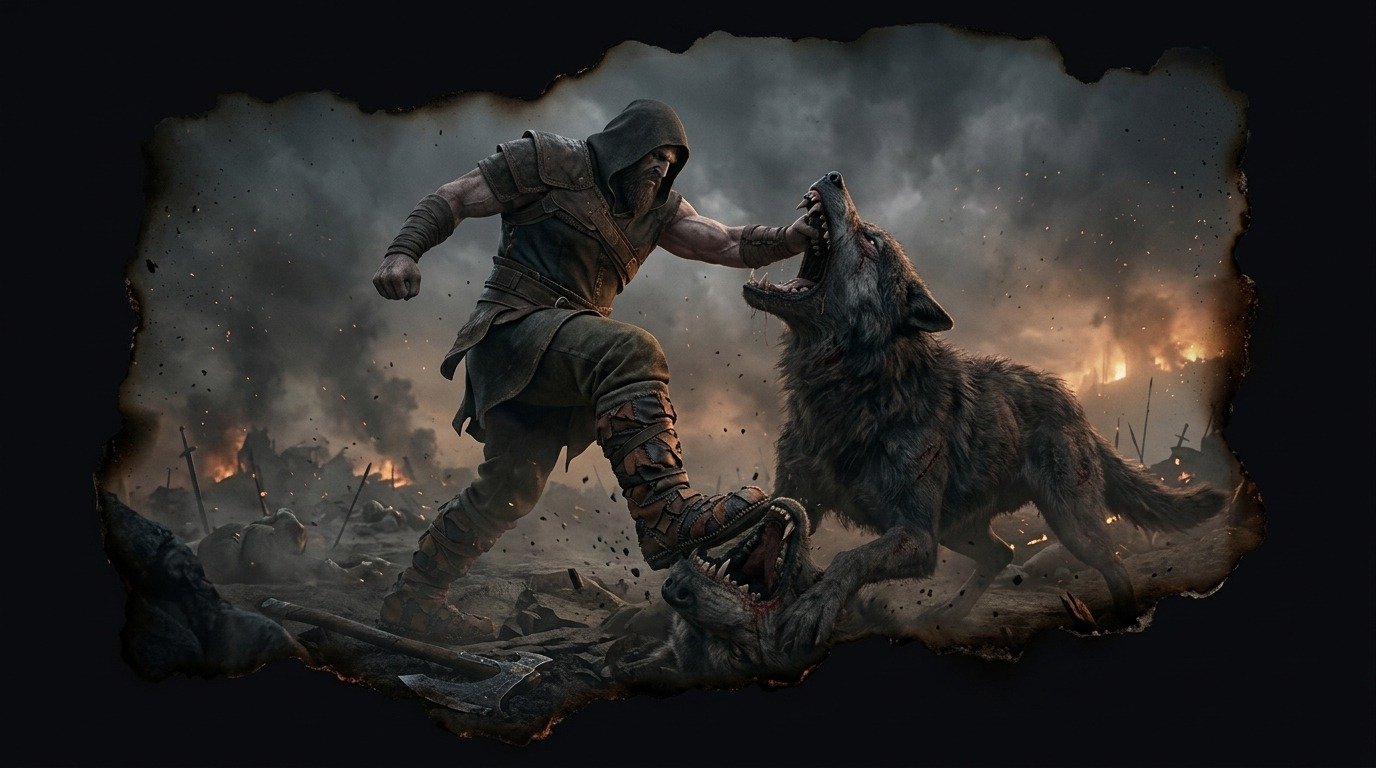
It is in that instant of absolute despair that Vidar's silence breaks into action. The silent god advances without uttering a single cry, a contained storm walking toward the monster. With the coldness of one fulfilling a long-planned task, Vidar plants his boot of a thousand scraps upon Fenrir's lower jaw, pinning it against the barren ground of the plain of Vigrid. The boot resists the wolf's acidic saliva and teeth.
With his free hand, Vidar grasps the beast's upper jaw and, with the combined strength of his giant lineage and his repressed divinity, tears upward. The cracking of the wolf's bones and tendons echoes above the din of the end of the world. Vidar tears Fenrir in half, avenging his father and halting, if only for an instant, the tide of destruction that threatens to erase existence. His victory is not one of jubilation, but of a somber and necessary consummation.
The Heir of the New Dawn
When the ashes of Ragnarök settle and the old world is swallowed by the ocean, a new land emerges, green, fresh, and clean of the old feuds of gods and giants. Vidar, having survived the catastrophe alongside his brother Váli, walks upon this new ground.
His role is no longer that of a rearguard warrior or an executor of vengeance, but that of a pillar for reconstruction. In the new order, where weapons are no longer necessary and silence is once again a space of peace rather than preparation for war, Vidar stands as one of the rulers of the new pantheon. His figure represents the survival of the spirit, the strength that does not break before the worst of storms, and the certainty that, even after the most absolute collapse, there always remains a firm foundation upon which to build anew.
Comments
Share information, an experience, or a source to help enrich this entry. They are automatically reviewed before being published.
Loading comments...