Freyja
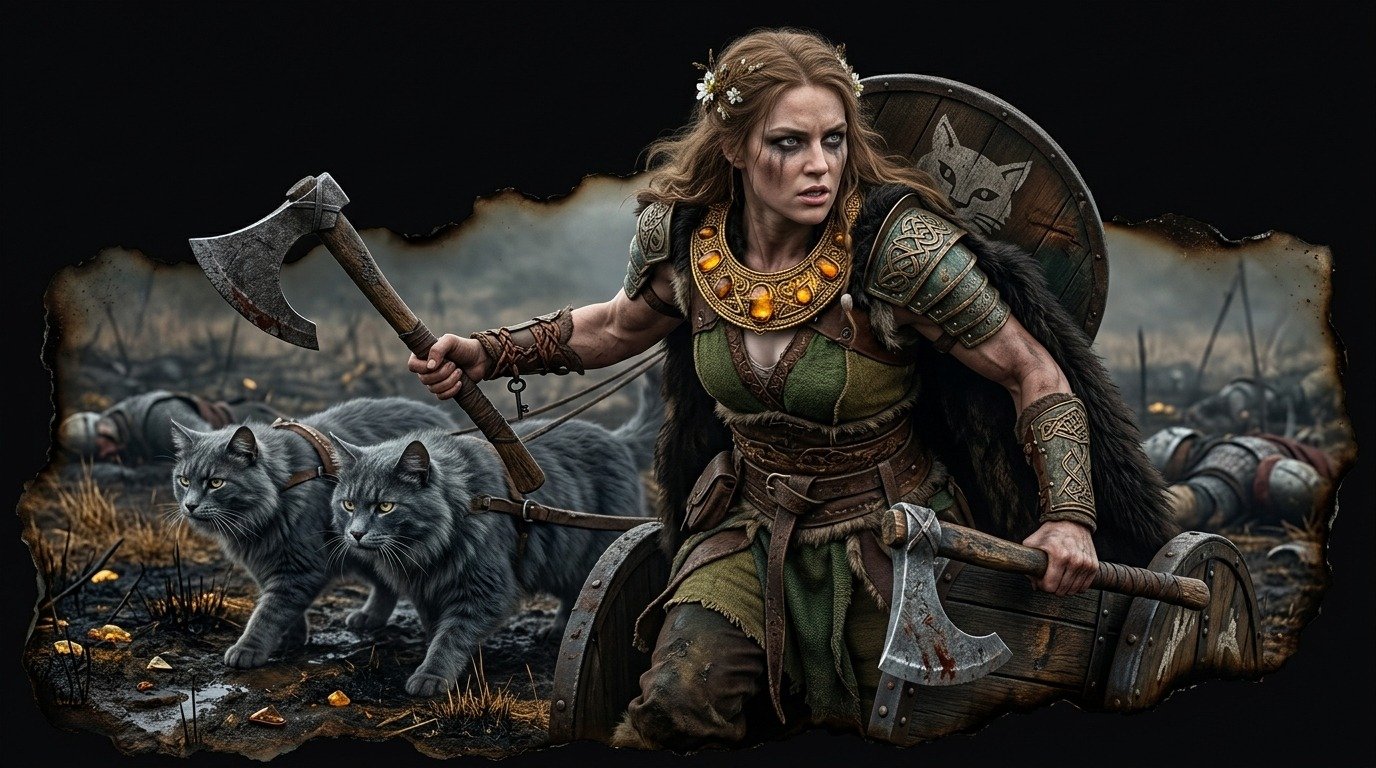
Freyja: The Golden Tear and the Whisper of Witches
The Hostage of Light
Freyja does not belong to the lineage of the Aesir, the warrior gods of Asgard, but to the Vanir, the ancient deities of fertility, the sea, and the damp earth. After a devastating war between both factions that threatened to tear the cosmos apart, Freyja arrived at Odin's court alongside her father Njörðr and her twin brother Freyr as part of a peace treaty intended to seal their concord. Her presence transformed the sobriety of the warriors' realm, bringing with it the scent of spring flowers, the whisper of the wind through the wheat fields, and the mysteries of a magic that the Aesir had never imagined. She is the most beautiful of all deities, possessing a sensuality that arouses the greed of men, giants, and dwarves alike. However, to reduce Freyja to a simple goddess of beauty is to ignore the wild fire that burns within her. She is an untamed force of nature, the lady of desire who moves the world and, at the same time, an implacable warrior who does not fear staining her hands with the blood of her enemies. Her palace, Sessrúmnir, is located in Fólkvangr, the field of the people; a place that rivals in glory with Valhalla itself.
The Necklace and the Tears
The object that defines Freyja's power and majesty is Brísingamen, a golden necklace of such dazzling beauty that it seems to contain the light of the world's first dawn. To obtain it, the goddess descended into the depths of the earth, where she discovered four dwarves forging the jewel in their stone smithy. Unable to resist its brilliance, Freyja offered to pay any amount of silver or gold for it, but the craftsmen demanded a different payment: that the goddess spend a night with each of them. Freyja accepted the deal without hesitation, paying the price of the flesh to claim eternal beauty, proving that her will stands above the moral judgments of men and gods. Despite her immense power, Freyja's life is marked by a constant and painful quest. Her husband, the mysterious Óðr, disappeared on long journeys through unknown worlds, leaving her plunged into a sadness that paralyzes nature. When Freyja weeps for his absence, her tears are not of common water: as they fall upon the leaves of the trees, they transform into red gold, and as they sink into the sea, they solidify into the amber that men gather on northern beaches. Every piece of gold found in the earth is, in truth, a fragment of the broken heart of the goddess of love.
The Lady of Seidr and of the Dead
Freyja's great gift to Asgard, and in particular to Odin, was the teaching of Seidr, an ecstatic and shamanic form of magic that allows one to alter destiny, predict the future, bring about madness or death, and travel through the worlds in spiritual form. It is a feminine and dangerous sorcery that requires entering a deep trance, communicating with the hidden forces of nature. Through this art, Freyja became the mistress of the *völvas*, the wandering prophetesses whom the Vikings consulted before battle and whose graves are still respected in Nordic lands. Her relationship with death is as close as Odin's. Far from being a passive deity, Freyja rides to the battlefields in her chariot pulled by two blue-grey cats, Bygul and Trjegul, with shining eyes and silent claws. She has the primal right to choose half of the warriors fallen in battle before the Allfather can claim his own for Valhalla. In her great hall of Sessrúmnir, the dead find a different rest, welcomed by the warmth of the goddess who offers them not only eternal banquets, but the comfort of a mother and the passion of a celestial lover.
The Beast Among the Flowers
Beneath her delicate appearance of gold and tears, Freyja hides the claws of a predator. When the giant Thrymr stole Thor's hammer and demanded Freyja's hand as the sole ransom, the goddess refused with such fury that the walls of Asgard shook and the necklace Brísingamen burst from her neck from the tension of her veins swollen with rage; rather than submit to the will of a giant, Freyja preferred to see the world burn in total war. In Ragnarok, the lady of cats and prophecies will fight with the ferocity of a cornered she-wolf to defend the sacred ground that welcomed her as a hostage and crowned her as queen. Although the ancient chronicles become elusive when narrating her final fate in the great battle, her spirit survives in the memory of the North every time spring breaks the ice of the rivers, every time a woman proudly claims her own desire, and in the golden gleam of the stones that the sea casts upon the cold sand of the Baltic.
Comments
Share information, an experience, or a source to help enrich this entry. They are automatically reviewed before being published.
Loading comments...