Frigg
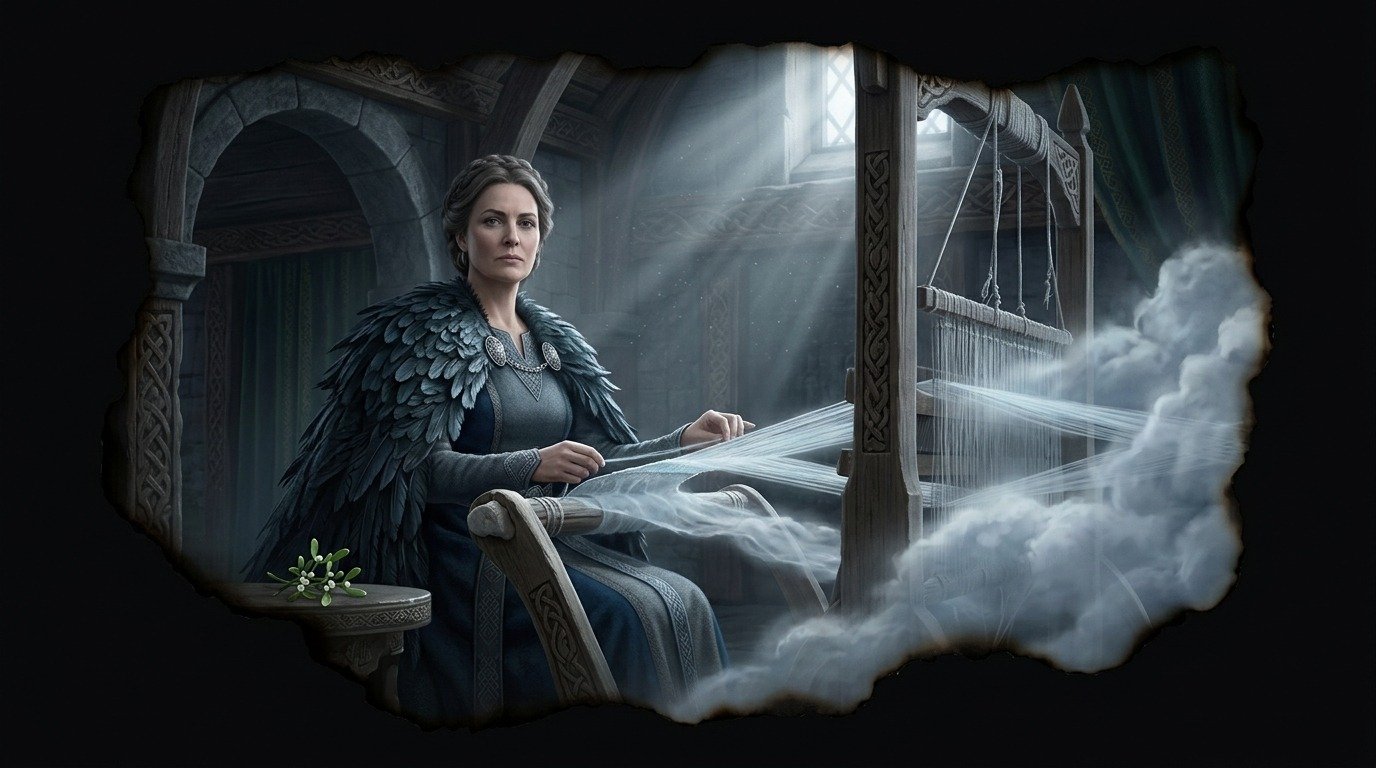
Frigg: The Loom of Destiny and the Silence of the Queen
The Weaver of the Clouds
While the halls of Asgard echo with the war cries of heroes and the intrigues of the wise, a deep and reverent silence reigns in the palace of Fensalir. There dwells Frigg, the queen of the gods, wife of Odin and mistress of the heavens. Her power is not manifested in the crash of thunder nor in spilled blood, but in the constant whisper of the loom with which she weaves the clouds that cover the firmament of men. Her threads, fine as morning mist, sustain the order of family life, the sacredness of marriage, and the solemn oaths that hold society together.
Frigg possesses a gift that even Odin envies and fears: she knows the destiny of all things, the exact thread of every life, and the way the world will come to an end. However, the queen keeps a sacred silence. She never reveals what she sees in the webs of time; she knows that destiny is not something to be fought with swords, but accepted with the dignity of one who sustains the foundations of existence. While her husband travels the world desperately seeking to change the inevitable, Frigg remains on her throne spinning the future, a figure of unshakable majesty dressed in a cloak of falcon feathers that allows her to fly silently through the nine worlds.
The Universal Oath and the Mother's Tragedy
Despite her wisdom and her acceptance of destiny, Frigg's heart is not free from the frailties of maternal love. When her son Baldr, the brightest and most beloved of the gods, began to have terrible nightmares foretelling his untimely death, the queen decided to defy the destiny she herself knew. She left her palace of Fensalir and traversed every corner of the cosmos, from the frozen peaks of Jotunheim to the burning depths of Muspelheim.
Before her knelt kings, giants, beasts of the earth, and plants of the forest. Frigg demanded and obtained a sacred oath from every stone, every metal, every disease, water, fire, and all living creatures: none would ever harm Baldr. However, on her immense journey, the queen overlooked a small and tender shoot growing to the west of Valhalla: the mistletoe, deeming it too insignificant to pose a threat. This omission, born of a mother's exhaustion, was the crack through which Loki's cunning slipped, leading to the subsequent ruin of Asgard.
Silent Sovereignty
The relationship between Frigg and Odin is a constant game of wits where the queen often proves to have a deeper understanding of justice and sovereignty. On one occasion, when both gods disputed the fate of two rival tribes, the Vandals and the Winnili, Odin promised to grant victory to those he saw first upon waking in the morning, knowing that his bed faced the camp of his favorites.
Frigg, who supported the Winnili, devised a cunning plan. She instructed the women of the tribe to let down their hair and tie it under their chins as if they were thick beards, and before dawn, she turned her husband's bed toward them. Upon opening his single eye, Odin exclaimed in surprise: "Who are those long-beards?" Frigg, with a triumphant smile, reminded him of his promise and granted victory to the tribe that, from that day on, was known as the Lombards. With this gesture, the queen demonstrated that sovereignty does not belong solely to the warrior who wields the spear, but to the mind that knows how to govern hearts and circumstances.
The Invisible Grief
The tragedy of Frigg is that of the spectator who watches her own home fall without being able to intervene to save it. After the death of Baldr, her palace Fensalir became a sanctuary of silent grief. She represents the resilience of the home before the impending storm, the guardian of the values that give meaning to the lives of men even when the end of the world looms over their heads.
At Ragnarok, Frigg will suffer her second great sorrow when she sees Odin fall to the jaws of Fenrir. The weaver of destiny will watch as the thread of the Allfather is severed and the fire of Surtr consumes the clouds she herself wove for ages. However, in the rebirth of the world, when the ashes cool and a new land emerges from the waters, the sovereignty of the mother of the gods will be woven once more, silent and eternal, among the survivors of the new era.
Comments
Share information, an experience, or a source to help enrich this entry. They are automatically reviewed before being published.
Loading comments...