The Five Suns
The Five Suns: The Cosmology of the End of the World in the Aztec Empire
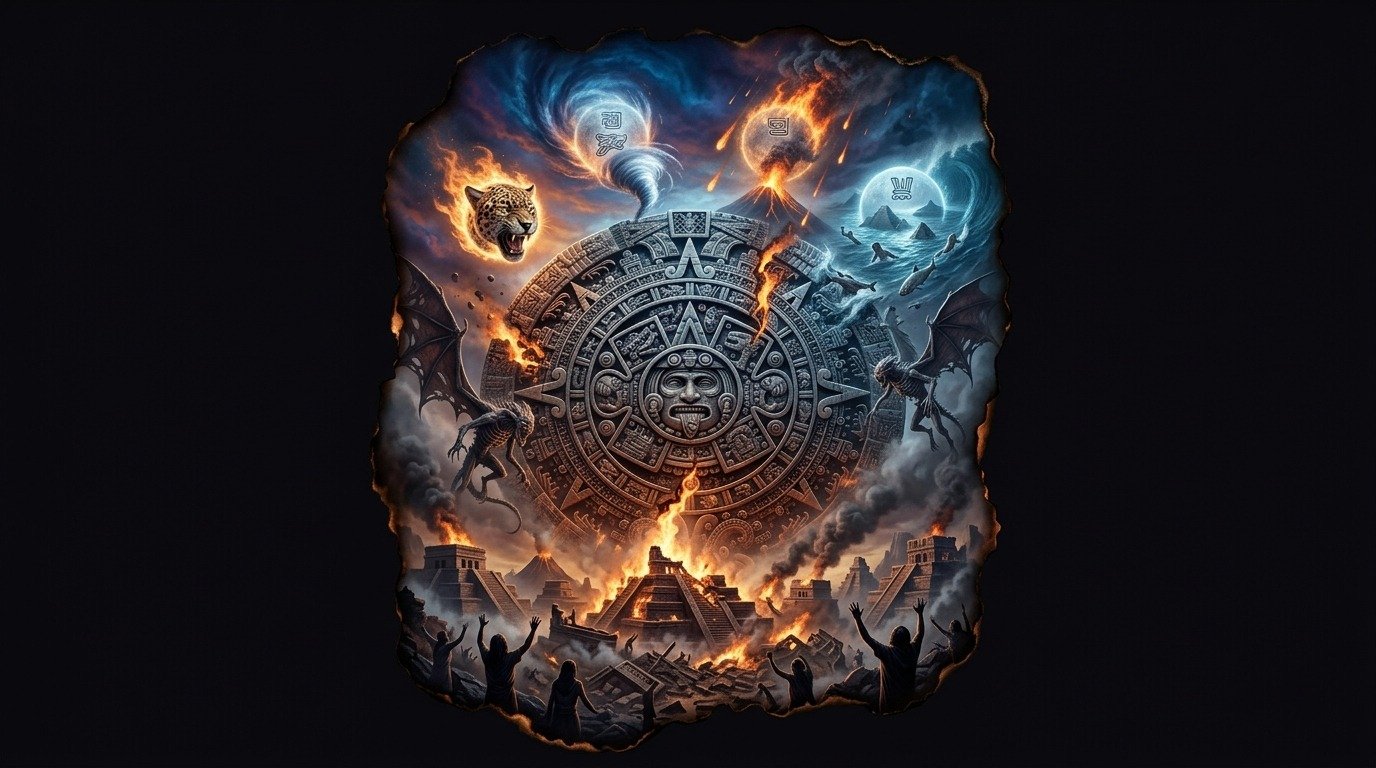
In November 1519, when the Spanish conquistadors entered the lake city of Tenochtitlan, Aztec priests lived under the constant fear that their world would imminently collapse due to a global earthquake. Their cosmology taught that the universe had already passed through four previous eras of creation and destruction, called "Suns," and that the current era, the Fifth Sun, was destined to end catastrophically. To postpone this inevitable end, the empire performed daily human sacrifices to feed the sun, Tonatiuh, with the precious water of blood. Each of the previous suns had ended in an absolute catastrophe that exterminated humanity: the first sun was devoured by jaguars; the second, destroyed by hurricanes; the third, consumed by a rain of fire; and the fourth, submerged by a flood of water that transformed humans into fish. The prophecy of the Fifth Sun, called the "Sun of Movement" (Ollintonatiuh), warned that the end would occur at the conclusion of a 52-year cycle, when the celestial bodies would stop and the monsters of the firmament, the Tzitzimime, would descend from the dark sky to devour all survivors.
The Catastrophes of Past Eras
Nahua mythology describes the previous eras as an unstable balance between opposing deities, primarily Quetzalcoatl, the feathered serpent, and Tezcatlipoca, the smoking mirror. The first sun, Nahui Ocelotl (Four Jaguar), lasted 676 years and was ruled by Tezcatlipoca, but it ended when Quetzalcoatl knocked him into the water with a blow from his staff; Tezcatlipoca emerged in the form of a giant jaguar and, along with his beasts, devoured the population of giants that inhabited the Earth. The second sun, Nahui Ehecatl (Four Wind), ruled by Quetzalcoatl, collapsed due to hurricane-force winds that tore up mountains, turning the survivors into monkeys so they could hold onto the trees. The third creation, Nahui Quiahuitl (Four Rain), ruled by the storm god Tlaloc, ended when Quetzalcoatl sent a scorching rain of fire and volcanic ash that burned the fields and transformed humans into turkeys. The fourth era, Nahui Atl (Four Water), ruled by the water goddess Chalchiuhtlicue, came to an end when the heavens broke and a universal flood drowned the world for fifty-two years; the force of the water was so destructive that mountains collapsed and people turned into fish to avoid dying.
The Mythic Origin Recorded in Stone
This cosmogonic myth was inherited by the Aztecs from earlier Mesoamerican cultures, such as the Toltecs and the Teotihuacans. The Aztecs carved the history of these cataclysms in the center of the monumental Sun Stone, a basalt relief weighing more than twenty-four metric tons (26.4 short tons) discovered beneath the Zocalo of Mexico City in 1790. In the center of the disk, the face of Tonatiuh is carved, surrounded by the hieroglyphs of the four past suns within a large symbol of movement (Ollin), indicating how the current era will perish. For the priests of Tenochtitlan, the creation of the Fifth Sun required the gods themselves to sacrifice themselves in Teotihuacan. The humble god Nanahuatzin threw himself into a divine bonfire to become the new sun, but it did not move across the firmament; it demanded the nourishment of cosmic combat to advance, forcing humans to keep the machinery of sacred wars and ritual human sacrifices alive.
The New Fire Ceremony
The fear of the prophecy translated into one of the most dramatic ceremonies of pre-Columbian America: the New Fire Ceremony, celebrated every 52 years at the summit of Huizachtlan hill. At the end of each calendar cycle, the Aztec population broke their household idols, destroyed their kitchen utensils, and extinguished all fires in homes and temples, leaving the entire night plunged into total darkness. Priests carefully observed the passage of the Pleiades stars through the center of the sky at midnight. If the stars successfully crossed the zenith, it meant that the Fifth Sun would not stop and that the monsters of space would not descend. In that moment of collective relief, the priests lit a new fire in the open chest of a sacrificed captive at the summit of the hill. Runners lit their torches from this bonfire and ran through the darkness to distribute the new fire to all the homes of the empire, ensuring the survival of the world for another 52 years.
The End of the Empire and the Myth
The Spanish conquest in 1521 coincided with the political collapse of the Mexica, who interpreted the arrival of the foreigners and the devastating epidemics as premonitory signs of the end of their solar era. Although the Fifth Sun did not physically end with a global earthquake on the expected date, the end of their way of life and the collapse of their temples meant the death of their cosmic era to the ancient sages. The Sun Stone survives today as the physical monument of that cyclical terror. The image of the Tzitzimime, skeletal deities that waited hidden behind the light of the sun during solar eclipses, remains a reminder of an Aztec universe that hung by a thread and required blood to keep the sky from collapsing onto the Earth.
Comments
Share information, an experience, or a source to help enrich this entry. They are automatically reviewed before being published.
Loading comments...