Quetzalcoatl
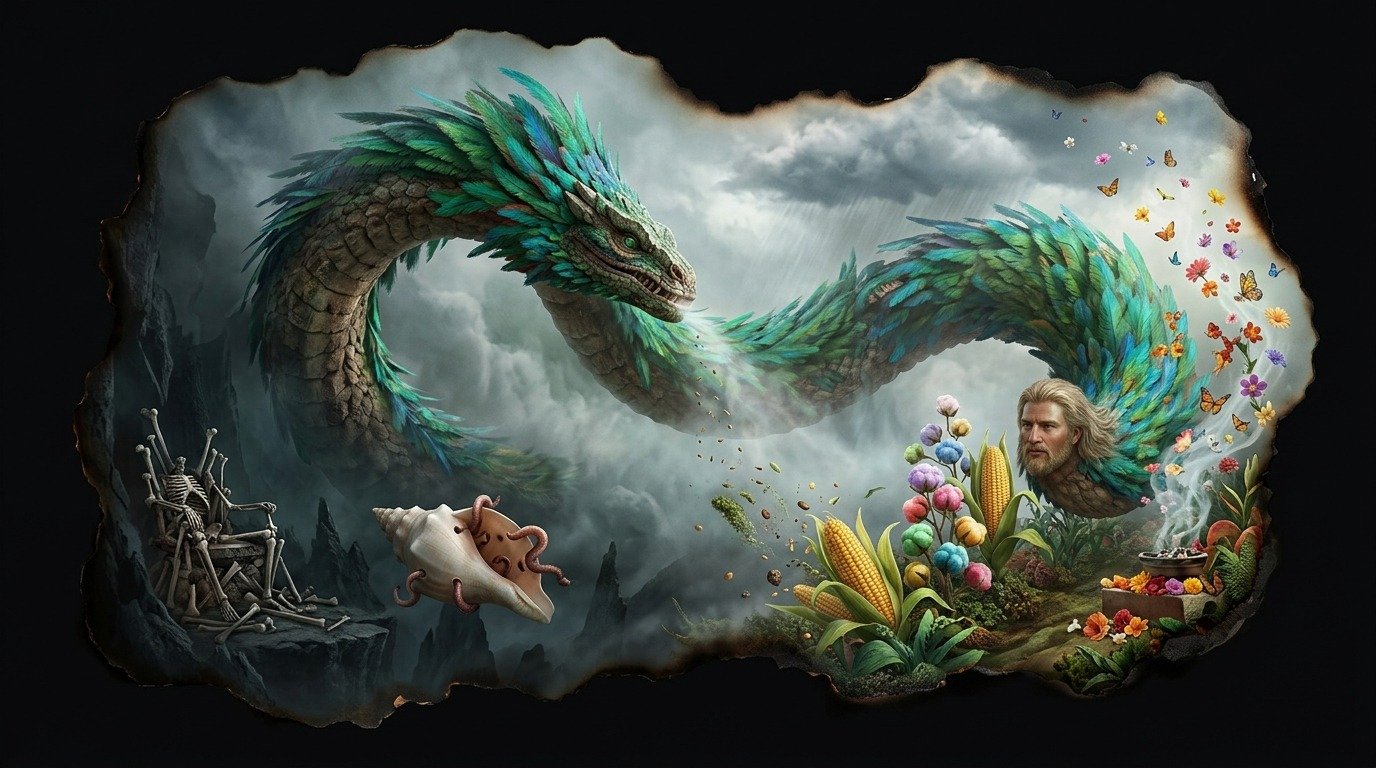
Quetzalcoatl: the primordial breath and the light of the east
The wind that precedes life
Before dry land, temples, or night existed, there was the wind. Not a casual current of air, but an intelligent, dense, and warm breath that pushed against the nothingness to open up a space for existence. That breath was Quetzalcoatl, the Feathered Serpent, a force that united what should never have been separated: the scaly heaviness of the earth and the celestial weightlessness of quetzal feathers. While other divinities of creation sought to impose themselves through brute force or destructive fire, he understood that the universe required a delicate balance, a constant sway between matter and spirit. When he moves, the air becomes saturated with the scent of damp vegetation and freshly turned earth. It is he who clears the paths with his breath so that the rain gods can pass with their vessels; it is his whistle that awakens the sleeping seeds beneath the primordial mud. His nature is not that of a distant sovereign, but that of a tireless shaper. For Quetzalcoatl, divinity is not demonstrated by demanding terror, but by delivering the tools for chaos to become order, beauty, and understanding.
The descent to Mictlan
The greatest act of compassion of the Feathered Serpent occurred when the world was left deserted, devoid of beings who could worship the creators or understand the course of the stars. The bones of past generations lay in the deepest part of Mictlan, the underworld of eternal darkness, guarded by the relentless lord of the dead. Quetzalcoatl did not send messengers; he descended himself into the depths, where light is extinguished and the air turns to ash. In front of the throne of bones, the lord of the underworld imposed a challenge upon him that he believed impossible: he had to sound a conch shell that had no holes to blow into. Quetzalcoatl, observing the trap, called upon the worms to drill the shell and the black bees to enter it, creating a hum so deep that it made the walls of death tremble. Seeing himself outwitted, the sovereign of shadows pretended to yield, but dug a pit on the path back. Quetzalcoatl stumbled, fell into the trap, and the sacred bones he carried with him broke into a thousand pieces. Although the pain of the fall was immense, the Feathered Serpent stood up, gathered the splintered fragments, and managed to escape to the surface. There, he poured his own blood over the bone dust to infuse it with a new spark of life. From that mixture of broken death and divine sacrifice, human beings were born; that is why people have different heights and why their lives are beautiful, fragile, and marked by imperfection.
The fall of the sacred king
The story of this god is not one of uninterrupted triumph, but of a painful exile that defines the soul of the world. In the times when he ruled the great city of Tollan, Quetzalcoatl presented himself in a human form with light hair and a beard, teaching men the cultivation of corn, writing, the art of smelting metals, and the value of peaceful sacrifices, composed solely of flowers, butterflies, and copal. Tollan prospered so much that ears of corn grew to the size of a man and cotton sprouted from the earth already dyed in a thousand colors. But perfect light always summons the densest shadow. His brother and eternal rival, the smoking mirror of the night, enveloped him in deceit using an obsidian mirror to show him his own physical decay and convince him to drink a concoction that stripped him of his reason. Upon waking from his drunkenness and understanding that he had lost the purity required by his office, Quetzalcoatl could not bear the shame. He set fire to his palaces of turquoise and silver, gathered his servants, and marched toward the shore of the Eastern sea. There, on a raft built with intertwined serpents, he went out into the waters of the ocean. Before losing himself on the horizon, he promised that he would return in a specific year to reclaim his throne and restore the lost order. Men stood watching the empty sea, waiting for the day when the wind of the east would blow again with the strength of the beginning of time.
The Feathered Serpent: the matter that learned to fly
*Quetzalcoatl* (in Nahuatl: *quetzalli*, precious feather; *coatl*, serpent) is not the mere cataloging of a cryptid or a folkloric monster: it is a primordial metaphysical principle, a theogonic and cosmological force that the Mesoamerican peoples (Olmecs, Toltecs, Teotihuacanos, and Mexicas) recognized as the axis of creation and the manifestation of spiritual light in dense matter.
Physically, his manifestation is that of an ophidian reptile covered by the bright green plumage of the quetzal. This physiognomy encloses a geometrical and theological paradox: the serpent, which crawls through the mud and represents the immanence of the earth, gravity, and perishable matter, unites with the feathers of the bird, which flies toward the sun and represents transcendence, the wind, the intellect, and the free spirit. Quetzalcoatl is, therefore, the symbol of matter that has learned to fly; the divinization of the human and the humanization of the divine.
Ce Acatl Topiltzin and the morning star
The central myth of Quetzalcoatl places him not only as the creator of the humanity of the Fifth Sun (by descending to Mictlan to steal the bones of past generations and sprinkle them with his own ritual blood), but also as a historical king and cultural initiator in the mythical city of Tollan (Tula). Under the name Ce Acatl Topiltzin Quetzalcoatl, he ruled as a chaste priest who forbade human sacrifices, demanding instead offerings of butterflies, flowers, and thorny self-sacrifice.
His fall is an esoteric drama of transmutation. Deceived by his brother and cosmic counterpart, Tezcatlipoca (the Smoking Mirror), who shows him his own aged and mortal face in an obsidian mirror, Quetzalcoatl loses his purity by becoming intoxicated with pulque and committing incest with his sister Quetzalpetlatl. In this version of the myth, upon waking and contemplating his degradation, he decides to self-immolate on a sacred pyre on the shores of the divine ocean. From his ashes, precious birds arise, and his heart ascends to the firmament to become *Tlahuizcalpantecuhtli*, the morning star (the planet Venus).
Esoteric meaning and pre-Hispanic alchemy
From the perspective of Hermetic initiation and Toltec esotericism (*Toltecayotl*), Quetzalcoatl represents the process of rectification and elevation of vital energy. The serpent is the internal fire (similar to the Hindu *Kundalini*) that lies dormant at the base of the spine. The plumage represents the opening of the higher spiritual centers through the sacrifice of the ego, the discipline of knowledge, and artistic creation.
His duality with Tezcatlipoca is fundamental to understanding the cosmology of polarity: - **Tezcatlipoca:** The night, the unintegrated unconscious, the obsidian that reflects the brutal truth of the ego, the cold of the north, the relentless destiny. - **Quetzalcoatl:** The day, the light of spiritual consciousness, the wind that cleanses the path of the rain, the generating east, the will for self-rectification. Both principles destroy and recreate each other in each cosmic era, demonstrating that divine creation requires the constant tension between the light of intelligence and the darkness of the unmanifest mystery.
Ehecatl and the return of the wind
Quetzalcoatl manifests on the subtle plane as *Ehecatl*, the God of the Wind, whose breath sweeps the paths before the arrival of the waters of Tlaloc. His movement is always spiral (represented in the *Ehecacozcatl* or wind breastplate cut from a marine conch shell), indicating the non-linear nature of spiritual time and the evolutionary ascent of the soul.
To attune to the current of Quetzalcoatl, traditional guidelines require: 1. **The Practice of Self-Sacrifice (*Nextlahualiztli*):** Not through the shedding of others' blood, but through voluntary deprivation, fasting, the rigorous study of the arts and sciences, and the active destruction of personal pride. 2. **Art as an Offering (*Toltequity*):** The true servant of Quetzalcoatl must be a creator of beauty. Art is seen as the materialization of the spirit; shaping clay or weaving feathers with purity of intention is equivalent to ordering the chaos of matter in the image of the Creator. 3. **The Cultivation of the Wind:** Conscious breathing exercises (Mesoamerican *Pranayama*) performed facing the East during dawn, recognizing the vital breath (*Ihiyotl*) as the divine spark that animates the body of clay.
Comments
Share information, an experience, or a source to help enrich this entry. They are automatically reviewed before being published.
Loading comments...