Tlaloc
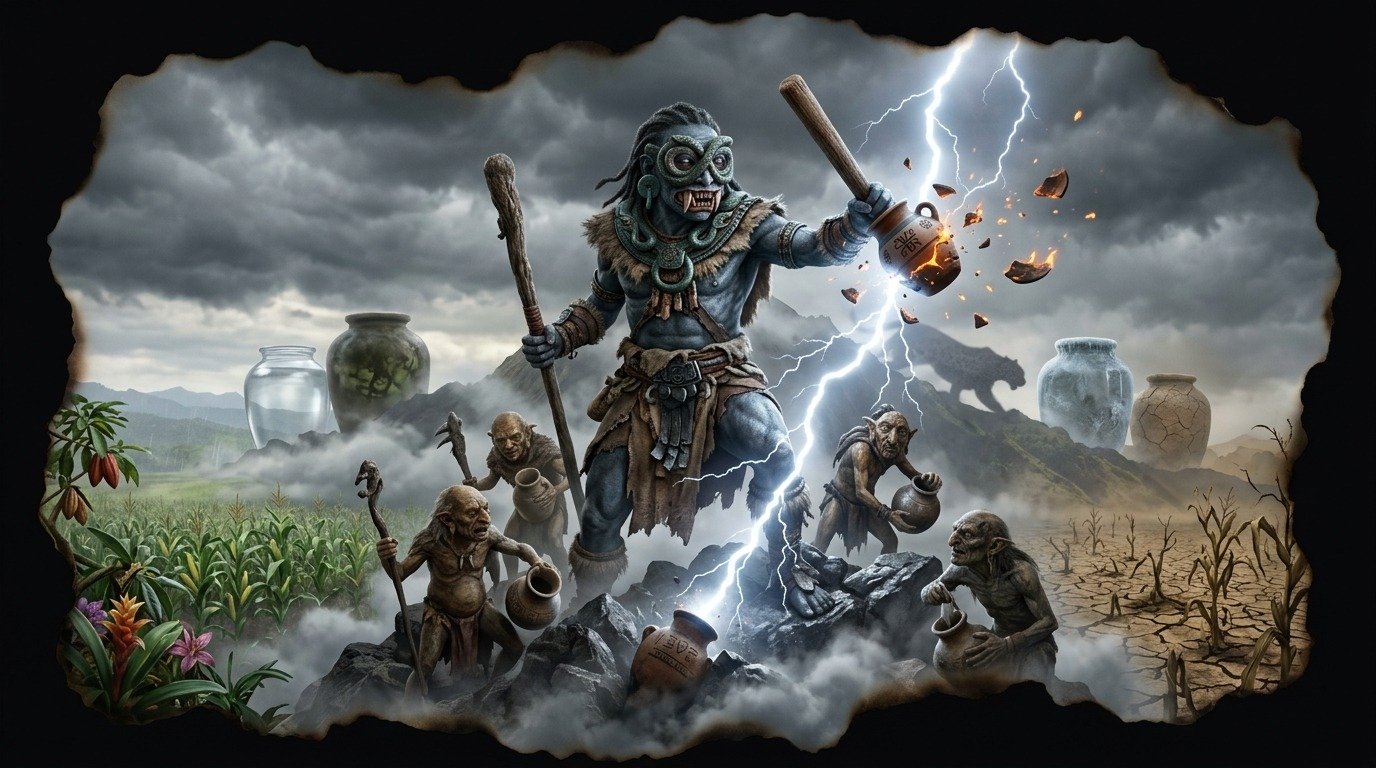
Tlaloc: The Lord of Lightning and the Celestial Vessel
The Gaze of Obsidian and Lightning
Long before the great empires raised their pyramids, the earth already trembled beneath the footsteps of Tlaloc. He is one of the oldest deities of the Mesoamerican world, a primordial force inhabiting the summits of the highest mountains, where clouds gather like gray armies ready to besiege the valleys. His physical appearance inspires a reverent awe: large goggles formed by intertwined serpents surrounding his dark eyes, a mouth equipped with long jaguar fangs, and skin dyed the color of the sky before a storm.
Tlaloc is the undisputed master of the waters that fall from the sky and those that gush from the damp earth. Upon his will depends whether the earth yields its fruits or becomes a barren wasteland of dust and ash. He is not a benevolent god in the modern sense; he is an elemental force just as capable of sending the gentle rain that makes the green maize sprout, as he is of unleashing destructive hail, furious floods, and lightning bolts that tear apart ancient trees. His temple is Tlalocan, a damp, subterranean paradise where flowers, cacao, and lush vegetation abound, reserved for those who die by drowning, struck by lightning, or from water-related illnesses.
The Rumor of the Four Vessels
In his mountainous retinue, Tlaloc does not work alone. He relies on the tlaloque, a group of rain dwarfs who dwell in the caverns and deep ravines of the mountain ranges. The god has under his care four immense clay vessels, oriented toward the four cardinal points of the universe, and each contains rain of a different nature.
The first vessel contains the good, clean, and timely water that fertilizes the fields and ensures the survival of the peoples. The second contains the rain that brings plagues, fungi, and caterpillars that devour the maize crops. The third vessel pours out relentless frosts and snow that rot roots before they can grow. The fourth vessel harbors devastating drought, which cracks the earth and turns rivers into paths of dry stone.
When Tlaloc decides that the time has come to water the world, he orders the tlaloque to take smaller vessels and fill them with the contents of the great celestial containers. The dwarfs fly over the clouds and, with large wooden staffs, break the jars to release the water. The din of those blows against the clay is what mortals hear on earth as thunder, and the fragments that fly off, ignited by the friction of the sky, are the lightning bolts that strike the tops of the hills.
The Tribute of Tears
The relationship of men with Tlaloc is one of absolute and often painful solemnity. To ensure that the god would open the vessel of good water and keep those of hail and drought closed, the priests had to offer him what he valued most: the moisture of life.
During the festivities that marked the beginning of the planting season, processions were held to the summits of the sacred hills and to the whirlpools of the lagoons. In these rituals, young children, richly adorned in colorful garments and quetzal feathers, were offered to the god. The weeping of the infants before being consecrated was considered the best possible omen, as their tears symbolized the raindrops that Tlaloc would send to moisten the fields. Only through this painful liquid communion, where human tears merged with the water of the clouds, did the earth guarantee its fertility for another year, beneath the muffled thunder of the jaguar that dwells in the mountain.
Comments
Share information, an experience, or a source to help enrich this entry. They are automatically reviewed before being published.
Loading comments...