Viracocha
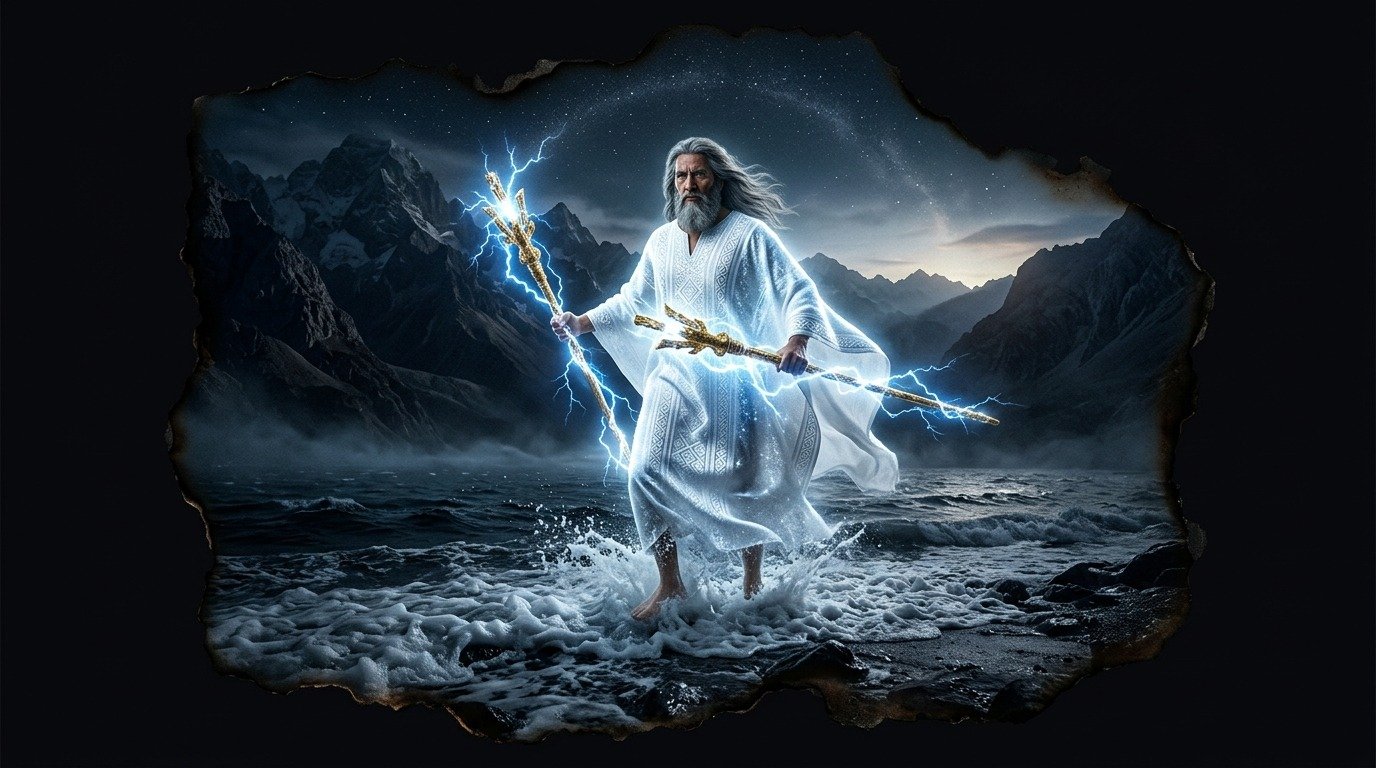
Viracocha: The Maker Who Rose from the Foam of Titicaca
The Awakening in the First Night
Before there was an above and a below, the world was a cold wasteland, plunged into a thick mist and a darkness that knew no dawn. From the frozen depths of Lake Titicaca, where the water merges with the abyss, emerged a tall figure, dressed in a white tunic that gleamed like frost and holding in his hands two golden staffs that controlled the forces of lightning. He was Viracocha, the Lord of the Foam, the god who had no beginning because he is the beginning of all things.
Seeing the deathly silence that enveloped the earth, Viracocha blew upon the waters of the lake and created light. With a gesture of his right hand, he ordered the Sun to rise into the firmament from the sacred island of Copacabana; with his left, he commanded the Moon and the stars to populate the night so that darkness would never again be absolute. His gait was silent, yet each of his steps left a footprint of order upon the chaotic stone of the mountain range.
The Walking Clay
Viracocha's dominion is not limited to the physical creation of the landscape; he is the molder of humanity. His first attempt to populate the earth was crude: he sculpted giants out of limestone, monumental beings but without soul or understanding who soon fell into pride and disobeyed the creator's laws. Without hesitation, Viracocha destroyed them, sending a flood of cosmic proportions that dissolved the stone and returned the world to silence.
In his second attempt, the god used wet clay from the Andean valleys. He modeled life-sized men and women, painted the features of each tribe upon their faces, gave them the clothes they were to wear, the languages they were to speak, and the seeds they were to plant. Then, he breathed life into their mouths and ordered them to enter the depths of the earth—caves, lakes, and the roots of sacred trees—so that they might emerge from there to populate the different regions of the Andes.
The Wandering Beggar of the Andes
Unlike other gods who rule from inaccessible thrones, Viracocha preferred to walk among his creations. He hid his divine radiance under the guise of a ragged beggar, a traveler covered in dust and sores who walked the mountain paths leaning on a wooden staff. He did this to test the hearts of men, to see if the compassion and reciprocity he had taught them were still alive in their breasts.
During his journey through the town of Cacha, the inhabitants did not recognize the maker. Seeing him so poor and ragged, they mocked him, threw stones at him, and chased him to expel him from the valley. Viracocha, his face saddened, raised his wooden staff and the sky split open in tongues of fire that fell upon the surrounding hills, causing the stones to burn like coal and the earth itself to begin melting into a river of lava. Terrified, the locals threw themselves at his feet, begging for forgiveness. Moved by their repentance, the god touched the earth with his staff and extinguished the sacred fire, leaving as a testament a field of black, scorched rocks that even today recalls the creator's warning.
The Journey of No Return to the West
When Viracocha completed his journey through the mountain range and ensured that the laws of the cosmos and of men functioned in harmony, he headed toward the coast of the Pacific Ocean. On the beach of Manta, facing the infinite waters, he gathered his last servants and gave them his final instructions. Then, he spread his white tunic over the surface of the water and, as if walking on dry land, began to float away on the sea foam toward the western horizon, where the sun sets. He did not die; he simply entered into the mystery of the ocean, leaving behind the promise that, when men lose their way once more and chaos threatens to devour everything, his white silhouette will appear again upon the waves.
Comments
Share information, an experience, or a source to help enrich this entry. They are automatically reviewed before being published.
Loading comments...