Xólotl
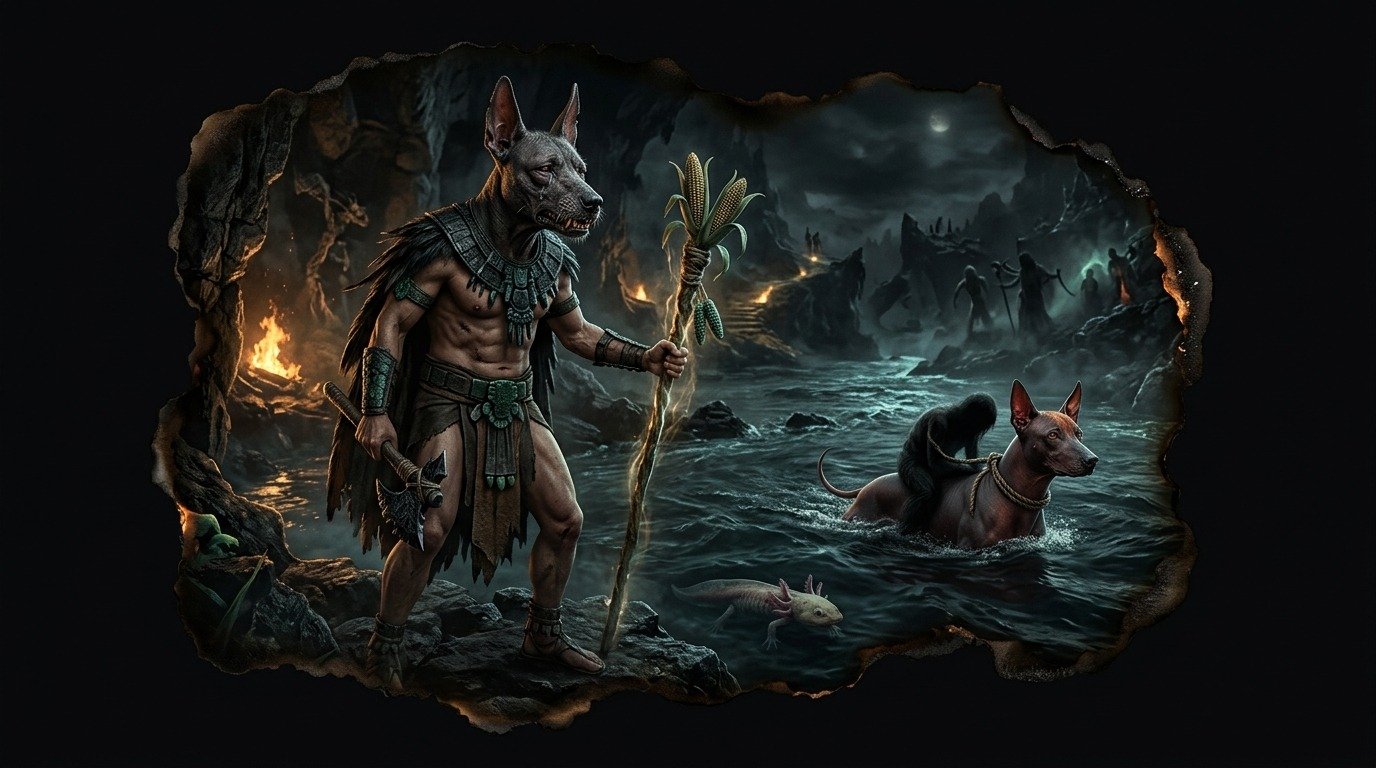
Xólotl: the dog god who guides the dead and the origin of the xoloitzcuintle
Who is Xólotl
Xólotl is the Mexica dog-headed god who accompanies souls on their journey through Mictlán, the realm of the dead. He is the dark twin of Quetzalcóatl, the god of the evening star, the one that sinks into the horizon and descends into the underworld every night. He was also the lord of lightning, of twins, and of everything born double or deformed. His name is at the origin of Mexico's most famous dog, the xoloitzcuintle, the animal that according to tradition carries the dead across the river of the afterlife.
The dark twin of Quetzalcóatl
Venus appears in the sky in two ways: at dawn, as the morning star, and at dusk, as the evening star. For the Mexica, they were two brother gods. Quetzalcóatl was the light that announces the day. Xólotl was the one that goes out in the west and goes down into the darkness.
That is why, when Quetzalcóatl descended to Mictlán to steal the bones of past generations and create the new humanity, in several versions of the myth he did not go alone: he was accompanied by Xólotl, his double, the one who knows the path of the dead.
The god who did not want to die
In the myth of the Fifth Sun, the gods gathered in Teotihuacán and sacrificed themselves in the fire to set the Sun in motion. Everyone accepted to die. Everyone except one.
Xólotl cried so much that his eyes swelled, and he fled. When they caught up with him, he hid in a cornfield and transformed into a plant with two ears of corn, which is called *xólotl*. They found him. He fled to a maguey field and transformed into a double maguey, the *mexólotl*. They found him again. He threw himself into the water and became a strange animal, the *axólotl*. There they caught him and put him to death.
That animal in which he hid still exists and bears his name: it is the **axolotl**, the Mexican salamander that never finishes growing, which lives in the canals of Xochimilco and can regenerate its own limbs. For the Mexica, he was the god who refused to die.
The dogs that cross the river of the dead
The soul's journey through Mictlán lasted four years and crossed nine regions. The first obstacle was a wide and deep river, the Chiconahuapan. No dead person could cross it alone. They needed a dog.
That is why the Mexica buried or cremated their dead alongside a dog, or with a dog figurine, and in some places they tied a cotton thread around the deceased's neck. Upon reaching the river, the dog would recognize its owner, jump into the water, and carry them across on its back.
According to the tradition recorded after the conquest, not just any dog would do. The white one refused because it said it had just washed itself. The black one refused because it said it had just gotten dirty. Only the reddish, yellowish dog accepted to carry the soul. That is why dogs of that color were bred to accompany the dead.
The xoloitzcuintle, the dog of Xólotl
The name **xoloitzcuintle** joins *Xólotl* and *itzcuintli*, "dog." It is a breed that has existed in Mexico for more than three thousand years: a hairless dog, with dark, smooth skin, large ears, and a steady gaze. It was considered the representative of the god on earth and the natural guide of souls.
In the ancient tombs of western Mexico, especially in Colima, hundreds of clay sculptures of plump dogs accompanying the dead have been found. It is believed that many represent xoloitzcuintles.
The Mexica also bred them as food and for their warmth: they were used as living hot water bottles to relieve aches and pains. After the conquest, the breed was on the verge of extinction and was saved in the 20th century by breeders and artists like Frida Kahlo and Diego Rivera, who lived surrounded by them. Today it is one of the symbols of Mexico and one of the protagonists of the Day of the Dead: on many altars there is a clay or paper xoloitzcuintle, ready to guide the deceased who returns to visit.
Xólotl in heaven and on earth
Xólotl is an uncomfortable god: the one who was afraid, the one who hid, the deformed one, the one in charge of the work that nobody wants, leading the dead through the darkness. But he is also the most faithful. Every night he goes down with the Sun to the underworld and every night he rises again. And in every dog that looks at its owner as if it had known them forever, the Mexica saw the guide who would one day be waiting for them on the shore of the river of the dead.
Comments
Share information, an experience, or a source to help enrich this entry. They are automatically reviewed before being published.
Loading comments...