Ehécatl
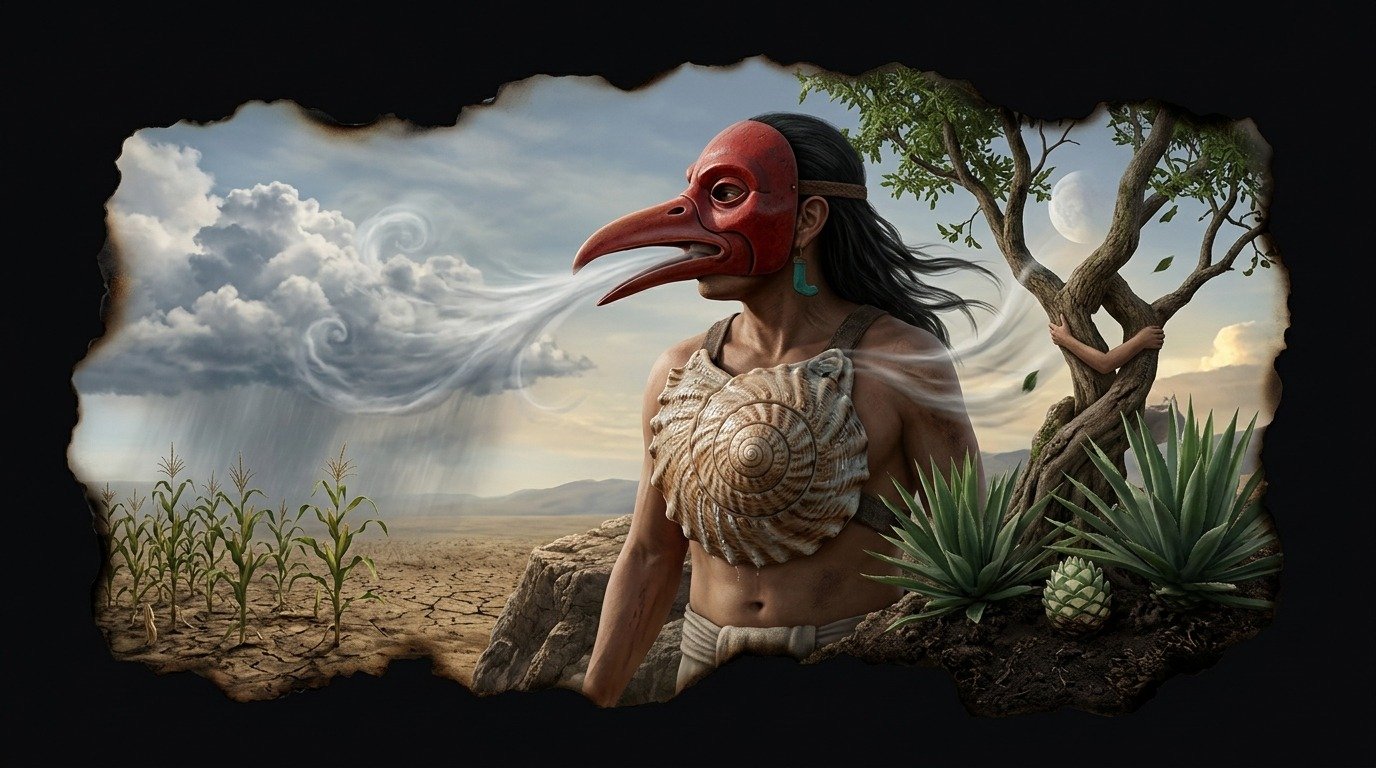
Ehécatl: the breath that moves the worlds
The breath of the origin
Before roads, rivers, or crops existed, the world was a motionless pond under a dull sky. From that primordial stillness arose Ehécatl, the deity of the wind, the great sweeper of the gods. His appearance is unmistakable and strange: he wears a red mask with an elongated bird's beak through which he blows to clear the paths of the world before the arrival of the rains, and upon his chest rests the Ehecailacacozcatl, the wind breastplate cut from a conch shell that resonates with the vibration of storms. Ehécatl is movement personified. He is not simply the air that caresses the fields, but the cosmic impulse that rouses the universe from its inertia. He is the breath of life that enters the lungs of newborns and the invisible force that pushes the water-laden clouds of his brother Tláloc, allowing the thirsty earth to receive the moisture necessary for corn to sprout.
The sacrifice that ignited the sun
The most crucial myth of Ehécatl takes place in Teotihuacan, during the birth of the Fifth Sun. Two gods had thrown themselves into the sacred pyre to become the sun and the moon: Nanahuatzin, the humble one, and Tecuciztecatl, the proud one. Both emerged in the sky as resplendent spheres, but they remained static on the horizon, refusing to follow their course. The earth began to burn under an unbearable heat, and time was frozen in a perpetual noon. The other gods understood that movement required an extreme sacrifice. One by one, they gave their lives to feed the new celestial bodies, but the sun still did not move. It was then that Ehécatl took on the immense task. Standing tall over the earth, he gathered all the air of the cosmos into his lungs and blew with devastating violence. The divine gale shook the heavens, breaking the cosmic paralysis. Under the force of his breath, the sun began its majestic march toward the west, followed by the moon, thus inaugurating the succession of day and night and beginning the era of humanity.
The lover of the wind and the gift of the maguey
Ehécatl's wind does not only bring storms and cosmogonies; it is also capable of a profound tenderness. On one occasion, he descended to the celestial realm to seek out Mayahuel, a young virgin guarded by the terrible deities of darkness, the Tzitzimime. Ehécatl convinced her to descend to earth to share a love that would unite heaven and earth. Upon reaching the earthly world, they intertwined in an embrace and transformed into a tree with two branches that swayed gently in the breeze. When Mayahuel's grandmother discovered the escape, she descended in a fury and tore her granddaughter's branch to pieces so that it would be devoured by her servants. Ehécatl, unharmed, wept bitterly over the remains of his beloved and buried the fragments of her body in the fertile earth. From those ashes and tears sprouted the maguey plant, the sacred cactus that offers aguamiel and pulque to gladden the hearts of men and soothe their pains. Thus, in every drop of pulque and in every gust that shakes the leaves of the maguey, the living and passionate breath of Ehécatl continues to beat.
Comments
Share information, an experience, or a source to help enrich this entry. They are automatically reviewed before being published.
Loading comments...