Itzamná
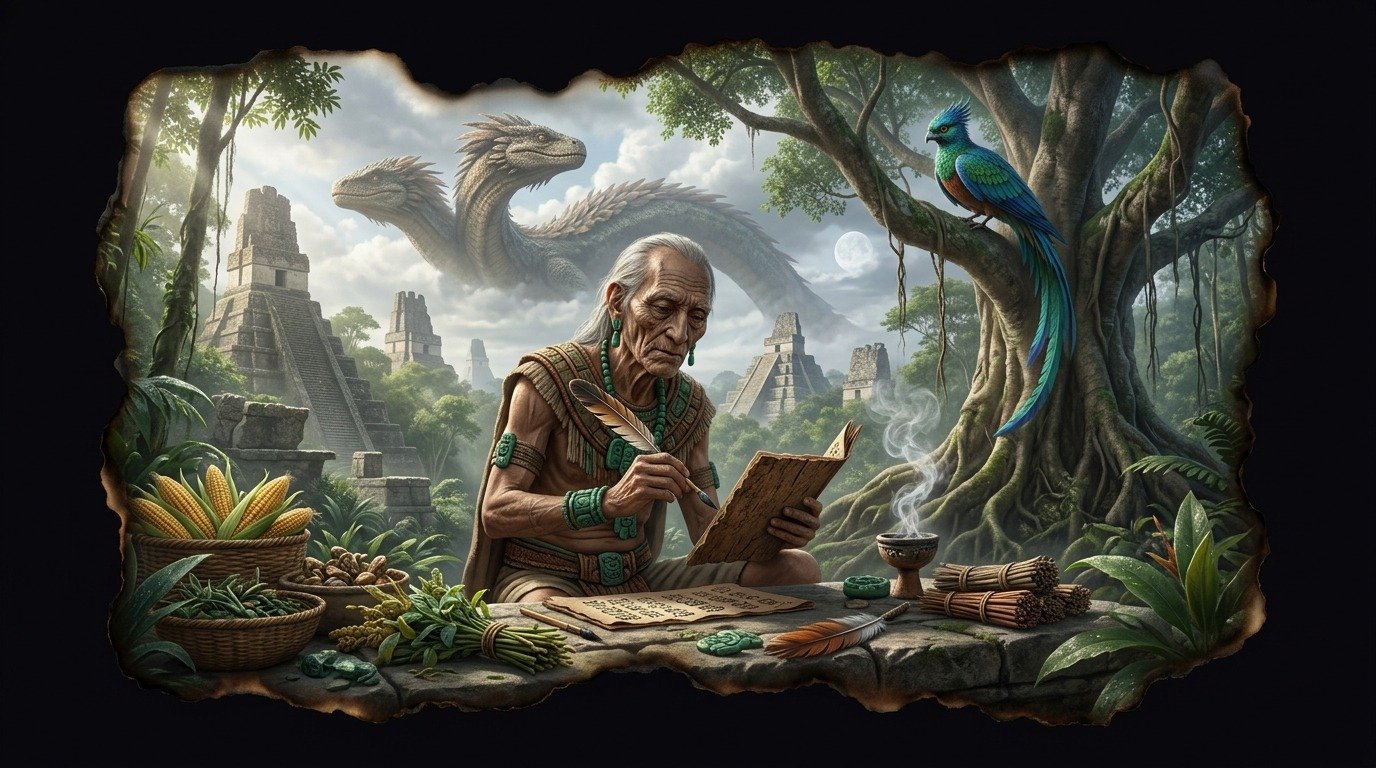
Itzamná: The Lord of the Dew of the Heavens
The Architect of Cosmic Order
In the vast pantheon of the southern jungles, where stone temples rise seeking the clouds, Itzamná stands as the supreme deity, the ruler of the heavens, day, and night. His most common form is that of a wise old man, with sunken cheeks, a toothless mouth, and tired eyes that denote an age older than that of the stars themselves. He is also often represented as a colossal two-headed reptile that spans the firmament, or as a celestial bird that watches over the order of the world from the branches of the cosmic tree, the sacred ceiba.
Itzamná is the antithesis of chaos. He represents the divine intellect placed at the service of civilization. While other gods personify the blind and destructive forces of the storm or fire, Itzamná is the calm water of the morning dew—that which nourishes the crops without harming them—and the serene light of the moon that guides travelers through the night jungle.
The Inventor of Memory and the Written Word
Itzamná's greatest feat was not fought with weapons or blood sacrifices, but with the mind. At the dawn of time, seeing that men wandered the earth aimlessly, devouring roots and forgetting their own stories from one generation to the next, the wise god decided to gift them the tools of culture.
Itzamná descended to the fields of mortals and taught them the cultivation of corn, selecting the strongest seeds so that sustenance would never be lacking on their tables. But his most precious gift was hieroglyphic writing and the calendar. He designed the sacred glyphs with which scribes would record the deeds of kings, the cycles of the stars, and the mysteries of the gods. With this act, Itzamná rescued humanity from oblivion, allowing human knowledge to flow through time like an endless river. He also taught them the use of medicine, revealing the hidden properties of jungle plants and the sacred prayers capable of warding off the illnesses that dwell in the humid air.
The Sustainer of the Universe
As lord of the sky, Itzamná is the invisible pillar that prevents the celestial vault from collapsing onto the earth. The priests and rulers of the great Maya cities considered themselves his representatives on the earthly plane, seeking to imitate his wisdom and temperance when dispensing justice. In New Year ceremonies, his image was carved in wood and placed at the crossroads to bless the crops and ensure the prosperity of the people.
Itzamná does not demand the violence of mass sacrifices; he is better pleased with the burning of aromatic resins, the smoke of copal, and the prayers of scribes who, before tracing a single glyph on bark paper, wet their brushes invoking the name of the wise old man who invented memory so that men could remember that, once, they walked alongside the gods at the beginning of creation.
Comments
Share information, an experience, or a source to help enrich this entry. They are automatically reviewed before being published.
Loading comments...