Mama Quilla
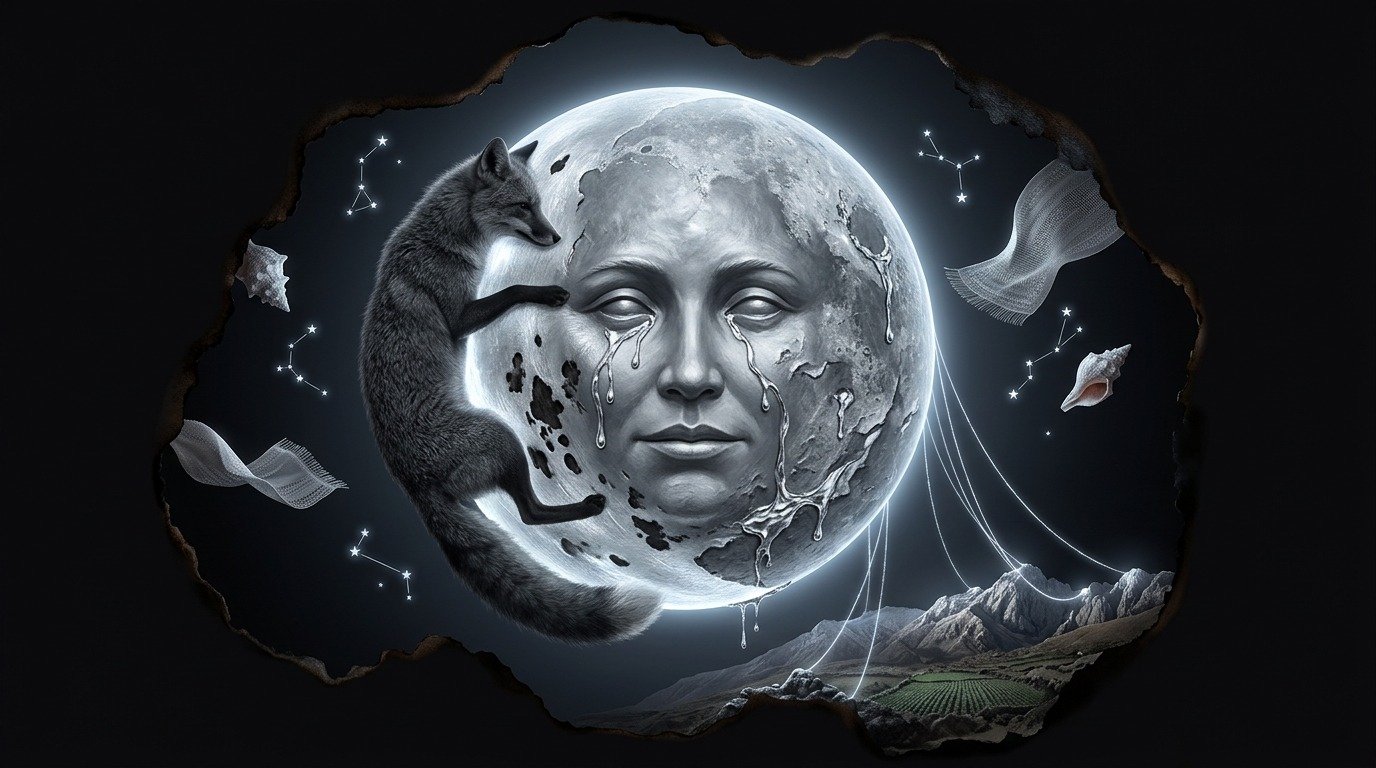
Mama Quilla: The Silver Weeping That Watches Over the Night
The Silver Half of the Cosmos
Before time was measured in harvests, the great creator emerged from the waters of Titicaca to bring order to the primordial chaos. From his breath were born the two eyes of the sky: Inti, the sun of burning fire, and Mama Quilla, his sister and wife, the lady of nightly calm. Together they were tasked with weaving the course of days and eras, but while he was endowed with a light that burns and demands reverence, she was granted the mild glow of silver, a light that does not hurt the eyes and allows men to rest from the weariness of the earth.
Mama Quilla is no mere spectator of the firmament; she is the regulator of the great loom of time. Her slow walk through the monthly phases dictates the rhythm of the tides, the exact moment when the seed must sink into the furrow, and the invisible flow that governs the blood of women. For the Andean people, she is the mother of the firmament, a protective deity who dwells in a palace of beaten silver walls, from where she watches with compassionate eyes the sorrows of the world below.
The Metal of Divine Tears
To understand the power of Mama Quilla, one must look at the silver of the mountains. The ancient inhabitants of the Andes did not see this metal as an instrument of exchange or commercial wealth, but as the physical embodiment of the goddess. Silver was, literally, the tears that Mama Quilla shed over the snowy peaks as she contemplated the pains and hardships of mortals. Every vein discovered in the depths of the rock was a fragment of her divinity that allowed itself to be caressed by the hands of goldsmiths.
In Cusco, the heart of the empire, her sanctuary occupied a place of honor alongside that of the Sun in the Qorikancha. That temple of the Moon knew no gold; it was entirely clad in polished silver plates that reflected the torchlight with a spectral and peaceful glow. In its center rested a representation of the goddess: a large disc of pure silver with a carved human face, surrounded by representations of the stars that served as her retinue. There, women, midwives, and queens came to place offerings of sacred shells and fine textiles, for Mama Quilla was the ultimate protector of female fertility, the guardian of safe births, and the weaver of happy marriages.
The Fox of the Firmament and the Spots on the Moon
Men always wondered why the face of the sky goddess was not a perfect mirror, but instead showed dark shadows that tarnished her silver glow. The Andean answer is found in a story of love and daring involving the most cunning of the animals of the puna: the fox.
In the early times, when the earth was still young, a grey-furred fox fell in love with the unattainable beauty of Mama Quilla. Night after night, the animal climbed to the highest peaks of the altiplano to howl his love to the lady of the sky, begging her to descend or to allow him to climb to her side. Moved by his persistence, or perhaps amused by the creature's audacity, the Moon wove an invisible rope from the threads of her own light and let it fall over the mountaintop.
The fox, without hesitation, climbed the silver ladder until he reached the celestial palace. Finding himself before the goddess, intoxicated by her radiance and fearful of losing her, he threw himself upon her to embrace her. The embrace was so passionate and violent that the fox remained stuck forever to the face of the deity. Since then, when the Moon is full and bathes the valleys in her cold light, men can clearly distinguish the dark silhouette of the fox, an eternal reminder that the desire of mortals can leave its mark even on the skin of gods.
The Dread of the Eclipse: The Fight for the Light
The most terrible moment in the worship of Mama Quilla occurred when shadow took over her face with no apparent explanation. For the inhabitant of the Andes, the lunar eclipse was not a play of astronomical lights, but a desperate battle for the survival of the goddess and, therefore, of all creation.
It was believed that a monstrous feline from the dark regions—sometimes described as a black jaguar, other times as a celestial puma with fangs of ice—ascended to the firmament with the intention of devouring the Moon. As the monster tore her flesh, the goddess began to bleed, staining her usual silver disc with a macabre, purplish-red hue. If the feline managed to consume her completely, the Moon would die, the night would become eternal, and the spirits of the underworld would descend to devour humanity.
To prevent this catastrophe, entire peoples mobilized in a ritual of noise and fury. In every village, from the arid coasts to the highest peaks, people beat drums, blew conch shells, and shook metal spears toward the sky. They made dogs whine and beat household pets so that their cries would rise to the heavens, hoping that the deafening clamor would scare the great feline and force it to release its prey. Only when the red color subsided and the silver glow once again reigned on high did calm return to the earth, and men knew that Mama Quilla had survived once more to continue watching over her children from the silence of the night.
Comments
Share information, an experience, or a source to help enrich this entry. They are automatically reviewed before being published.
Loading comments...