Ixchel
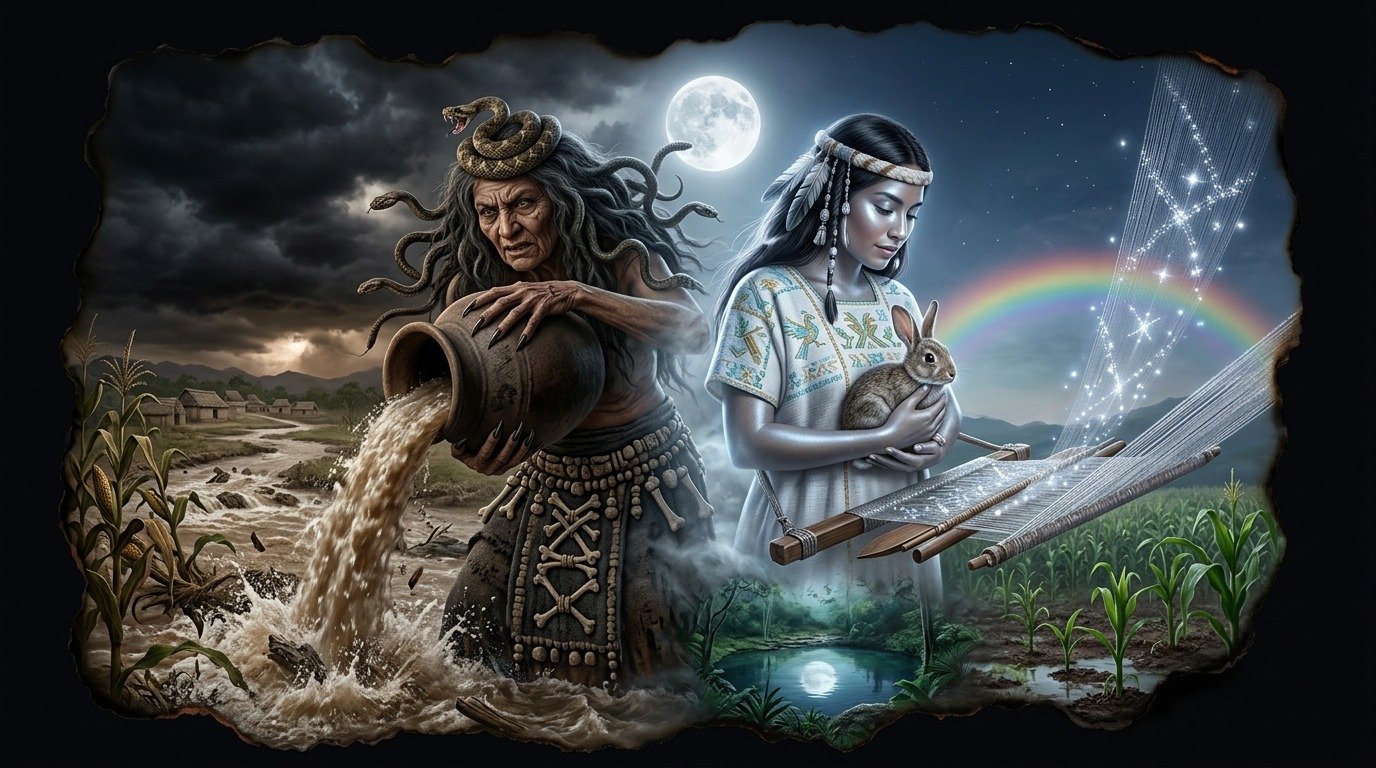
Ixchel: The Weaver of Tides and Silver Destiny
The Old Woman of the Icy Water and the Rainbow Maiden
On nights when the moon hides behind the black storm clouds, an old woman with sharp claws and snake hair tilts a clay pitcher over the earth. From the mouth of the vessel falls no gentle water, but a furious torrent that floods crops, overflows rivers, and punishes the arrogance of men. She is Ixchel in her shadow aspect, the destroyer of the ancient world. But when the sky clears and the moon shines in its round fullness, that same deity transforms into a young woman of luminous beauty who holds a rabbit in her arms and weaves the destiny of newborns with silver threads on a backstrap loom. Ixchel is the duality of water and of life itself. She is the midwife who receives the child's first cry and the death that claims the old man's last breath. Born from the clash between sunlight and the moisture of the primordial jungle, her home is in the firmament, but her gaze is always fixed on the wombs of women and the depths of the sacred cenotes, where the still water reflects her changing face.
The Loom of the Threads of Life
Ixchel's power extends over everything that flows and transforms. She rules the cycles of the moon and, therefore, the ocean tides, the growth of plants, and the blood that runs through the veins of women. On her cosmic loom, the cotton threads represent the lives of humans; every knot is a birth, every crossing of threads is an encounter, and the final cutting of the strand is the end of the earthly journey. Healers and midwives invoke her name before touching the womb of a mother in labor, for they know that only Ixchel has the power to open the birth canal or close it forever. Her medicine is not of abstract chants, but of bitter roots, leaves crushed under the light of the waning moon, and the warm steam of temazcal baths where the body is cleansed of pain and bad winds.
The Flooding Weeping of the Waning Moon
There was a time when humanity forgot the respect due to the earth and the cycles of water. The wells dried up out of greed, and the water of the cenotes turned bitter. Ixchel, enraged by the arrogance of mortals, assumed her form of a terrible old woman. Crowned by a rattlesnake hissing upon her forehead and wearing a skirt decorated with crossed bones, she completely emptied her sacred pitcher over the world. The heavens broke and the ocean waters rose to cover the highest mountains. There was no corner left untouched by her liquid wrath. However, in the midst of the destruction, Ixchel saw a couple floating on a sacred cedar log, protecting the seeds of corn and medicinal plants. Seeing that respect for life still beat in their chests, the goddess stopped the flood, stored the storm back in her pitcher, and painted a rainbow in the damp sky, promising that water would henceforth be a source of life and not of death, as long as men did not forget to offer the first drink of every harvest to the earth that sustains them.
The Pilgrimage to the Island of the Dawn
The memory of the goddess of the loom still beats strongly on the island of Cozumel, her most sacred sanctuary. In ancient times, women from all over the Mayan world paddled in canoes through rough water channels to reach her altars and ask her for fertility, a safe childbirth, or the cure of a persistent fever. Today, the sound of the waves crashing against the island's reefs seems to repeat her name, and the light of the full moon upon the sea remains proof that Ixchel continues to weave, in the silence of the night, the destiny of all who walk beneath her silver mantle.
Comments
Share information, an experience, or a source to help enrich this entry. They are automatically reviewed before being published.
Loading comments...