Huitzilopochtli
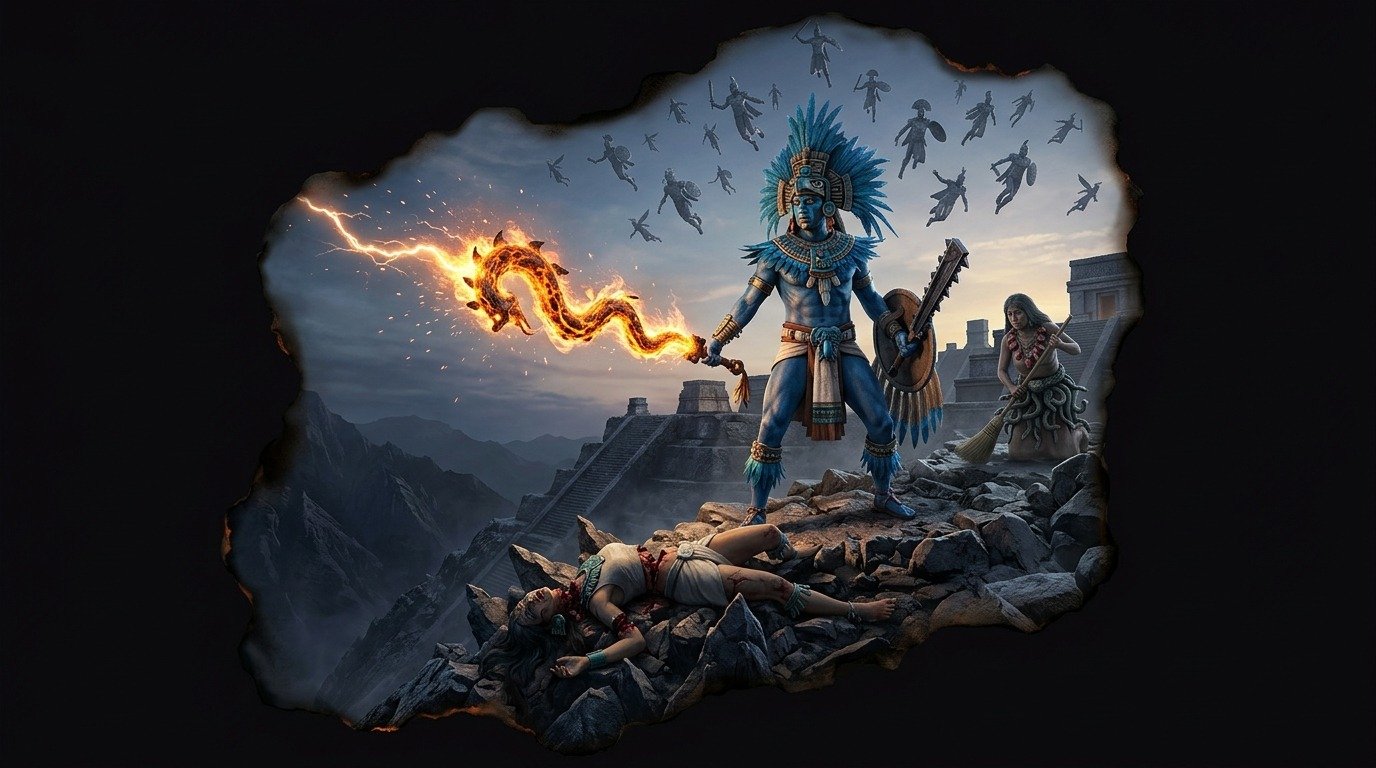
Huitzilopochtli: the warrior hummingbird of the solar will
The birth on the dragon mountain
On the summit of Coatepec, the Mountain of the Serpent, the ancient mother of the gods, Coatlicue, was performing her penance duties sweeping the temples when a small ball of bluish hummingbird feathers fell from the sky. The mother carefully tucked it into her bosom, and at that very moment she became pregnant with the most fearsome and luminous force the cosmos would ever know: Huitzilopochtli.
However, her other four hundred children, the southern stars, and her older sister, the implacable Coyolxauhqui, considered this mysterious pregnancy an unbearable dishonor. Armed with copper axes and obsidian shields, they marched in war formation toward the mountain to decapitate their own mother. As the army of the night ascended the slopes with the clatter of bronze bells, a voice resonated from Coatlicue's womb, telling her not to fear, for he knew well what he had to do.
At the precise moment the attackers reached the summit, Huitzilopochtli was born. He did not come into the world as a helpless infant, but as a formidable warrior, his body painted blue, hummingbird feathers adorning his head, and wielding in his right hand the Xiuhcoatl, the fire serpent that is the solar ray. With a single swift movement, Huitzilopochtli severed the head of his sister Coyolxauhqui and cast her body down the hill, dismembering with every fall upon the rocks. Then, he pursued the four hundred celestial brothers, dispersing them across the firmament so they could never threaten the light again.
The eternal battle of midday
Since that day of blood on the sacred mountain, Huitzilopochtli assumed the heaviest task of the cosmic order: to guide the sun across the celestial vault and defend it from the clutches of the night. Every dawn is a recreation of the battle of Coatepec. The god must fight against the stars and the monsters of twilight so that the light can warm the crops and sustain life on earth.
To wage this daily war, the Left-Handed Hummingbird needs energy. He is not a deity who settles for abstract prayers or the scent of flowers; he demands the precious water, the warm blood of warriors captured in combat. His physical strength is directly linked to the combative will of his worshipers. If the flow of sacrifices is interrupted, Huitzilopochtli will weaken, the beasts of darkness will devour the sun, and the entire universe will plunge into a cold, endless night where humanity will cease to exist.
The engine of the obsidian empire
Huitzilopochtli is not just a force of the cosmos; he is the jealous protector and absolute guide of the Mexica. It was he who spoke to them in the northern deserts, ordering them to abandon their original homeland and march on a pilgrimage that would last for centuries. During this exodus, the priests carried on their shoulders a sacred bundle containing his relics, and from within it, the god whispered precise instructions on where to camp, whom to wage war against, and how to purify their lineage.
The long march culminated when the god showed them the promised sign in the middle of Lake Texcoco: an eagle perched on a nopal cactus, devouring a serpent under the midday sun. In that swampy and inhospitable place, Huitzilopochtli ordered the erection of his great temple, an architectural reflection of the mountain of Coatepec. From that stone fortress, the god of fire drove the expansion of an empire that saw war as a mystical and necessary mission: to keep the universe alive through the edge of obsidian and the fire of sacrifice, under the ever-watchful gaze of the great metal hummingbird.
Comments
Share information, an experience, or a source to help enrich this entry. They are automatically reviewed before being published.
Loading comments...