Mictecacíhuatl
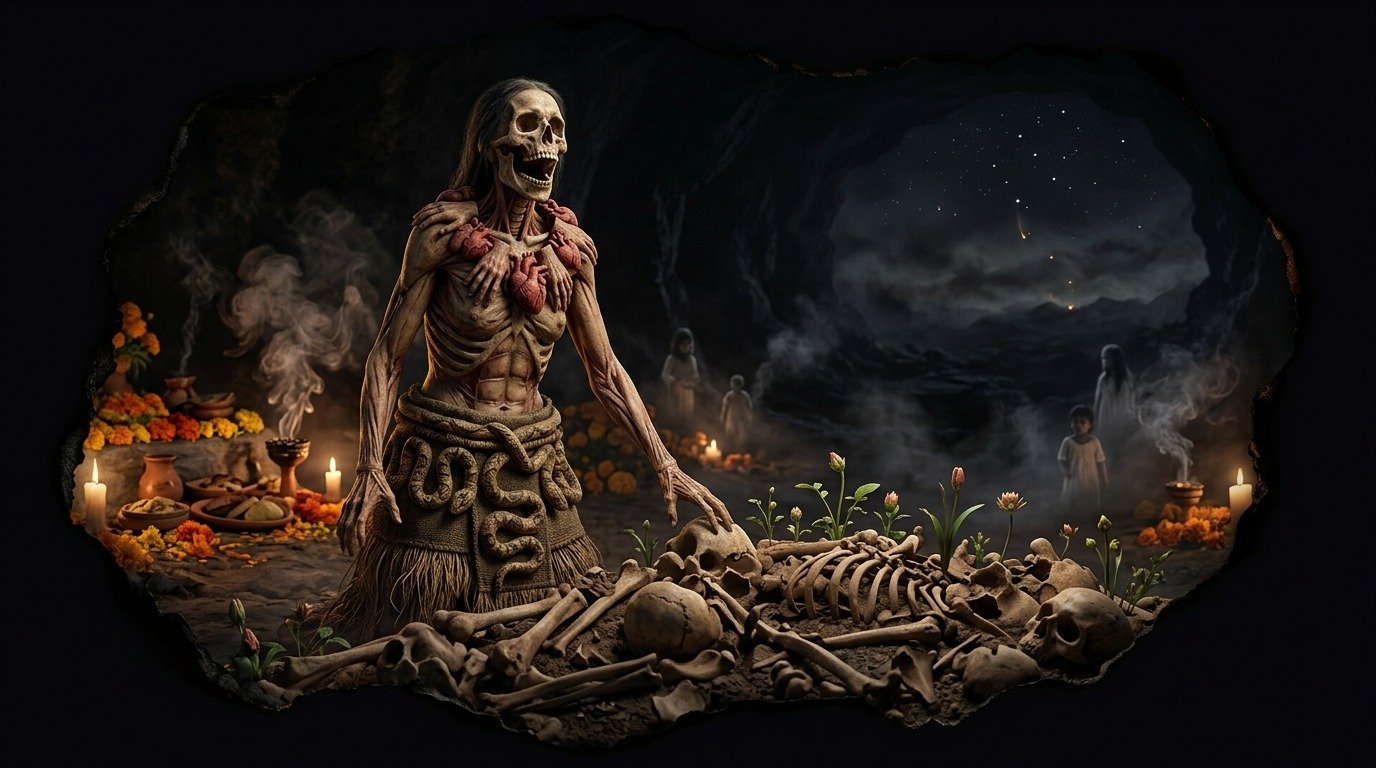
Mictecacíhuatl: The Lady of the Dead
Who is Mictecacíhuatl
Mictecacíhuatl is the Mexica goddess of death, the queen of Mictlán, and the wife of Mictlantecuhtli, the lord of the underworld. Her name means "Lady of the place of the dead." She was the guardian of the bones of the deceased and the one who presided over the festivals that the Mexica dedicated to their dead, the very same ones that, after the conquest, were transformed into the Day of the Dead. For this reason, many consider her the true mother of that celebration and see her reflected in La Catrina.
The Queen of the Ninth Level
At the end of the four-year journey through Mictlán, when the soul finally crosses the river, the clashing hills, the wind of obsidian blades, and the beasts that eat hearts, it reaches the last level. There, two figures waiting in the darkness await them: Mictlantecuhtli and Mictecacíhuatl.
The codices show her with a fleshless body, a skull face, and an open jaw, as if she were ready to swallow the stars that sink into the horizon every night. She wears a skirt adorned with snakes and, sometimes, necklaces of hands and hearts. It is an image made to inspire fear, but also to recall something the Mexica took for granted: everything that is born ends in her hands.
The Guardian of the Bones
For the Mexica, bones were the seed of life. From them, current humans had been created when Quetzalcóatl went down to Mictlán to steal the remains of previous humanities. And from them, they believed, new life could sprout, just as a plant sprouts from a buried seed.
Mictecacíhuatl was the custodian of that seed. She cared for the bones of all the dead who arrived in her kingdom. She did not destroy them: she kept them. That is why her figure is not only that of the end, but that of the earth that receives and preserves what once lived.
The Festivals of the Dead
In the Mexica calendar, there were two months dedicated to the deceased: one for children, the "little festival of the dead," and another for adults, the "great festival of the dead." They fell in the middle of summer, and Mictecacíhuatl was their protector.
During those days, the dead were honored with food, flowers, songs, and offerings, and it was believed that their souls could draw close to the living again. When the Spaniards arrived, the Church moved those festivals to November 1 and 2 to make them coincide with All Saints' Day and All Souls' Day. They changed the date and the prayers, but not the central idea. The festival of Mictecacíhuatl survived under another name: Day of the Dead.
The Goddess Who Was a Sacrificed Child
Some late versions tell that Mictecacíhuatl was born in the world of the living and was sacrificed when she was still a baby, and that is why she ended up reigning in the world of the dead. The story does not appear in the oldest sources and is probably a later reworking, but it is repeated a lot in Mexico and gives the goddess a more human face: that of someone who knew death all too soon.
Mictecacíhuatl and La Catrina
Every November, millions of people paint their faces like skulls and adorn themselves with flowers to look like La Catrina, the elegant skull created by the engraver José Guadalupe Posada at the beginning of the 20th century. Posada was not inspired by the goddess: his skull was a mockery of people who denied their roots. But over the years, the people merged them. Both are a woman made of bones, both reign over the dead, and both return every year when the candles are lit on the altars.
For many, La Catrina is the modern disguise with which Mictecacíhuatl continues to walk among the living.
Comments
Share information, an experience, or a source to help enrich this entry. They are automatically reviewed before being published.
Loading comments...