Kukulkán
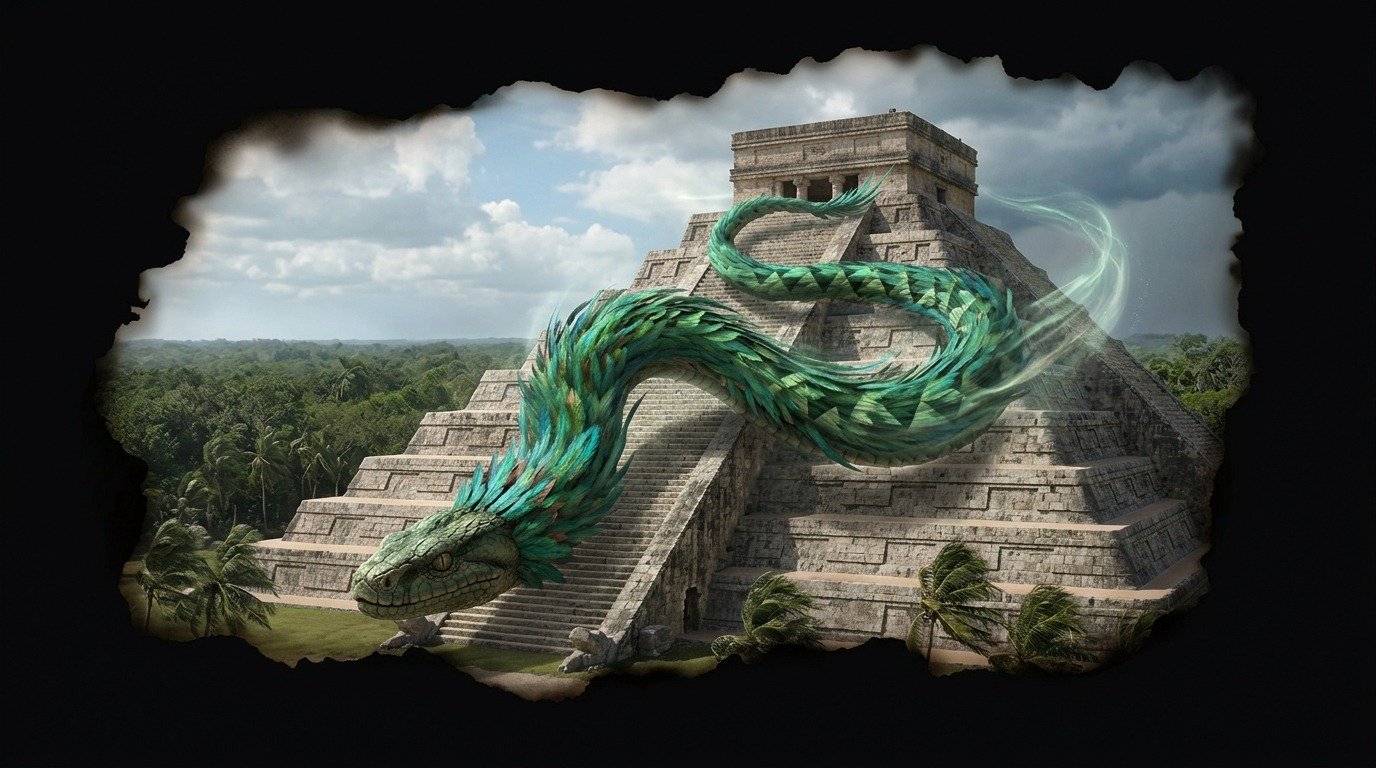
Kukulkán: the breath of wind dressed in feathers and light
The descent of the feathered lizard
In the heart of the stone jungle, when the year splits in half, a precise shadow begins to crawl down the northern stairway of the great temple of Chichén Itzá. It is no ordinary shadow; it is a body made of triangles of light and darkness that slowly descends from the celestial heights to join the stone head waiting at the foot of the pyramid. This play of shadows is the god himself returning to touch the earth. He is the serpent that flies, the reptile covered in quetzal feathers that unites the abyss of the underworld with the purity of the high sky.
His origin is the wind that sweeps the paths before the storm, the humid air that travels from the eastern sea to awaken the dry land. Before he breathed upon the clay, the world was a silent and warm swamp. Kukulkán was not born of flesh, but of the clash between the divine breath and ocean currents. His emerald body is a living contradiction: the heaviness of the reptile that knows the secrets of the earth and the weightlessness of the bird that masters the ether. When he moves, he does not crawl; he floats above the treetops, leaving a trail of fresh winds that cleanse the air of evil spirits.
The lord of the wind and the tides of sowing
Kukulkán does not claim desperate blood sacrifices nor demand the terror of his faithful; his domain is that of order, the measurement of time, and the flow of the seasons. He is the god who moves the air so that rain clouds empty over the cornfields. When the heat becomes unbearable and the milpa threatens to dry up, the whistling of the wind among the rocks is the sign that the Feathered Serpent is clearing the sky to make way for the sacred downpours.
His power manifests in the mathematics of the universe. He taught the priests to look at the stars, to calculate the passage of Venus, and to understand that time is not a line that dies, but a wheel that always returns to the same point. In every breath of wind that bends the palms, in every summer storm that shakes the coast, his energy in motion is felt. He is a civilizing force, the divine architect who laid out the avenues of the stone cities to align with the course of the stars.
The serpent who taught men
The myth that defines Kukulkán is that of his departure and his eternal promise of return. It is said that he arrived from the eastern sea, a being with a pale face and a beard of foam, wearing long robes that imitated the plumage of the quetzal. He brought with him the cultivation of corn, the writing that guards the memory of kings, and the use of the calendar that organizes the days of men. During his reign in mythical Tollan, the earth produced cotton of natural colors and the ears of corn were so large that a single man could barely carry them.
But light always attracts shadow. Deceived by darker forces that envied his purity and his love for mortals, Kukulkán had to abandon his kingdom. He did not do so in anger, but with a deep sadness. He built a raft of intertwined serpents and sailed toward the horizon where the sun rises. Before losing himself in the vastness of the ocean, he promised that he would return in a specific year of the wheel of time to reclaim his throne and restore the golden age. Since then, the men of the desert and the jungle look to the east every sunrise, waiting for the morning breeze to bring back the shine of his green feathers.
The eternal return upon the stones
His footprint has not been erased by the passage of centuries or the arrival of new cults. It remains alive in the limestone that still resists the siege of the jungle. The descent of the serpent during the spring and autumn equinoxes continues to gather thousands of souls who watch in silence as the god keeps his appointment with time. Kukulkán is not a relic of the past; he is the wind that keeps blowing over the ruins, the sea breeze that cools the hot afternoons of the peninsula, and the certainty that, sooner or later, everything that departed toward the east will find its way back.
Comments
Share information, an experience, or a source to help enrich this entry. They are automatically reviewed before being published.
Loading comments...