Chichén Itzá
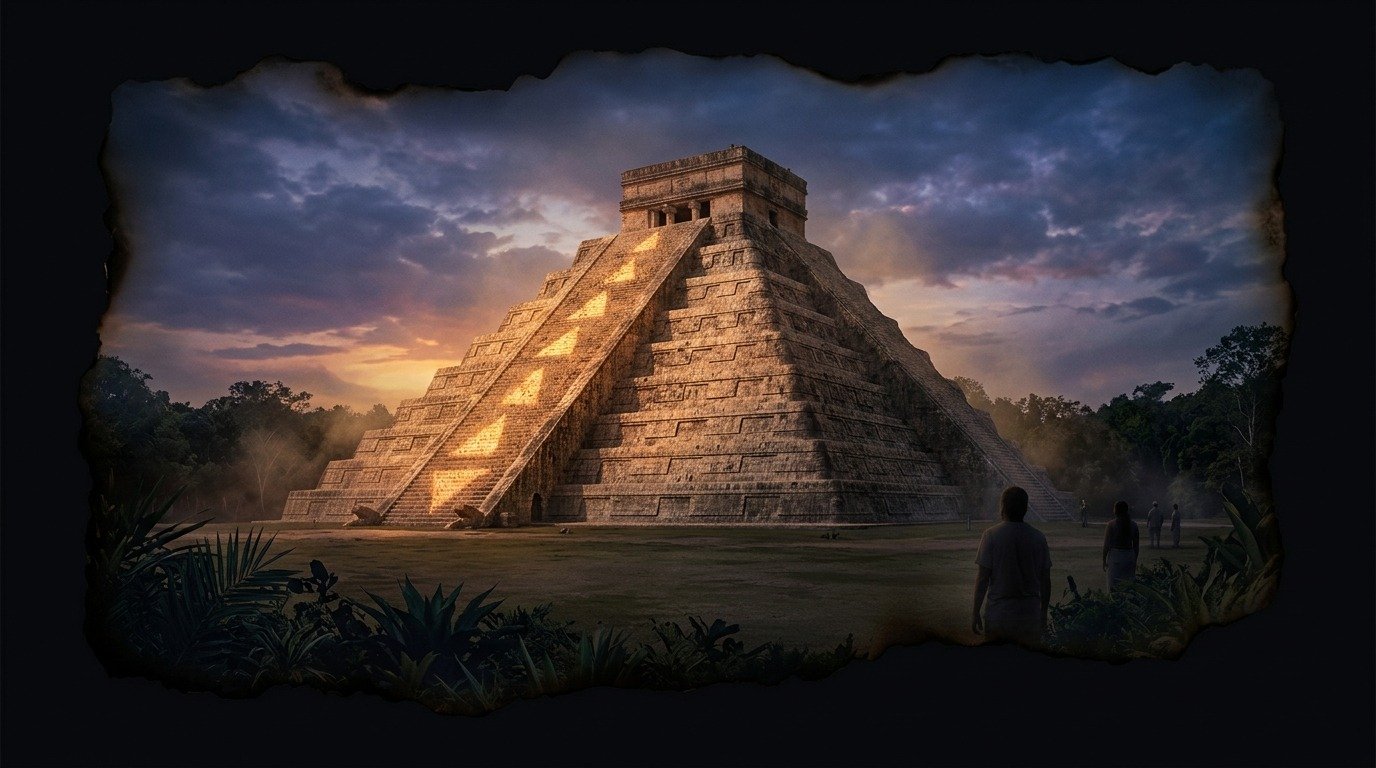
Chichén Itzá: The Descent of the Serpent of Light
During the spring and autumn equinoxes, at three in the afternoon, thousands of people gather in silence in front of El Castillo pyramid in Chichén Itzá. As the sun moves toward the horizon, the rays of light pierce the corners of the temple's terraces, casting a series of seven isosceles triangles of light and shadow onto the balustrade of the northern stairway. The optical phenomenon is unmistakable: the body of a serpent of light slowly descends from the top of the building until it joins the gigantic stone head of Kukulcán resting at the base of the pyramid, connecting heaven and earth in a spectacle designed a thousand years ago.
The Metropolis of the Sacred Wells
Chichén Itzá, which means "At the mouth of the well of the Itza," was founded in the north of the Yucatán Peninsula in a region devoid of surface rivers. The survival of the city depended entirely on cenotes, immense natural sinkholes that expose groundwater. The most important of all, the Sacred Cenote, is a circular pit sixty meters (197 feet) in diameter with vertical limestone walls that drop twenty-two meters (72 feet) to dark green water of unfathomable depth.
The city became the political and religious epicenter of the Mayan world between the years 600 and 1200 of our era. Under the influence of the Toltecs of central Mexico, the inhabitants of Chichén Itzá built imposing structures such as the Temple of the Warriors, the Group of the Thousand Columns, and the Great Ball Court, the largest court in Mesoamerica, flanked by stone walls carved with scenes of the ritual decapitation of team captains.
The Song of the Quetzal and the Rain God
El Castillo, the central pyramid of Chichén Itzá, is an astronomical calendar made of stone. Its four stairways have ninety-one steps each which, when added to the upper platform, total three hundred and sixty-five days, corresponding to the solar year.
The acoustic design of the pyramid is as astonishing as its astronomical architecture. If a visitor stands in front of the northern stairway and claps loudly, the echo bounces off the inner faces of the temple and returns as a high-pitched chirp that perfectly mimics the song of the quetzal, the sacred bird whose green plumage was more valuable than gold to Mayan rulers.
The Sacred Cenote, for its part, was considered the dwelling place of Chaac, the rain god. During periods of extreme drought, priests threw valuable offerings of jade, gold, copper, and seashells into the abyss, as well as live human victims, primarily children and young men, to appease the god's wrath and ensure the return of the water that gave life to the corn crops.
The Cold of the Cenote and the Whispers of the Ball Court
Visitors to Chichén Itzá describe a marked difference in temperature as they approach the Sacred Cenote; the air becomes humid, cold, and dense, heavy with the smell of decaying vegetation.
In the great Ball Court, the acoustics of the space continue to defy the laws of physics. A whisper uttered at one end of the court, one hundred and fifty meters (492 feet) away, can be heard with total clarity at the opposite end without the need to raise one's voice. Those who walk through the center of the court on solitary days claim to feel the heaviness of a space where life and death were decided by the bounce of a heavy rubber ball.
The Revelations of the Mud
At the beginning of the 20th century, the American consul Edward Herbert Thompson purchased the plantation where Chichén Itzá was located and dredged the Sacred Cenote. The excavations brought to light thousands of ceremonial objects and the skeletal remains of more than a hundred people.
Modern forensic analyses confirmed that the victims of the cenote showed marks of trauma and cuts consistent with ritual sacrifices, debunking the romantic nineteenth-century legend that only young virgins dressed in white were sacrificed. Furthermore, for many archaeologists, the descent of the serpent of light is not an accident of geometry, but the result of a precise calculation that combined knowledge of solar movement with the design of the temples; others believe it is a happy coincidence that the Maya knew how to exploit.
The Jaguar's Gaze
Inside El Castillo, within an older pyramid that was buried beneath the current one and to which public access is no longer permitted, rests a carved throne in the shape of a jaguar painted bright red with dozens of green jade inlays simulating its spots. The stone feline continues to guard the entrance of the temple, looking out toward the infinite jungle as it awaits the next equinox, when the serpent of light will descend once more from the sky.
Comments
Share information, an experience, or a source to help enrich this entry. They are automatically reviewed before being published.
Loading comments...