Stonehenge
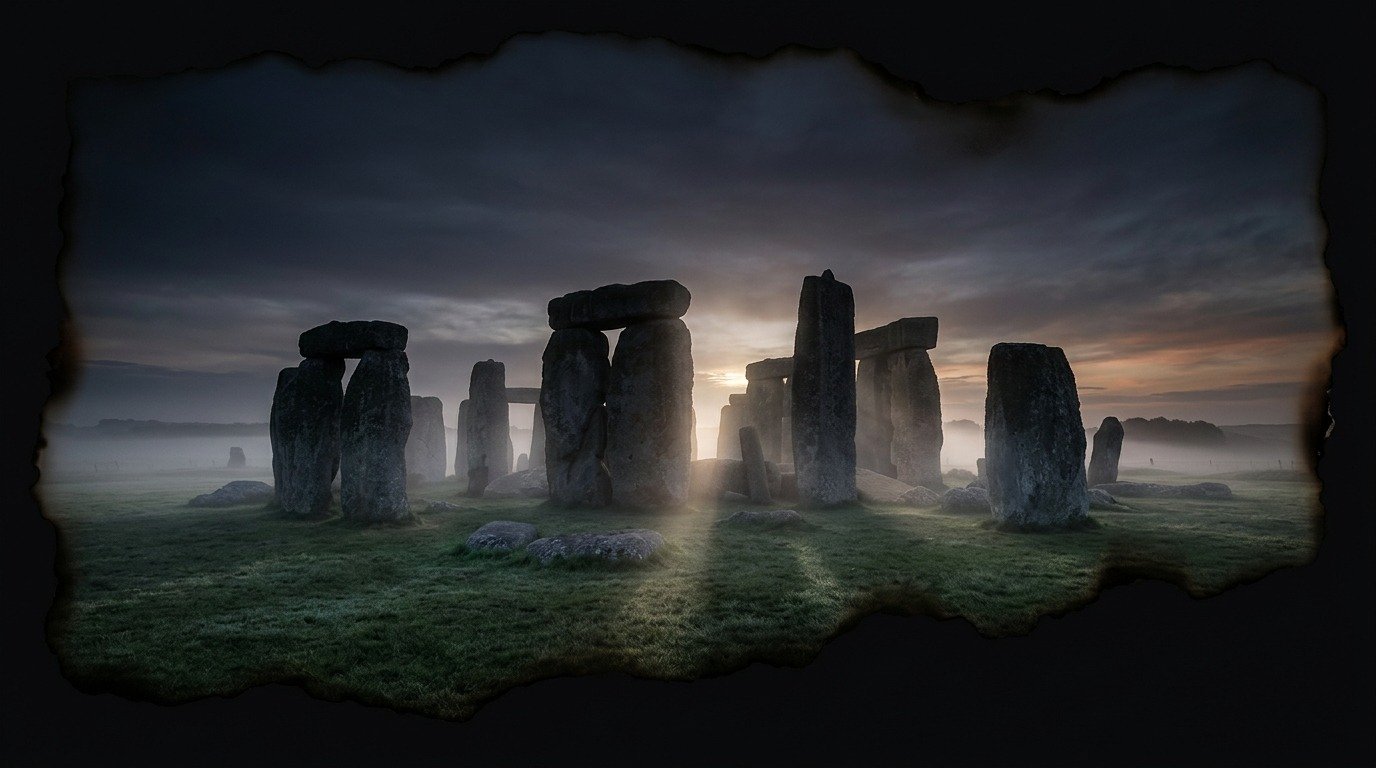
Stonehenge: The Temple of Giants and Solstices Under the Wiltshire Sky
The dawn of June 21st over Salisbury Plain is no ordinary dawn. When the first ray of sun cuts through the thick Wiltshire mist, it passes exactly over the Heel Stone and strikes the heart of the stone circle. Four thousand years ago, hundreds of people watched this moment in absolute silence, barefoot on the damp grass, knowing that the cosmic cycle was once again complete. There was no room for error: a millimeter (0.04 inches) of deviation in the calculation and the sun god would have rejected their offering.
The Construction of a Colossus
The history of Stonehenge began long before the great stones we know today were raised. Around 3000 BC, this piece of English land was just a circular ditch and an earthen bank. In that ground, the ashes of the dead were buried. It was a sacred cemetery, but the fate of the place changed completely five hundred years later. It was then that one of the greatest feats achieved by humans in antiquity began. The builders brought the so-called "bluestones," blocks of igneous rock weighing between two and five metric tons (2.2 and 5.5 short tons), from the Preseli Hills in Wales. They transported them over more than two hundred kilometers (124 miles) of rivers, hills, and marshes, without carts or draft animals, using only the strength of their arms, wooden rafts, and plant-fiber ropes. Later came the "sarsen" sandstone stones, monumental blocks of up to thirty metric tons (33 short tons) quarried from thirty kilometers (18.6 miles) away. To support the lintels that crown the circle, the builders carved mortise-and-tenon joints into the living rock, a woodworking technique applied to stone with millimeter precision. Each pillar was buried deep in the earth and balanced to withstand the battering of the north wind for the next millennia.
The Dance of the Giants and the Wizard Merlin
During the Middle Ages, faced with the impossibility of understanding how primitive men had raised such a structure, legend took hold of the place. The medieval chronicler Geoffrey of Monmouth wrote in the twelfth century that the stones did not belong to England, but instead formed a sacred circle called "The Giants' Dance" in Ireland. According to his account, King Aurelius Ambrosius wanted to erect a monument to commemorate the British nobles massacred by the Saxons. The wizard Merlin used his magic arts to dismantle the circle in Ireland and float it over the sea to its current location. Centuries later, seventeenth-century antiquarians attributed the construction to the Druids, the Celtic priests who performed rituals in the forests. They imagined bloody sacrifices upon the great central slab, known today as the Altar Stone. Although it is known today that Stonehenge was already abandoned when the Celts arrived in the British Isles, the Druidic mystique remained imbued in the rocks forever. The site went from being a cemetery to becoming an astronomical temple, a stone calendar capable of predicting eclipses and marking the passage of the seasons.
The Whisper of the Stones in the Rain
Anyone who approaches Stonehenge today feels a strange vibration in the air. Visitors claim that, upon approaching the circle, the noise of the wind outside decreases drastically, creating an unreal bubble of silence. Acoustic research revealed that the stones were arranged in such a way that they amplified chanting and drumming toward the inside of the temple, while blocking sound to the outside, isolating the priests from the rest of the tribe. The guards who watch over the monument at night recount phenomena that defy reason. They claim that compasses spin out of control near the bluestones and that, on stormy nights, electrical discharges seem to be attracted to the Heel Stone, illuminating the complex with bluish flashes erupting from the ground itself. At every solstice, thousands of people gather there to touch the cold stones and feel the energy accumulated over millennia of solar and stellar worship.
The Truth Beneath the Grass
Modern archaeology has stripped the site of its medieval fantasies, but it has revealed an even more astonishing truth. Excavations and carbon-14 analysis confirm that Stonehenge was the center of an immense sacred landscape. It was not an isolated monument: beneath the Salisbury grass, dozens of wooden and earthen monuments, burial mounds, and processional avenues connecting Stonehenge to the River Avon have been discovered. The human remains found at the site and its surroundings reveal that many of those buried came from afar: from Wales, the rest of Great Britain, and even continental Europe. Some presented serious illnesses and wounds, and this fuels one of the most fascinating theories about the place: that the bluestones of Wales were reputed to heal, and that Stonehenge was a sanctuary of healing and death, where the sick made pilgrimages to draw their last breath under the gaze of their deities. When night falls over the plain and the tourists leave, Stonehenge reclaims its true essence. The silhouettes of the trilithons outlined against the dark sky continue to guard the secrets of the men who raised them. There they remain, silent and eternal, waiting for the next solstice to light up once again with the sun's light.
Comments
Share information, an experience, or a source to help enrich this entry. They are automatically reviewed before being published.
Loading comments...