Pyramids of Giza
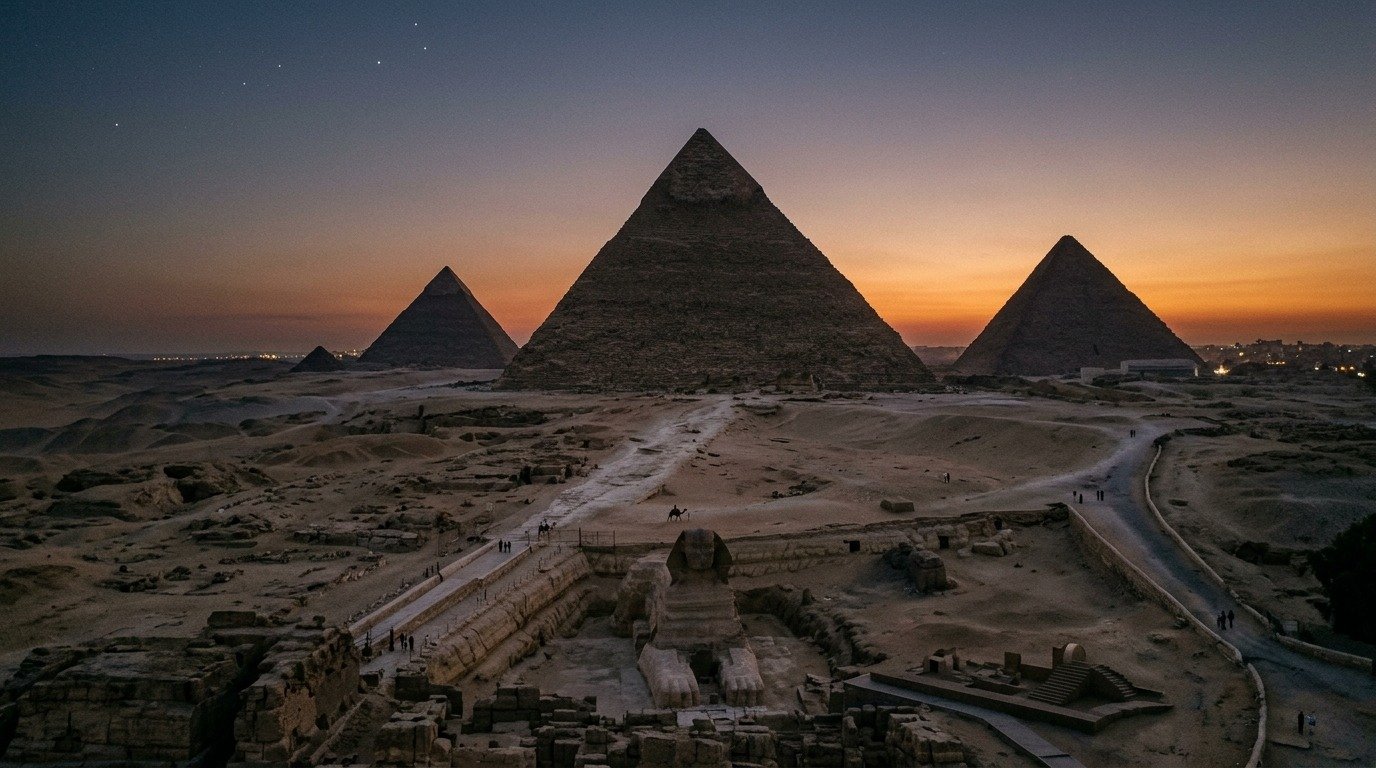
Pyramids of Giza: the stone mountains that defy time
In the year 820 of our era, Caliph Al-Ma'mun and his entourage of royal stonemasons forced their way into the Great Pyramid using battering rams, fire, and cold vinegar to crack the colossal limestone blocks. After breaking through the dense rock, they reached the so-called King's Chamber. The caliph expected to find mountains of gold, celestial maps, and the mummified bodies of ancient kings guarded by spells. Instead, the torches illuminated a completely empty room, with smooth red granite walls, and a single object in the center: a stone sarcophagus, carved from a single block, without a lid and absolutely empty.
The construction of the horizon
The Giza plateau, a rocky promontory overlooking the Nile Valley, was transformed more than four thousand five hundred years ago into humanity's most ambitious architectural project. During the Fourth Dynasty of the Old Kingdom, three pharaohs—Khufu, Khafre, and Menkaure—ordered the construction of these colossal stone mountains to ensure their passage into eternity.
The Great Pyramid, erected for Khufu, consists of more than two million three hundred thousand stone blocks, with an average weight of two and a half metric tons (2.75 short tons) each. Egyptian engineers aligned the four faces of the monument with the cardinal points with near-perfect precision, making an error of barely fractions of a degree. Each block was dragged from nearby quarries and fitted together with astonishing precision, creating a structure so solid that it survived earthquakes that leveled entire cities around it.
The map of the stars and the curse of the desert
The position of the three pyramids has always fascinated. According to a theory popularized in the nineties and highly debated by Egyptologists, the layout of the monuments on the plateau mimics that of the three stars of Orion's Belt, the constellation that the ancient Egyptians associated with Osiris, the god of resurrection and the underworld.
The mythology of the place is steeped in reverent awe. Some Old Kingdom tombs bear inscriptions threatening punishment to anyone who profanes the deceased's rest. The Great Sphinx, the lion with a human head guarding the entrance to the necropolis, was known by the Arabs as *Abu al-Hol*, the Father of Terror, a stone guardian destined to devour the souls of the impure who attempted to decipher the secrets of the plateau.
The vibration in the granite chamber
Those who manage to enter the Great Pyramid today and climb the Grand Gallery—an inclined passageway nearly fifty meters (164 feet) long with corbelled ceilings—describe a dense, warm atmosphere devoid of drafts. Upon entering the King's Chamber, the silence is absolute, but many visitors experience a strange physical vibration.
The chamber, built entirely of granite brought from Aswan, has a remarkable resonance: a sound emitted inside vibrates and lingers in a disorienting way. There are those who believe that priests used it in initiation ceremonies; no Egyptian text confirms this, but anyone who has ever chanted inside understands why the idea survives.
The truth of the builders
Modern archaeology has debunked the myth that the pyramids were built by slaves whipped under the desert sun. The discovery of the Giza builders' town revealed that the works were executed by tens of thousands of free, highly skilled laborers. These men lived in permanent camps, received wages from the State, ate premium-quality meat, and had access to advanced medical care for the time, as evidenced by recovered skeletal remains showing perfectly healed fractures.
For archaeology, the pyramids were tombs and part of a large funerary complex; for the esoteric tradition, they were also temples of transformation designed to unite the pharaoh with the celestial gods.
The last witness of the ancient world
As the sun sets behind the Giza plateau, the silhouette of the stone colossi cuts across the Cairo skyline. The Great Pyramid is the only one of the Seven Wonders of the Ancient World still standing. Centuries pass, empires fall, and civilizations fade into dust, but the old Arabic proverb remains intact: man fears time, but time fears the pyramids.
Comments
Share information, an experience, or a source to help enrich this entry. They are automatically reviewed before being published.
Loading comments...