Glastonbury
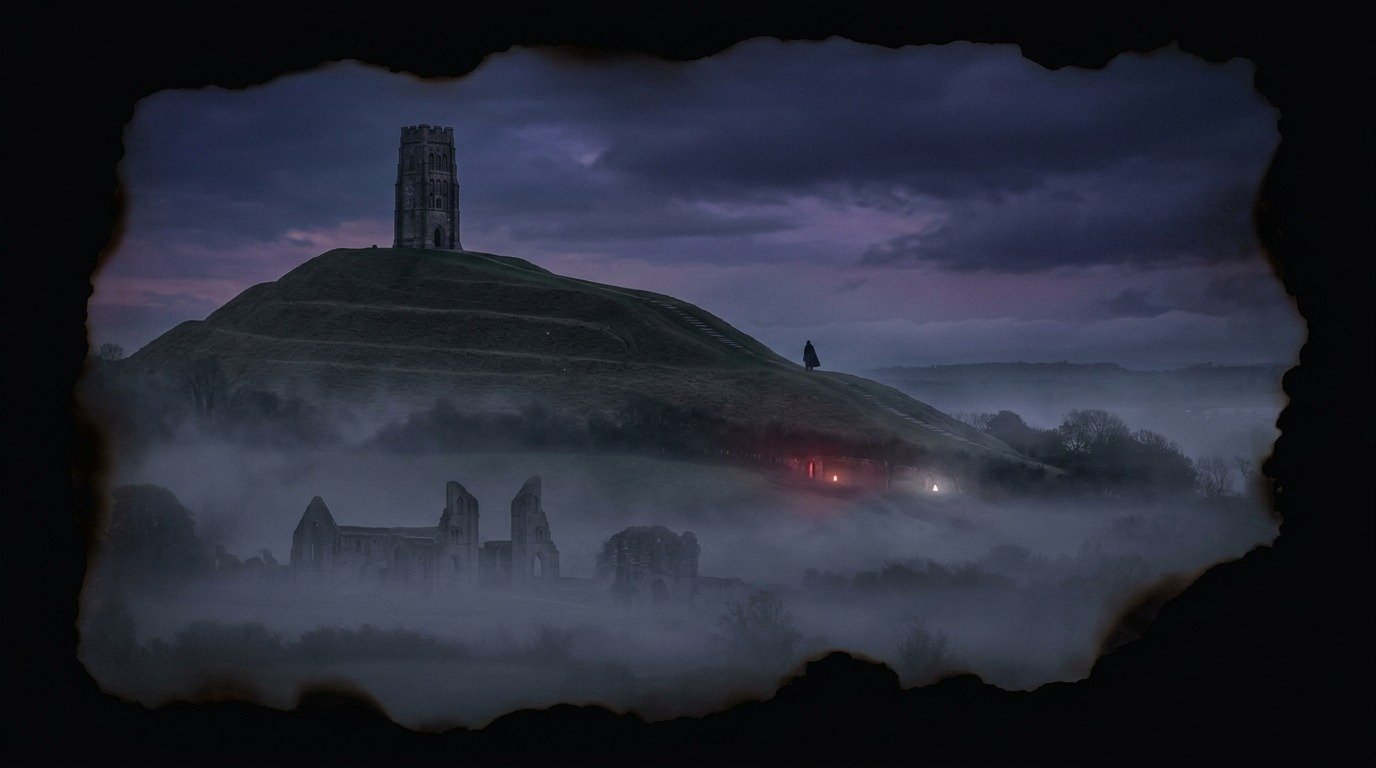
Glastonbury: The Hill of Mist Where the King and the Grail Sleep
In the year 1191, the monks of Glastonbury Abbey dug deep between two carved stone pyramids in the monastery cemetery. More than two meters (6.5 feet) deep, their shovels struck a hollow oak trunk that served as a coffin. Upon the wood rested a lead cross with an engraved Latin inscription: "Here lies buried the renowned King Arthur, with Guinevere his second wife, in the isle of Avalon." Upon opening the chest, the monks beheld the bones of a man of gigantic proportions and, beside them, a braid of blonde hair that crumbled to dust when one of those present attempted to touch it.
The Refuge Among the Marshes
Long before the Saxons set foot on these lands, Glastonbury was a real island. The water of the Somerset marshes completely surrounded the hill of the Tor, a rising of land that emerged from the mist like the back of a green whale. The Celts called this place *Ynys yr Afallon*, the Isle of Apples, a sacred territory where the boundary between the world of the living and that of the dead was as thin as the morning air.
In the first century, history and faith merged in the mud of Glastonbury. The tradition of the abbey tells that Joseph of Arimathea, the man who claimed the body of Christ, arrived on the island sailing through the marshy channels. Upon landing at Wearyall Hill, he drove his hawthorn staff into the ground to rest. The staff immediately took root and became a sacred hawthorn that, defying the laws of nature, bloomed every December, precisely on Christmas Eve.
The first church in England was born here, built of reeds and mud by the hands of those first hermits. Glastonbury quickly transformed into the spiritual heart of Britain, attracting monks, kings, and pilgrims who sought the blessing of a land that seemed to touch the sky.
The Portal to the Underworld and the Two Springs
The hill of the Tor, crowned today by the solitary tower of St. Michael's Church, is the axis of the area's darkest legends. Welsh myths claim that the Tor is the home of Gwyn ap Nudd, the lord of the underworld and hunter of souls. Those who ventured into the caves of the hill claimed to hear the barking of his hunting hounds, white beasts with red ears that pursued the dying.
At the foot of the Tor flow two springs with opposing properties, separated by barely a few meters (feet). The first is the Chalice Well (*Chalice Well*). Its waters, rich in iron, stain the stones a fiery red that evokes the blood of Christ; tradition holds that Joseph of Arimathea buried the Holy Grail at this exact spot, endowing the spring with healing properties. The second is the White Spring (*White Spring*), whose calcium-laden waters flow clear and icy through a dark stone cavern, consecrated since time immemorial to the water deities of the Celtic world.
The Weight of the Hill
Pilgrims who climb the spiral path ascending the Tor today describe an unusual physical pressure in their chest and ears. According to energy seekers, the hill is crossed by ley lines, currents of energy that dowsers claim to detect with their rods.
During autumn afternoons, when the mist completely covers the low fields of Somerset, the Tor emerges above the low clouds. Those who observe the phenomenon from a distance swear they see the mythical isle of Avalon floating once again over a white sea, just as the ancient Celtic kings saw it before the marshes were drained.
What the Earth Reveals
Documented history confirms that Glastonbury Abbey was one of the richest and most influential in Northern Europe until Henry VIII ordered its destruction in 1539. The last abbot, Richard Whiting, was hanged and quartered at the summit of the Tor for refusing to surrender the abbey's sacred treasures to the Crown.
As for the discovery of King Arthur's tomb, a 1962 excavation in the monks' cemetery found traces of a pit that had been dug and refilled, confirming that an excavation did take place there. But many historians believe the discovery was a hoax to attract pilgrims and funds following the devastating fire of the abbey in 1184, and the lead cross was lost in the 18th century.
The Glastonbury thorn, which tradition traces back to the staff of Joseph of Arimathea, continues to bloom twice a year. Each December, a branch of the thorn is cut and sent to the British monarch to decorate their Christmas table, a living cord that unites the present with the mysteries of the island of mist.
Comments
Share information, an experience, or a source to help enrich this entry. They are automatically reviewed before being published.
Loading comments...