Mount Kailash
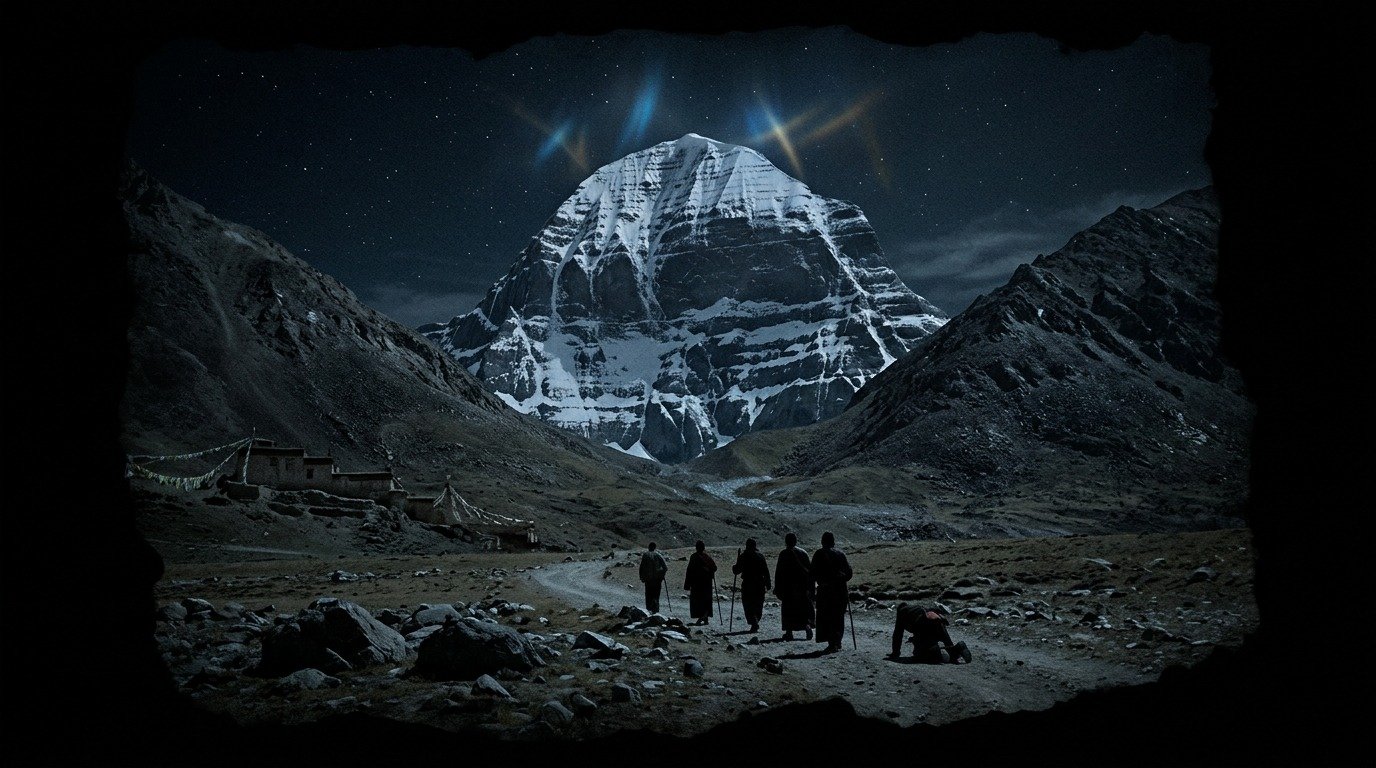
Mount Kailash: The Ice Pyramid Where the Gods Dwell
The Pass That No One Can Cross
In the year 1936, the Austrian mountaineer Herbert Tichy stopped at the base of the south face of Mount Kailash, in western Tibet. He gazed at the massive bulk of sandstone and ice rising 6,638 meters (21,778 feet) above sea level, an almost perfect pyramid whose four faces align with the cardinal directions. Tichy asked a local monk if it was possible to climb it. The monk looked at him with surprise and calmly replied: "Only a man free of sin could climb Kailash. And he would not have to scale the walls of ice; he would simply transform into a bird and fly to the summit." Tichy did not attempt it. No one ever has.
The Mountain of Four Religions
Mount Kailash is not the tallest mountain in the Himalayas, but it is the spiritual center for nearly a billion people. For four different religions, this peak is the axis of the world. Hindus believe that on the summit of Kailash sits the god Shiva, in perpetual meditation alongside his consort Parvati, covered in sacred ashes and with the Ganges River flowing from his matted hair. For Buddhists, the mountain is the abode of Demchok, the deity of supreme compassion. Jains revere the peak as the exact place where their first prophet, Rishabhadeva, attained spiritual enlightenment. And for followers of the ancient Bön religion, which predates Buddhism in Tibet, Kailash is the descent from heaven to earth of the very soul of their faith. For this reason, setting foot on the summit is considered the gravest sacrilege in the region. Kailash remains unconquered, not for lack of technology or technical skill, but due to a spiritual veto that the authorities of China and Tibet have maintained over time, respecting the will of the pilgrims who travel thousands of kilometers (miles) to encircle it.
The Duel of Miracles in the Heights
The mountain's most famous legend tells of the confrontation between the Buddhist sage Milarepa and the Bön magician Naro Bön-chung in the 11th century. Both competed for spiritual dominance over Tibet and agreed that whoever reached the summit of Kailash first on the morning of the solstice would be the winner. Naro Bön-chung sat on his double-headed ritual drum and began to rise through the air toward the summit amidst the twilight of dawn. Milarepa's disciples, in despair, woke their master, who was still sleeping peacefully. Milarepa smiled, waited for the first ray of sunlight to touch the summit, and, riding the beam of light, materialized at the peak in a fraction of a second, before the magician could touch the snow with his drum. Since that day, Buddhism has ruled Tibet, but Milarepa left the mountain untouched so that no one would disturb the peace of the gods.
The Journey That Cleanses a Lifetime
Today, thousands of pilgrims perform the *kora*, the 52-kilometer (32-mile) circuit around the base of the mountain. The average altitude of the route exceeds 5,000 meters (16,404 feet), where the air is thin and the cold cuts the lips. The most extreme devotees do not walk: they perform full prostrations. They throw themselves chest-first onto the rock and ice, stretch out their arms, mark the ground with their fingers, stand up, walk to the mark, and prostrate themselves again. Completing a single circuit in this manner takes nearly a month. Those who return from Kailash speak of a distortion of time. Mountaineers who camped in its vicinity claim that their hair and nails grew twice as fast during the weeks they spent under the shadow of the north face. Pilgrims report strange lights floating over the peak during clear nights, blue and golden flashes that do not correspond to satellites or stars.
The Origin of Asia's Waters
The geography of Kailash confirms its role as a source of life. From its glaciers are born four of Asia's largest and most sacred rivers: the Indus, the Brahmaputra, the Sutlej, and the Karnali (a tributary of the Ganges). These rivers flow in four different directions, feeding more than a billion people downstream. Science explains that the perfect pyramidal shape of Kailash is due to the fracturing of the Earth's crust during the collision of the Indian tectonic plate with Asia, a process that uplifted sandstone sediments and compacted conglomerates that resisted glacial erosion much better than neighboring peaks.
The Untouched Guardian of Tibet
The mountain remains there, isolated on the Tibetan plateau, protected by an invisible wall of devotion and respect. In the 1980s, the Chinese government offered the famous mountaineer Reinhold Messner permission to climb Kailash. Messner, who had completed the planet's fourteen eight-thousanders, refused: as he later recounted, conquering that mountain would have been conquering something in the soul of the people.
Comments
Share information, an experience, or a source to help enrich this entry. They are automatically reviewed before being published.
Loading comments...