Shiva
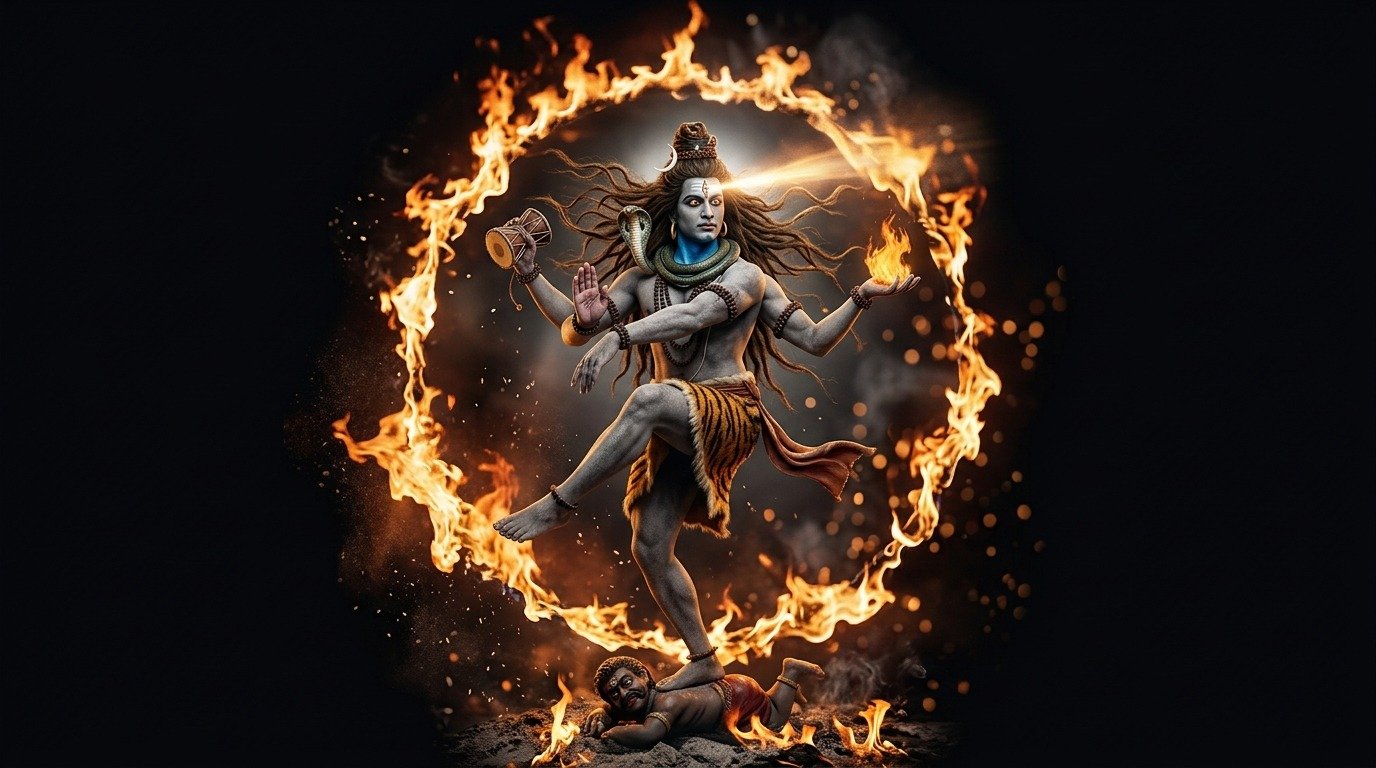
Shiva: The Dance of Ashes and Fire
The Ascetic of the Frozen Mountain
At the summit of Mount Kailash, where the wind roars with the violence of a wounded wolf and the snow never melts, dwells the god who needs nothing. Shiva is the perfect ascetic. His skin is covered in the ash of cremation grounds, a constant reminder that all material things will eventually turn to dust. He wears his hair matted, falling like wild waterfalls over his shoulders, and coiled around his neck is Vasuki, the queen of serpents, who hisses to the rhythm of his slow breathing. Shiva is the destroyer, but his destruction is not an act of malice; it is the plow that breaks the old earth so that the seed of the new creation can germinate. He is the silence that remains after the storm and the storm that breaks the oppressive silence. While the other gods inhabit golden palaces and wear fine silks, Shiva wraps himself in a tiger skin, intoxicates himself with sacred herbs, and meditates motionless for thousands of years, sustaining the stability of reality through the sheer force of his will.
The Gaze That Consumes Desire
Shiva's power is absolute and devastating. In the center of his forehead rests his third eye, the eye of inner wisdom and cosmic destruction. It remains closed almost all the time, for if it opens wide, the light it emanates is capable of reducing the entire universe to ashes in an instant. Thus discovered Kamadeva, the god of love and desire. Attempting to awaken Shiva from a deep meditation so that he would fall in love with the goddess Parvati, Kamadeva shot him with an arrow made of sugarcane flowers. Shiva, annoyed by the interruption of his cosmic contemplation, opened his third eye for a fraction of a second. A beam of pure fire erupted from his forehead and instantly consumed the god of love, leaving him bodiless forever, turned into a mere sigh in the air. In his ascetic hands, Shiva holds the Trishula, a trident whose three prongs represent creation, preservation, and destruction, as well as the three states of time: past, present, and future. He also carries the Damaru, a small hourglass-shaped hand drum whose rhythmic beating generates the heartbeat of the cosmos and marks the flow of time.
The Drink That Saved Existence
There was a time when the gods and demons churned the ocean of milk to obtain the elixir of immortality. However, before the sacred nectar emerged, from the depths of the sea erupted the Halahala, a black poison so dense and lethal that its vapors began to suffocate all living creatures and wither the worlds. Desperate, everyone turned to Kailash. Shiva, without hesitating before the danger that terrified the others, scooped up the poison in the bowl of his hands and drank it in a single gulp. The poison was so searing that it threatened to burn the very entrails of the god. Seeing this, his consort, Parvati, rushed to him and squeezed his neck with both hands, preventing the lethal substance from descending past his throat. The poison remained trapped in his neck, staining his skin an intense, brilliant blue. Since then, Shiva has been known as Neelakantha, the blue-throated one, the savior who carries the pain and venom of the world so that others may go on living.
The Dance of the End of Times
When the ignorance of men reaches a point of no return and the order of the universe is hopelessly corrupted, Shiva abandons his silent meditation and descends to the cosmic battlefield as Nataraja, the king of the dance. Framed in a circle of devouring flames, Shiva lifts his left leg and begins to dance the Tandava, the dance of total destruction. His wild hair strikes the stars, dislodging the constellations from their celestial perches. With one right hand, he plays the drum that announces the end of the era; with his left, he holds the fire that will purify the empty space. Under his right foot, he crushes Apasmara, the dwarf demon of ignorance and forgetfulness. Each step of his rhythmic dance dismantles the illusions of the ego and of matter, reducing the cosmos to a clean canvas where, eventually, silence will once again harbor the seed of a new beginning.
Comments
Share information, an experience, or a source to help enrich this entry. They are automatically reviewed before being published.
Loading comments...