Lakshmi
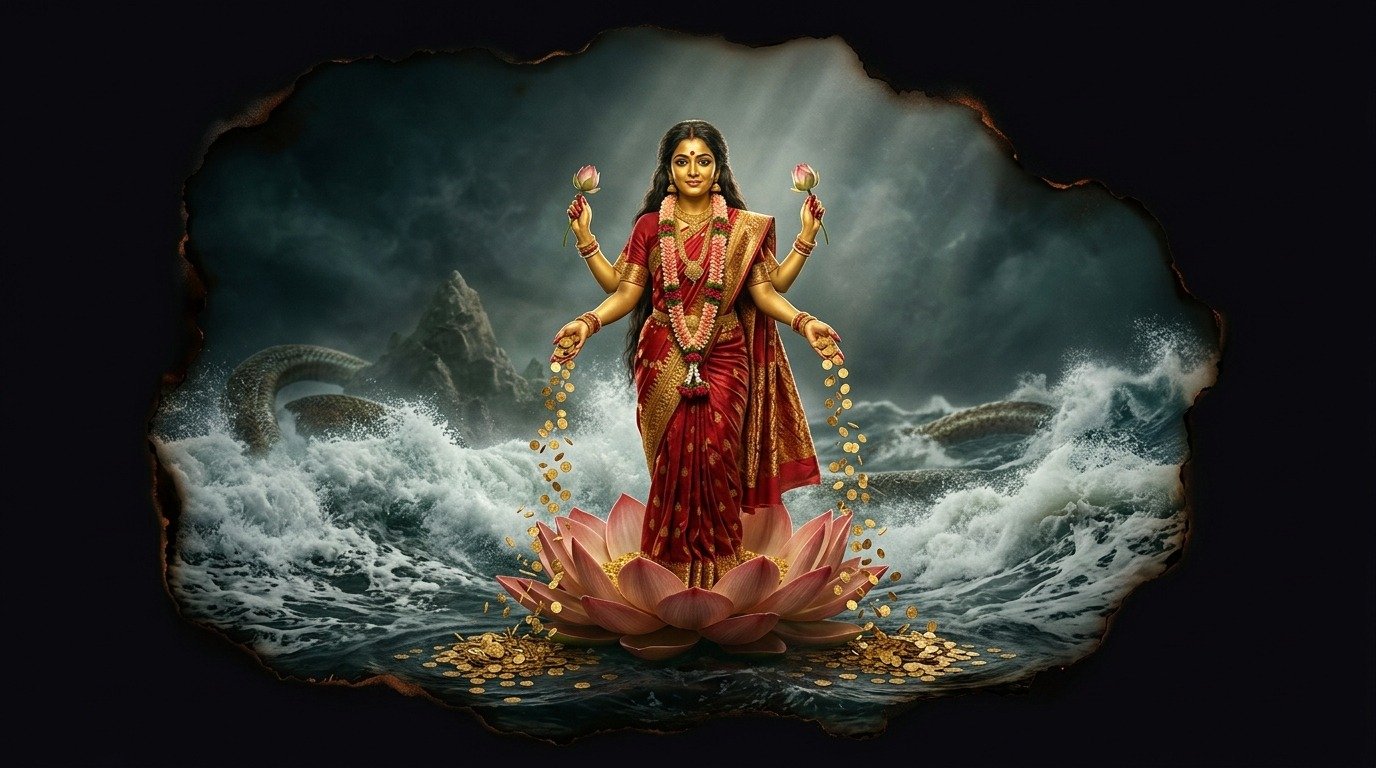
Lakshmi: The Brilliance of the Lotus and the Tide of Fortune
The Foam of the Sacred Tide
When the universe was young, the gods and demons temporarily allied to perform a task of colossal proportions: churning the ocean of milk to extract the Amrita, the elixir that grants immortality. Using Mount Mandara as a churn and the gigantic serpent Vasuki as a rope, they stirred the abyssal waters for millennia. From the churned depths of the cosmic sea, wondrous treasures began to spring forth, but none moved creation as much as what emerged from the white foam. Upon a fully opened lotus floating on the rough waves, Lakshmi emerged. Her beauty was so pure that the wind held its breath and the waters calmed instantly. Her skin was the color of polished gold, and she wore red garments embroidered with threads of sunlight. In her hands she held lotus buds, and from her open palms fell a constant rain of gold coins that chimed upon the water. Everyone present, captivated by her splendor, desired to possess her. But she, with a graceful step and a serene gaze, walked through the crowd of suitors and placed a garland of flowers around the neck of Vishnu, choosing him as her eternal consort, uniting the wealth of the earth with the law that preserves it.
The Rain of the Four Gifts
Lakshmi is not simply the goddess of paper money or gems hidden in mines. Her domain is abundance in all its dimensions: the health of the body, the fertility of the earth, the peace of the home, the wisdom of the spirit, and success in human endeavors. She is Shri, the personification of beauty, grace, and prosperity, without which life becomes gray, sterile, and hopeless. In her most sacred representations, Lakshmi has four arms representing the four goals of human life: Dharma (moral duty and justice), Kama (love, desire, and sensory enjoyment), Artha (material wealth and economic security), and Moksha (spiritual liberation). From her rear hands bloom lotuses symbolizing the self-realization that grows amidst the stagnant waters of the material world. Her front hands offer blessings of protection and charity, reminding mortals that true wealth is only maintained when it flows and is shared, and that it slips like water through the fingers of those who try to hoard it selfishly.
The Light That Drives Away the Dark Sister
Although Lakshmi is a benevolent deity, her presence is not guaranteed forever. She is known to be fickle, moving quickly from one place to another if she is not treated with due respect. Her arrival is always preceded by order, cleanliness, and devotion; her departure leaves ruin and bitterness in its wake. It is often said that Lakshmi has an older sister, Alakshmi, the deity of misery, discord, and scarcity. Alakshmi dwells in dirty homes, where people argue, where laziness reigns, and where no light is lit. Lakshmi, on the other hand, is attracted to the light of clay lamps and the scent of fresh incense. This is why, during the night of Diwali, the festival of lights, homes all over the land clean their rooms until they are spotless, draw beautiful mandalas of colored powder at their entrances, and place small lit lamps in windows and doorways. They know that Lakshmi walks the earth on that moonless night, searching for clean homes and open hearts to settle in, bringing with her the promise of a prosperous year free of shadows.
The Golden Thread That Accompanies the Hero
As the consort of Vishnu, Lakshmi is not left behind when the preserver descends to the mortal world to restore balance. She comes down to earth, adopting forms that perfectly complement the destiny of her beloved. When Vishnu was born as Prince Rama, Lakshmi incarnated as Sita, the embodiment of loyalty and the purity of the earth, whose abduction triggered the war against the demons of Lanka. When he descended as the cowherd Krishna, she took the face of Radha, the mystical love that makes souls dance, and of Rukmini, the queen of grace and devotion. In each of these earthly lives, Lakshmi demonstrated that fortune is not an inert treasure kept in a chest, but a living force, a golden thread that binds the effort of mortals with the grace of the gods, ensuring that beauty always finds its way back home.
Comments
Share information, an experience, or a source to help enrich this entry. They are automatically reviewed before being published.
Loading comments...